MONTGOMERY, Ala. – Gov. Kay Ivey is proposing record budgets for both the General Fund and education budgets in fiscal 2026 with increases for Medicaid, state employees and teachers retirement systems and health insurance.
But state finance officials warned lawmakers that recent revenue growth is slowing and an economic downturn may be ahead.
Ivey proposed a record $9.9 billion in regular education spending – a $600 million increase over the current year’s education budget – for the 2026 fiscal year, and $3.7 billion in spending – a $300 million increase over the current year – for the General Fund, which funds non-education entities.
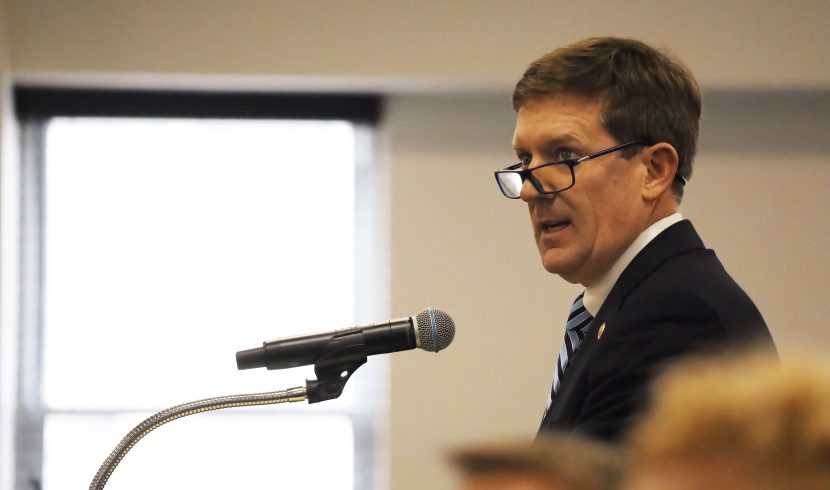
State Finance Director Bill Poole presented Ivey’s budget to lawmakers Wednesday, telling them “the sugar high is over,” with respect to the large amounts of tax revenue Alabama has collected in recent years.
One big factor behind growth in the General Fund is unprecedented earnings from interest on state deposits. Where interest on state deposits brought in $10 million to $60 million each year between 2015 and 2022, in 2023, interest revenue jumped to $404 million and rose to $557 million in 2024.
Despite the high interest earnings, Poole warned the windfall is temporary.
“We know and have to anticipate a return to historical norms, and that is going to be a big challenge,” Poole said, cautioning lawmakers to keep that in mind as they consider future General Fund budgets.
Even with record interest earnings, General Fund receipts for 2026 are expected to decline by nearly 2%, Poole said.
The Education Trust Fund saw record growth in recent years due to billions in federal pandemic relief. With those funds now gone, revenue growth has slowed considerably.
“We had a couple of years of 20%, even 30% growth in the ETF,” Poole said. “Those days are over.” Estimates predict just under 2% growth from 2025 to 2026, slightly under the historical 3% to 4% growth, he added.
State Deputy Fiscal Director Kirk Fulford urged lawmakers to budget conservatively as federal reserve officials say the economic outlook is “uncertain.”
“We don’t try to be overly conservative until it’s necessary,” Fulford said. “It’s necessary. It’s really necessary.”
Budget priorities
Ivey’s budget proposal focuses on public safety, education, workforce, veterans’ needs and economic development.
Notable amounts from Ivey’s General Fund request include:
- Department of Corrections – $827 million request (up from $737 million this year),
- Alabama Law Enforcement Agency – $142 million request, (up from $130 million),
- Medicaid – $1.2 billion request, (up from $955 million),
- Mental Health – $248 million request, (up from $238 million),
- State employees’ health insurance increase – $21 million (new request).
While the General Fund has seen overages of nearly $870 million over the past five years, there will be no supplemental proposal from Ivey for 2026, Poole said.
Medicaid has long been the General Fund’s largest expenditure and the 2026 increase is not a true year-over-year jump in expenses, Poole explained.
“Medicaid has benefited from pandemic funds over recent years that are not available now,” he said. “They’ve also had carry forward funds over recent years.”
Those eased the burden on the General Fund, but they’re gone now.
In Ivey’s Education Trust Fund request, notable amounts include:
- Department of Early Childhood Education, $213 million, (up from $201 million this year),
- Alabama Community College System – $622 million, (up from $587 million),
- Funding retirement and health insurance increases – $158 million (new request)
- Alabama Law Enforcement Officers’ Family Scholarship Program – $10 million (new program),
- Department of Workforce – $19.8 million (transitioning programs from the Department of Labor)
Beyond the regular education budget, Ivey is proposing:
- $524 million in supplemental funding to K-12, higher education and other agencies from $1.8 billion in unexpected 2024 tax revenue.
- $1.3 billion from the Advancement and Technology Fund to K-12 and higher education
- $133 million from the Educational Opportunities Reserve Fund, with $100 million distributed to K-12 school districts through a new student-based funding formula.
Neither budget proposal includes raises for employees but Poole noted when speaking to reporters Wednesday afternoon they do include needed increased funding for retirement systems and health insurance.
“Health care costs are going up … nobody’s immune to that in the private sector or the public sector,” Poole said.
Lawmakers will likely take up the budgets about halfway through the session, House Education Budget Chair Danny Garrett, R-Trussville, told Alabama Daily News.
Poole and Fulford commended lawmakers for moving hundreds of millions of dollars in revenue generated from federal pandemic relief spending into reserve funds that can be accessed in a downturn.
Poole said those actions strengthen Alabama’s financial position relative to other states and bolster its standing with credit agencies.
Several General Fund agencies have budget hearings before lawmakers today.
Alabama Daily News’ Mary Sell contributed to this report.