BIRMINGHAM, Ala. – The board overseeing the state’s health insurance program for education employees previewed a “worst case scenario” Wednesday, projecting a shortfall of between $360 million and $418 million in fiscal year 2027. Worse still, estimates show a nearly $490 million gap the following year.
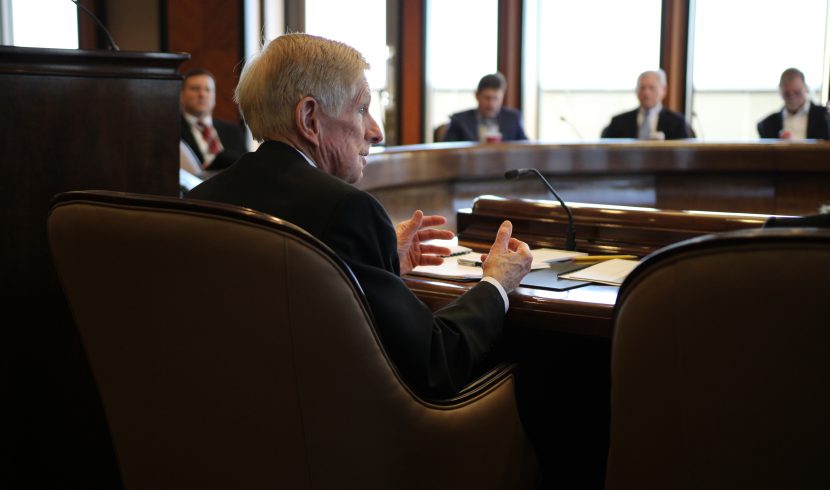
“This is our worst case scenario that I’m going to give you here,” Retirement Systems of Alabama Chief Finance Officer Diane Scott told board members at their quarterly meeting in Montgomery. “Because it’s my responsibility to let you know where the upper limit is.”
The projected shortfalls are driven by uncertainty in federal Medicare policy and an unexpected spike in claims costs, Scott said.
The assumptions behind the projections include a 10% year-over-year increase in claims costs – more than twice the expected 4% growth.
Scott cited several factors contributing to the rising expenses, including coverage for about 550 additional members, increased behavioral health costs, and a growing number of high-dollar claimants – those with more than $100,000 in annual claims.
Other key factors: hospitalizations are up and inpatient stays are lasting longer.
“January, February and March of this year saw significant flu activity, which is naturally going to increase your cost across the board, whether it’s medical or whether it’s drugs,” Scott said.
RSA CEO David Bronner warned board members the projections pose a serious risk.
“It’s dangerous – danger to the state of Alabama,” Bronner said. “It’s a danger to the insurance program that teachers have in this state.”
About 350,000 teachers, retirees and their dependents are currently enrolled in Public Education Employees Health Insurance Program.
State Finance Director Bill Poole, an ex officio member of the PEEHIP board, echoed the concern.
“It is a big deal and it’s not good news,” he told Alabama Daily News. “Everything in the healthcare sector right now is extraordinarily volatile.”
That volatility makes projecting costs difficult, he added. “I think it’s worth noting that it’s hard to estimate out that far what your health insurance liabilities are going to be.”
Poole said it would likely be difficult for the Education Trust Fund to absorb the cost of the shortfall. “Hopefully we will have a little bit more clarity by September,” he said. “But there will be potentially some difficult decisions.”
PEEHIP is already facing a shortfall in FY26 due to rising costs for Medicare-eligible retirees, whose health care expenses are expected to climb from $50 million in FY24 to $250 million in FY25. To cover the gap, the board increased the employer contribution rate from $800 to $904 per employee – the legislature approved the additional $124 million that generated – and approved a $119 million transfer from the Retiree Trust Fund.
Still, board staff emphasized that these are projections, and the outlook could improve as more data becomes available.
“I don’t get too worried about that at this point,” Scott said. “We’ve seen some dramatic improvements when we’ve looked at three years, and then when we got there, it wasn’t as bad. But still, I need to show you the way the numbers pan out today.”
She told board members that staff will continue evaluating the numbers and will present a “buffet line” of options for the board to consider in September, when it will vote on its FY27 legislative request.
PEEHIP Projections – June 4, 2025 by Trisha Powell Crain on Scribd