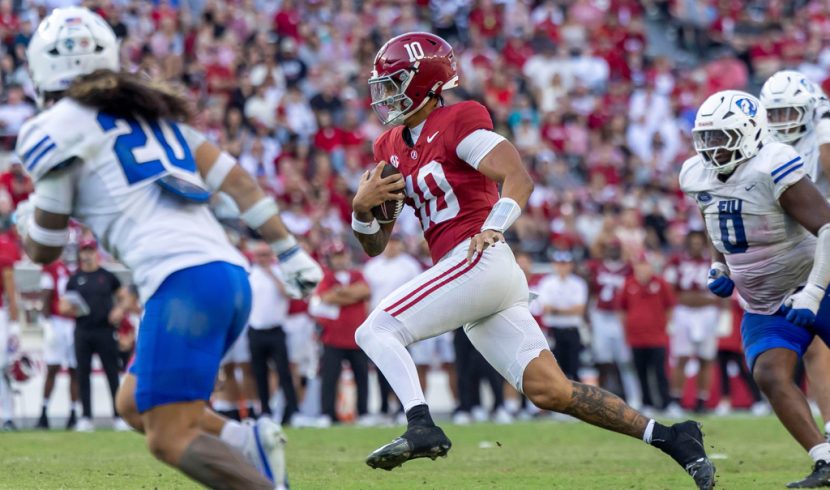
WASHINGTON — Hours before the U.S. House was set to vote Wednesday on legislation to establish a framework for student-athlete compensation, GOP leadership pulled the bill from the House floor.
The bill faces opposition from Democrats, including from the Congressional Black Caucus, who are concerned the bill does not adequately protect student-athletes. Republican Rep. Chip Roy of Texas also said he would oppose the measure. A few other Freedom Caucus members voted against the rule Monday that tees up a vote on the bill.
But Rep. Shomari Figures, D-Mobile, is one of the few Democrats supporting the Student Compensation and Opportunity through Rights and Endorsements (SCORE) Act. He’s also a lead sponsor of the legislation that would provide guidelines around name, image, and likeness, or NIL, deals. It would also preempt any state NIL laws. Alabama currently does not have its own NIL law.
“This bill is about protecting student-athletes, about preserving their right to be compensated for their name, their image, their likeness, while also preserving and mandating that they get access to the things that we all agree that they need,” Figures told Alabama Daily News, referring to the bill’s requirements that Division I schools offer college athletes academic and health services.
Five other House Democrats have also joined Republicans to sponsor the bill.
The comprehensive bill, backed by the NCAA and college sports conferences, would provide the organizations with a limited antitrust exemption.
“It does provide them the ability to create rules relating to NIL, transfers and eligibility requirements without being concerned about violating antitrust laws,” Jonathan Wohlwend, an intellectual property attorney at the law firm Bradley, told ADN.
The legislation comes in the wake of the House settlement in June that allowed schools to start paying student-athletes through revenue sharing.
Under the SCORE Act, student-athletes would be prohibited from becoming university employees.
“It would permanently strip college athletes of labor and employment rights, including the right to unionize; prevent them from challenging harmful or anticompetitive conduct; and grant the National Collegiate Athletic Association (NCAA) and conferences sweeping immunity when their actions jeopardize athletes’ education, health, safety, or financial well-being,” the Congressional Black Caucus said in a statement opposing the SCORE Act Wednesday.
Figures said the bill is and should remain focused on NIL, not NCAA reform.
“I think that the conversation now has expanded well beyond the original NIL issue to include things like revenue sharing, to include things such as player unionization and employment, and that just opens up a different can of considerations on a number of levels,” Figures, who is also a member of the Congressional Black Caucus, told ADN.
If the SCORE Act passes the House, it faces an uncertain path in the Senate. The measure would need the support of at least seven Democrats to pass.
Sen. Maria Cantwell, D-WA, the top Democrat on the Commerce Committee, forcefully opposed the measure Monday, calling it a “David and Goliath fight,” ahead of the House’s planned vote.
She argued that Power 2 conferences would benefit under the bill, while smaller conferences and schools would be hurt. Cantwell has introduced her own bill, dubbed the SAFE Act, that amends the Sports Broadcasting Act to allow universities to pool media rights to increase revenue for all schools.
Former Auburn football coach Sen. Tommy Tuberville, R-Ala., wouldn’t directly say if he will support the SCORE Act if it comes to the Senate, but said he was focused on addressing the transfer portal.
“We have to do something, folks,” Tuberville told ADN. “We are ruining college sports.”
The NIL bill would allow the NCAA to set parameters around transfers, while requiring student-athletes to be able to transfer at least once and become immediately eligible to compete.
On Tuesday, the U.S. Olympic and Paralympic Committee voiced its support for the SCORE Act. The organization said it’s ready to work with the Senate and conferences to protect Olympic sports.