
WASHINGTON — Pinned at the top of his social media page, U.S. Sen. Tommy Tuberville, R-Ala., displays his controversial, widely-shared post depicting side-by-side pictures of New York City Mayor Zohran Mamdani next to a photo of the 9/11 attacks, with the caption that reads “the enemy is inside the gates.”
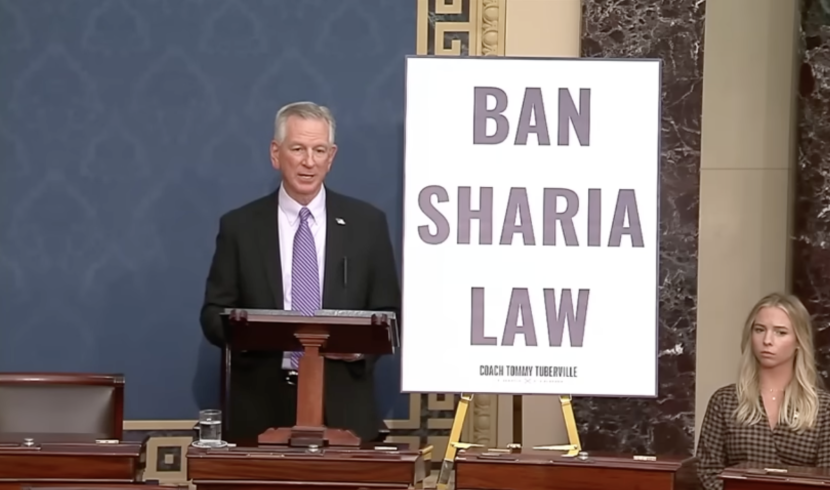
On the Senate floor, Tuberville has stood behind a lectern multiple times and warned against the dangers of “radical Islam” and vowed to fight against Sharia law.
Now, the senator turned frontrunner for governor’s anti-Muslim rhetoric on social media and in the Capitol is being mimicked down the GOP primary ballot in Alabama.
Jay Mitchell, a Republican candidate for attorney general, released a new campaign ad. In it, he said if you support “radical Islam,” “you can Allahu Akbar your butt all the way back to the Middle East.”
The Arabic phrase “Allahu Akbar” means “God is greater.” It’s an “innocuous expression” used often in prayers, according to H.A. Hellyer, a scholar of religion and politics at the Atlantic Council. But the phrase has gained notoriety from its association with Islamist terrorist attacks.
Mitchell specifically credited Tuberville for “leading” the charge on statements of Muslims.
“Liberal losers in blue states have created a safe space for the rise of radical Islam,” Mitchell said in a statement to ADN. “As Attorney General, I won’t let them bring that nonsense to Alabama. Soon-to-be Governor Tuberville has been leading on this issue, and I’ll stand alongside him and President Trump to ban sharia law, deport illegals, and keep Alabama safe.”
The attacks are also present in the race to become Alabama’s next lieutenant governor. Recently, Republican candidate Wes Allen called out fellow GOP candidate John Wahl for visiting an interfaith gathering at the Anniston Islamic Center during Ramadan.
Allen said in a press release that he will never visit an “Islamic Center or a mosque,” emphasizing that he wants “no part in Islam.”
“When John Wahl chose to enter an Islamic Center to celebrate the Muslim holiday of Ramadan…he showed us that he does not share the same values as the majority of Alabamians,” Allen continued. “He can’t spin this. There is no excuse for participating in the celebration of Islamic Ramadan.”
But Wahl pushed back. He argued that he used the event to speak about his Christian faith and that it was not a specific celebration of the Islamic holiday.
“The suggestion that I somehow embrace Muslim values or Ramadan is not only false—it is ridiculous,” Wahl said in a press release. “Anyone familiar with my life, my record, and my service knows that my Christian faith is central to who I am.”
Tuberville dismisses backlash
The rise in harsh rhetoric toward Islam and Muslims by Republican leaders is not new nor is it unique to Alabama politicians, but the frequency has turned up a notch during the campaign season and in the wake of the Iran war.
“This latest rash of more radical commentary is particularly concerning,” Britton O’Shields, staff attorney for the Alabama chapter of the Council on American-Islamic Relations, told Alabama Daily News. “Using reckless, dehumanizing language has real consequences for their constituents.”
In 2025, the Muslim advocacy group received a record number of anti-Muslim and anti-Arab complaints since it began tracking them in 1996, according to an analysis released in March.
Tuberville’s anti-Muslim social media posts have sparked outrage from Democrats, including Senate Minority Leader Chuck Schumer, calling it “mindless hate” and Mamdani responding to the senator’s comments, saying, “Let there be as much outrage from politicians in Washington when kids go hungry as there is when I break bread with New Yorkers.”
But none of that outrage seems to bother Tuberville. Instead, it led Alabama’s senior senator to ratchet up his remarks. He’s posted numerous times since then on social media about Islam and its practices, which are followed by millions of Americans.
The Muslim group, CAIR, designated Tuberville as an anti-Muslim extremist, the first U.S. senator to be added to the list late last year. It’s also given him an open invitation to visit a mosque to gain a better understanding of Muslim Americans and those living in Alabama.
Tuberville told ADN he’s open to talking to anyone and said he has Muslim friends in the state. But he continued to rail against Sharia, a set of guiding principles derived from the Quran and Sunnah that Muslims follow.
“I’ll visit and talk with anybody,” he said last month. “I love all people…I don’t care if you’re Muslim or Christian or Catholic or Jewish. It makes me no difference. But do not study and teach and preach and indoctrinate people in something that wants to have death to all Americans.”
O’Shields said CAIR has not heard back from Tuberville’s office on any of their requests to have a conversation.
O’Shields characterizes the rhetoric as Islamophobia and worries it will go beyond campaign ads and floor speeches into more far-reaching actions.
“This increase makes us believe that there could be real-world policy consequences for Muslims in Alabama,” she told ADN.
“Sharia-Free America” push on Capitol Hill
In Congress, Rep. Barry Moore, R-Enterprise, is also following in the footsteps of Tuberville, the senator he’s running to replace. Moore joined the “Sharia Free Caucus,” which has gained support from Tuberville. The group, made up of 60 Republican members, aims to “counter the alarming rise of Sharia Law in the United States.”
“No foreign legal code should ever influence American courts and create a parallel system of justice,” Moore said on the House floor during an hour sponsored by the caucus in late March. “Allowing outside legal framework to seep into our system would undermine the consistency and integrity of American law.”
But in the United States, the Constitution does not allow for the adoption of any religious code over U.S. federal law.
Most critics of Sharia law point to its traditional interpretations severely restricting women’s rights, allowing severe punishments, religious intolerace and treatment of LGBT people, according to the Council on Foreign Relations. The organization notes that “about half of the world’s Muslim-majority countries have some sharia-based laws,” which typically cover areas like marriage and child custody. About a dozen countries apply sharia to criminal law.
Moore and Tuberville are also sponsors of legislation, called the Defeat Sharia Law in America Act, which would “root out and stop the spread of Sharia Law.”
O’Shields said politicians use the rhetoric around Sharia to “create fear.” She added that she has no knowledge of Muslim Alabamians wanting to enforce Sharia law over people in the state.
“There’s no inherent conflict between being able to practice Sharia law and also living in Alabama or living under the laws of the Constitution,” O’Shields told ADN. “This conflict that these politicians are talking about is baseless.”