
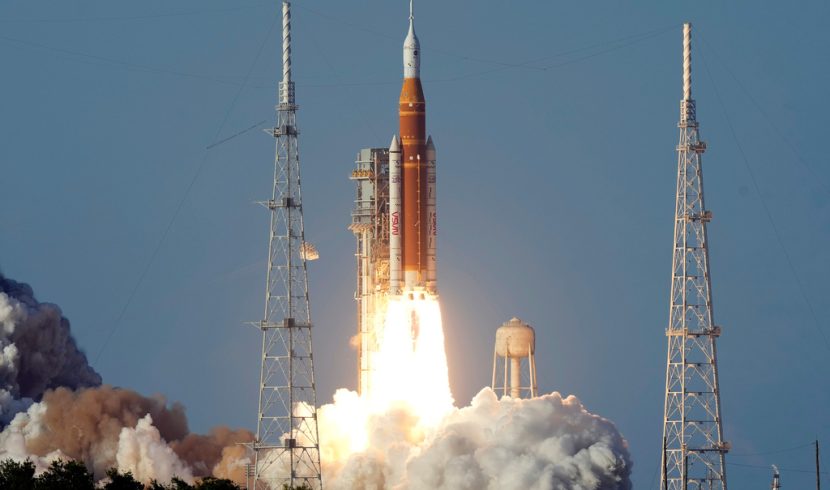
WASHINGTON — As Artemis II swings around the moon in a historic mission, the Trump administration proposed slashing NASA’s budget by 23% in its request released Friday. The budget outlines $18.8 billion for the agency in 2027, or a $5.6 billion decrease from this year’s enacted level.
But President Donald Trump’s budget for next year provides $8.5 billion for the Artemis program to land astronauts on the moon by the end of 2028. The money would fully fund “lunar landers, space suits, lunar surface systems, and astronaut transportation systems,” according to the budget document.
In conjunction with the One Beautiful Bill Act, which provided additional funding for the Space Launch System, the budget will allow the SLS rocket and Orion spacecraft to be used through Artemis V. The SLS is managed at Marshall Space Flight Center in Huntsville.
U.S. Sen. Katie Britt, R-Ala., previously told Alabama Daily News that she received assurances from NASA Administrator Jared Isaacman that he would follow through with utilizing the money allocated in the OBBA for the SLS before voting to confirm in December.
NASA will also continue to pursue commercial options to transport astronauts to the moon for future missions, including for setting up a lunar base camp.
The bulk of the proposed reductions comes from NASA’s science programs. The White House’s budget outlines nearly a 50% cut to over “40 low-priority missions,” such as the Mars Sample Return mission.
“By cutting unnecessary and overpriced activities, the Budget strengthens the National Aeronautics and Space Administration’s (NASA) focus and ensures that every dollar spent propels America’s dominance in the final frontier,” the budget reads.
Isaacman defended the budget cuts in an interview on Sunday on CNN’s State of the Union. He noted that NASA’s budget is greater than that of any other space agency in the world.
“We absolutely have the resources,” Isaacman said. “NASA doesn’t have a topline problem. We just need to focus on executing and delivering world-changing outcomes.”
But the Planetary Society, a space interest organization, said it was “deeply disappointed” by the proposed budget cuts.
“This proposal needlessly resurrects an existential threat to U.S. leadership in space science and exploration,” the organization said in a statement.
The White House also proposed slashing NASA’s budget last year, but most of the cuts were rejected in Congress.
Defense spending increase
While cutting NASA and nondefense programs, the White House wants Congress to boost funding for the Pentagon to $1.5 trillion.
Trump’s proposal would increase defense spending by 44% from this year’s enacted spending level. House Armed Services Chairman Rep. Mike Rogers, R-Saks, a vocal proponent of increased investment in national defense, praised the budget as a “historic” investment.
“This funding will ensure our military remains the most advanced in the world, supporting an unparalleled force capable of defending our interests in the 21st century,” Rogers said in a joint statement with Sen. Roger Wicker, R-Miss, chair of the Senate Armed Services Committee.
Out of the total $1.5 trillion defense budget, $1.1 trillion would come from the appropriations process, and $350 billion would come through reconciliation, used to circumvent the 60-vote threshold in the Senate, to support “increasing access to critical munitions and further expansion of the defense industrial base.”
Trump’s defense budget proposal focuses on bolstering the Golden Dome initiative, allocating tens of billions of dollars for shipbuilding and providing funding for the development of artificial intelligence for defense, among other priorities.
“America is facing the most dangerous global environment since World War II. Growing threats from adversaries such as China, Russia, Iran, North Korea, Islamic radicals, and narco-terrorists require decisive action and renewed urgency to reinvest in our defenses,” Rogers and Wicker continued in their statement. “This bold commitment provides the resources needed to rebuild American military capability and confront those challenges head-on.”
But the top Democrat on the Senate Armed Services Committee, Jack Reed of Rhode Island, said the request was “not a serious budget.”
“I will not rubber-stamp a bloated, undisciplined budget. I will work with my colleagues on a bipartisan basis to carefully scrutinize every penny,” he said in a statement. “Our forces and their families deserve a defense budget and strategy that is worthy of their sacrifice and meets the complex and evolving challenges of the 21st-century.”
Other cuts
Overall, the White House wants to reduce nondefense spending by 10%. Those reductions include cuts to environmental programs, health research and housing initiatives, according to the budget document. The budget calls for the elimination of the Low Income Home Energy Assistance Program, which helps families pay their energy bills, but Congress has previously rejected efforts to gut the program.
The request also includes a $5 billion reduction for the National Institutes of Health. But lawmakers rejected Trump’s proposed steep cuts to the health research agency in the last budget.
A president’s budget proposal is simply a request. It’s up to Congress to make the final decisions on federal funding each year. Lawmakers wholly rejected some of the president’s proposed steepest cuts in 2026.