
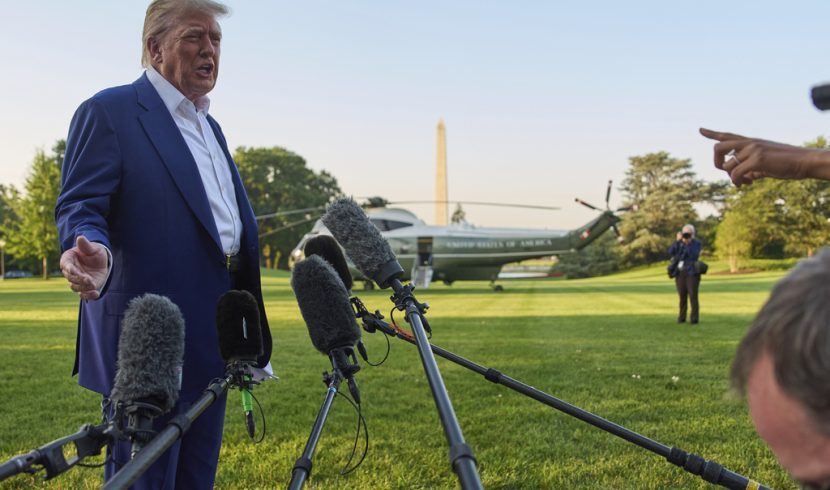
WASHINGTON — President Donald Trump wanted the brief and explosive American intervention in the Middle East to end with the satisfying tidiness of a prime-time season finale.
After days of stoking suspense over whether he would help Israel’s attacks on Iran, followed by a spectacular bombing mission against nuclear facilities, he announced a surprise ceasefire deal to bring the war to a close.
Trump even gave the conflict a definitive name — “THE 12 DAY WAR” — leaving no doubt that he viewed the storyline as complete.
Now the question is whether the rest of the world will follow the script that Trump has laid out.
An unsteady ceasefire adds uncertainty
The ceasefire has already proven shaky, with Israel and Iran bombarding each other after the truce took effect. Trump upbraided at both countries on Tuesday morning, saying “I’m not happy with them,” using the f-word in derision and demanding that they stop fighting.
Thus far, they’ve obliged. However, it could be years before the world knows whether this latest round of warfare will mark a turn toward greater peace or be the harbinger of more bloodshed.
The terms of the ceasefire remain unclear, and there are lingering questions about how much of Iran’s nuclear program survived the strikes over the weekend, despite Trump’s claims that it was “totally obliterated.” A preliminary intelligence assessment said the American attack caused a setback of only a few months. The White House criticized the report as “flat-out wrong.”
In addition, Iran’s theocratic leadership could retrench, jeopardizing the potential for Trump to reach durable diplomatic solutions to conflicts that have percolated in the region for decades.
“In the moment, he looks like a tough guy who produces results,” said Brian Katulis, a senior fellow at the Middle East Institute. “But when the dust settles and the blowback comes, you’re left thinking, wait a second, are we any better off?”
Jeffrey Lewis, a professor of nonproliferation at the Middlebury Institute of International Studies at Monterey, said the episode may ultimately demonstrate the limitations of military action to suppress atomic ambitions.
“I don’t think you can bomb nuclear programs out of existence,” he said.
For now, those issues appeared far from Trump’s mind as the Republican president reveled in emerging unscathed from a foreign policy gamble that his predecessors never attempted. On social media, he posted a picture of himself kissing the American flag with the phrase “Trump was right about everything.”
Alabama lawmakers weigh in
Alabama’s Republicans are standing behind Trump’s efforts to maintain a ceasefire between Israel and Iran.
U.S. Rep. Gary Palmer, R-Birmingham, said he hopes the ceasefire holds and mentioned what’s happened in the Middle East under Trump is “historic.”
“I hope that there are people in Iran that are taking note of this, because I think regime change needs to take place, but it needs to be done by the people of Iran, not by Israel, not by us,” Palmer told Alabama Daily News.
The Trump administration postponed classified briefings for congressional lawmakers on Iran that were set to happen Tuesday. Speaker of the House Mike Johnson said the House would now be briefed on Friday and senators will get a briefing on Thursday.
“I think when they do the briefing, I think they want to read us in as much as possible,” Palmer said.
Rep. Terri Sewell, D-Birmingham, posted on social media Tuesday, calling out the Trump administration for pushing back the lawmakers’ briefing on what happened in Iran to later in the week. She said she signed onto the War Powers Resolution to require Congress to approve any further military action in Iran.
“First of all, we need to know the strategy here,” Sewell said in a video posted to X. “And secondly, we need to know what they’re doing about protecting our servicemen and women, and lastly, I want to know how they plan on de-escalating this matter.”
Tuberville said Trump’s strikes on Iran were about stopping a war, not starting one. He said Iran’s position has been weakened.
“We knew that they were going to shoot the missiles over yesterday into Qatar, so they’re looking (for a) way to save face,” Tuberville told reporters Tuesday. “They’re about out of bullets, I think.”
Rep. Barry Moore, R-Enterprise, also praised Trump’s actions. He said the president had to show force to hurt Iran’s nuclear facilities.
“President Trump’s a peacemaker by being on the move and taking out those sites in many ways, it brings peace to the region in a way like we haven’t seen a president do in my lifetime,” Moore told ADN.
How it unfolded
The fighting began nearly two weeks ago when Israeli attacked on Iran, targeting military leaders, scientists, missile launchers and anti-air defenses.
However, only the United States has the bombers and the weapons needed to penetrate Iranian nuclear facilities that are buried deep underground. Although Tehran has maintained that its program is only for peaceful purposes, U.S. and Israeli leaders have long feared that it would build a nuclear weapon.
American spy agencies did not believe the Iranian government had decided to take that step, despite enriching uranium to levels beyond what’s needed for civilian use. However, Trump seized an opportunity to strike with war already underway, brushing aside fears that he could become mired in exactly the kind of open-ended conflict in the Middle East that he had pledged to avoid.
He ordered U.S. bombers to fly halfway around the world to attack three nuclear facilities, then threatened more strikes if American troops faced retaliation.
It was the kind of dramatic action that has always appealed to Trump, who has cultivated an air of unpredictability and aggression on the global stage.
Iran was a top target of his brinksmanship during his first term. He called off U.S. strikes after Iran shot down an American drone, fearing that his response would be disproportionate, but he also assassinated one of the country’s top generals.
Two days after the U.S. strike on nuclear facilities, he announced that Israel and Iran had agreed to a ceasefire.
“CONGRATULATIONS TO EVERYONE!” Trump wrote on social media, where he had been narrating every twist and turn of the conflict. “This is a War that could have gone on for years, and destroyed the entire Middle East, but it didn’t, and never will!”
Approval is coming from unusual corners
Praise came from some unlikely corners of the American foreign policy establishment.
For example, Brett McGurk, who coordinated Middle East policy under President Joe Biden, said “this is about the best place we can be” and “I give extremely high marks to this national security team and President Trump for managing this crisis.”
Katulis isn’t so sure. He said the Trump administration “seems to be operating without a cogent diplomatic playbook” and “fixated on military tactics and operations in absence of an overall strategy.”
Before the war, Trump had been pressuring Iran to abandon its nuclear program as part of a negotiated settlement. There’s no guarantee that Tehran will return to the bargaining table, although the president insisted that “IRAN WILL NEVER REBUILD THEIR NUCLEAR FACILITIES!”
“It was my great honor to Destroy All Nuclear facilities & capability, and then, STOP THE WAR!” Trump wrote on Tuesday as he flew to the annual summit of the North Atlantic Treaty Organization in the Netherlands.
Leon Panetta, who held top national security roles under President Barack Obama, chuckled at Trump’s stream of consciousness on social media.
“We always know what he’s thinking,” Panetta said, “but we don’t know whether what he’s thinking is really happening.”
Alabama Daily News’ Alex Angle contributed to this report.