
While a majority of members on the Alabama Medical Cannabis Commission have defended how companies were to be awarded licenses to grow and distribute medical marijuana, not everyone was happy with the process.
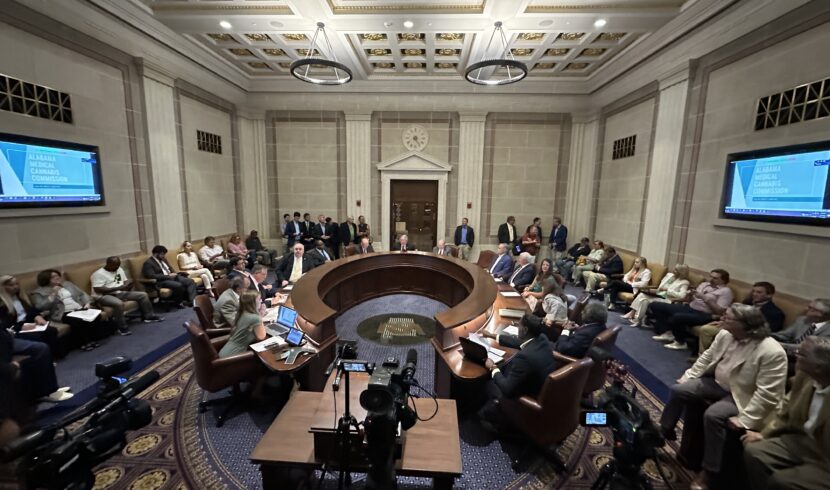
That split was on full display Monday during a commission meeting in Montgomery when at least two members proposed changing how companies are awarded medical marijuana licenses – which the commission plans to reissue in August – citing a lack of transparency in the existing process.
Background
The AMCC was created with the purpose of deciding which companies would be awarded the right to grow, produce and distribute cannabis after medical marijuana became legal in the state in 2021. Eager to receive the exclusive right to get in on what is expected to be a $33.6 billion industry by the end of 2023, more than 90 companies applied to receive a license.
In June, the AMCC awarded 21 licenses in what was a highly competitive process, making their decision based on a set of scoring criteria developed by the University of South Alabama. While the school developed the scoring criteria, anonymous evaluators hired by the university were the ones to actually score the applicants.
The identity of the evaluators, along with information on the scoring criteria, was intentionally withheld from the commission to avoid potential conflicts of interest.
Just days after the 21 companies were notified that they would be receiving a license, the AMCC postponed awarding the licenses due to “inconsistencies” in the scoring data, but did not elaborate.
In late June, Montgomery Circuit Judge James Anderson issued a temporary stay on the awarding of licenses until the scoring data issue could be resolved. On Monday, the commission met to approve their own stay on the awarding of licenses until a meeting on Aug. 10, where the commission will vote to nullify existing license award winners, as well as approve new ones based on the scoring data, which will be evaluated by an independent third party.
And while approving a delay to coincide with the judge’s stay was the only item on the AMCC’s agenda, several commission members voiced issues with the process.
‘I don’t want us to get in the weeds’
With several lawsuits having been filed before the license awards were even announced, and several more afterward regarding the selection process, plenty of criticism has been thrown toward the commission for how companies were ultimately chosen.
John McMillan, AMCC director, opened Monday’s meeting by pushing back against criticism of both the commission and the process, calling it “unjust” and “ridiculous.”
“It’s hurtful, and that’s okay, we’re all big boys and girls and we can deal with it, but it’s also unfair to the public to put out stuff that’s just patently untrue, and it’s a real human temptation to want to lash out at those that do that kind of stuff,” McMillan said.
“After the June license awards, we immediately realized that there were some things that just didn’t add up, and instead of trying to cover that up – which would have been mighty easy I think, and I think we probably would’ve gotten away with it – we knew it was not the right thing to do.”
McMillan went on to say that the commission had retained the same group to rescore the applications, and that he expected the scoring data issues to be resolved by late July, well ahead of its next meeting on Aug. 10.
It is yet unclear how many licenses will be impacted, if any, after the scoring is reevaluated.
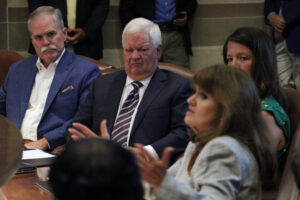
On the vote to approve a stay on awarding licenses until Aug. 10, the motion passed, save for two no votes from commissioners Charles Price and Loree Skelton. Following the vote, Skelton took aim at what she considered to be a lack of transparency in the process, and called for her fellow commissioners to reconsider their approach to awarding licenses.
“As a commissioner, I have not been given the opportunity to make informed decisions on the matters that have been put before me to vote,” Skelton said.
“Almost a year ago today, I raised my initial concerns on a contract review, and I was told there were anonymous evaluators, and I was not going to be privy to who those evaluators were. I was not going to be privy to criteria that they utilized to make that recommendation to us.”
Skelton argued that for her to make an informed decision, she should be privy to more details on how companies were graded, and who the anonymous evaluators were.
“It was my understanding that these people were supposed to be brought into the process to assist us, to give us their expertise in particular categories; we would then be able to incorporate it into our interpretation and our review of the application,” she said.
“That did not happen. What happened was we got pieces of paper with numbers and percentages that told us what these evaluators had come up with, and we got it first thing Monday morning, the same day we’re supposed to review everything and come to a decision.”
Commissioner Dwight Gamble argued that while AMCC members all held expertise in certain fields, many of them medical, it would be too daunting of a task to expect every member to grade medical marijuana producers without any outside assistance.
“This is such a huge, overwhelming process that we have to rely on some outside help… as a commission member, I can’t make every decision about each applicant,” he said.
“I don’t want us to get in the weeds. We have to have faith and trust in something that we have out there, and I think with a university that certainly has credibility, that now we’re trying to throw everything in that process in a tainted light, I don’t want to do that.”
“That’s not my suggestion at all, it’s quite the contrary,” Skelton responded.
Several other members, including Jerzy Szaflarsk and Eric Jensen, who both attended the meeting virtually, also said that they would like to know who the anonymous evaluators are, with Jensen saying it would make him more confident if he knew “the background of the evaluators.”
Price, who had voted against the commission staying the license awards until Aug. 10, went one step further than Skelton and filed a motion proposing that the commissioners themselves select who would be awarded a license.
The motion failed in a roll call vote, and was quickly followed by a motion by Skelton to pause the process to give the commission time to come up with a different process. Skelton’s motion also failed.
Following the meeting, Steve Stokes, the chairman of the commission, defended the decision to use anonymous evaluators, as well as the decision to withhold certain information from commissioners as a way to avoid potential conflicts of interest.
“To be honest with you, I’m biased; I know at least four or five of these applicants,” Stokes said.
“They’re all good people, good business people, and if I’m asked to select them, I’m going to choose them because I know them. So that’s what we’re trying to do, is take the vice out of the commission and make it independent so everybody gets a fair opportunity to be involved in this program.”

When asked what he thought about the companies that had already spent hundreds of thousands of dollars preparing their facilities and infrastructure only to be denied a license, Stoked said the focus should not be on money, but rather, the patients.
“I don’t feel sorry for them; if you look at these (companies), and I know a lot of them, they’re all very wealthy people,” he said. “They’re not looking at this as some kind of altruism for the state of Alabama, they’re looking at this to make money, and so we need to think about the patients and trying to get the product to them as quick as we can.”
Also after the meeting, Skelton stood by her concerns over transparency in the process, and argued the lack of information could not only not allow her to fulfill her duties properly, but could lead to further lawsuits against the state.
“Information has been withheld from me at every turn, and I can’t make an informed, knowledgeable opinion if I’m not given the information upon which to base that,” she said. “I’ve been given numbers and percentages with no criteria, no backup, no analysis, no summaries and conclusions, and that doesn’t tell me what I need to know as to whether or not I am confident in relying on that.”
In regards to Stokes’ defense of the anonymous evaluators, Skelton told Alabama Daily News that she didn’t feel a commissioner knowing an applicant was a strong enough justification for withholding that information.
“Just because you may know an applicant, doesn’t mean that they’re not an appropriate applicant,” she said.
The next meeting of the AMCC will be on Aug. 10, where members will vote to void the previous license awards and approve new ones based on reevaluated scoring data.