
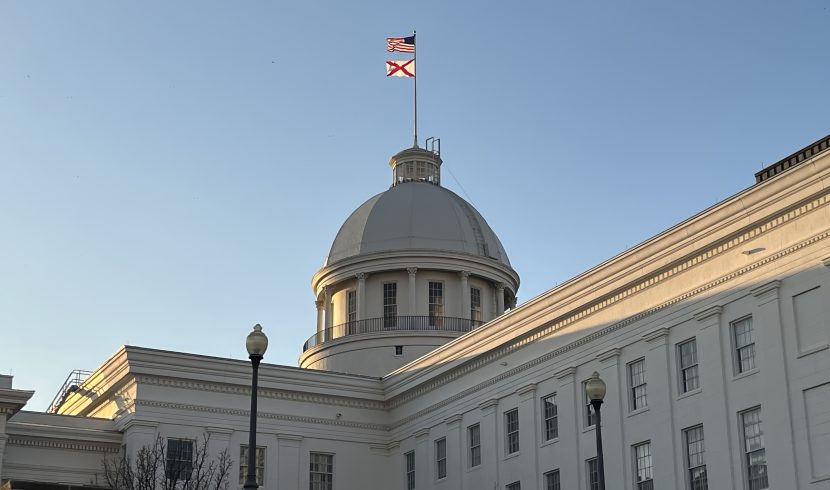
BIRMINGHAM, Ala. – Alabama voters will decide Nov. 3 whether public schools should be required to allow student-led prayer, conduct the Pledge of Allegiance daily and play the national anthem weekly. They’ll also decide whether neighboring county school systems should be allowed to merge.
Those questions make up Amendments 2, 3 and 4 of the proposed constitutional amendments on the November ballot. Amendment 1 addresses how the lieutenant governor would be replaced if the office becomes vacant.
The amendments would change Alabama’s constitution, which voters approved in its reorganized form four years ago.
The Fair Ballot Commission, created by lawmakers in 2014, provides nonpartisan explanations of proposed statewide constitutional amendments, including what a “yes” or “no” vote would mean.
Here’s what voters need to know about the three school-related amendments.
County school board mergers – Amendment 2
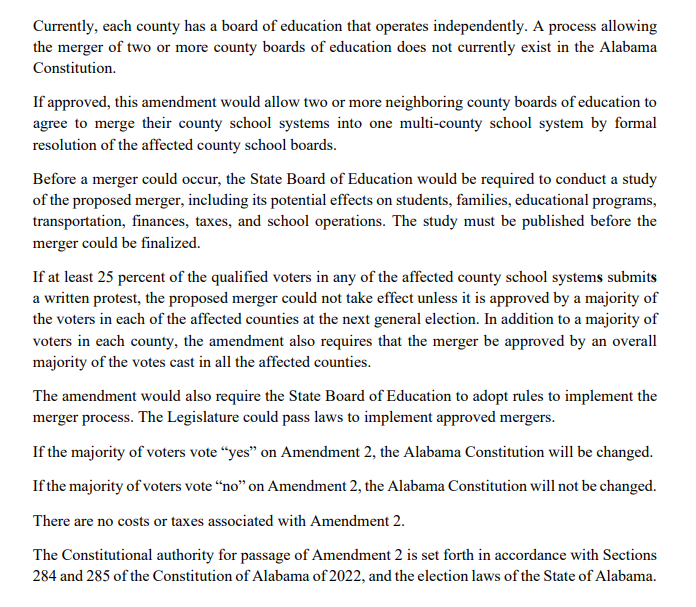
A “yes” vote would allow two neighboring county school systems to merge into a single, multicounty district. A “no” vote would leave the current prohibition in place.
Seven Alabama county school systems enrolled fewer than 1,000 students during the 2025-26 school year, while another four enrolled between 1,000 and 1,500.
Rep. Terri Collins, R-Decatur, who chairs the House Education Policy Committee, sponsored House Bill 380 to give smaller county systems the option to combine resources, reduce administrative costs and expand educational opportunities.
“My goal would be to put a little bit less in administration, get some economies of scale, but mostly be able to put more money back into the classroom,” Collins told the House Education Policy Committee in February.
Any merger would be voluntary and initiated by the affected school boards.
Before a merger could be finalized, the State Board of Education would have to study its potential effects on students, academic programs, staffing, facilities, transportation, finances and other operations. The study would have to be made public at least 30 days before the school boards adopted a final merger resolution.
Residents would also have an opportunity to challenge the merger. If at least 25% of qualified voters in any affected school district filed a written protest within 30 days, the proposal would go to a referendum.
Collins emphasized that the amendment would create an option, not a mandate.
The constitution currently allows city school systems to merge into county systems but does not authorize mergers between county school systems.
Lawmakers also passed separate legislation allowing two city school systems to merge, a change that did not require a constitutional amendment.
The image below shows the Fair Ballot Commission’s explanation of Amendment 2.
Student-led prayer and daily Pledge of Allegiance – Amendment 3
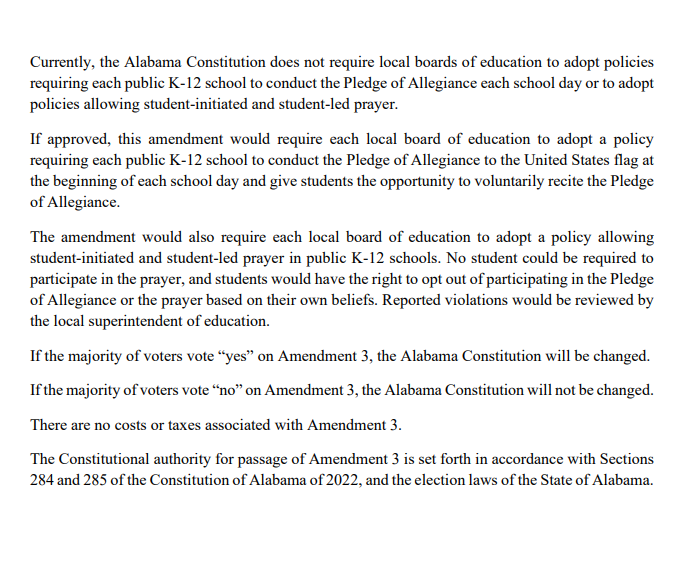
A “yes” vote would require public school boards to adopt policies allowing student-initiated, student-led prayer during the school day and to conduct the Pledge of Allegiance at the beginning of each school day.
Alabama law has required public schools to conduct the Pledge of Allegiance at the beginning of each school day since 2019. The proposed amendment would add that requirement to the state constitution.
The amendment would not require students to pray or recite the pledge. Instead, it would require schools to permit student-led prayer and provide for the daily pledge.
Rep. Reed Ingram, R-Pike Road, sponsored the proposal through House Bill 511 during the 2026 legislative session.
A “no” vote would leave the constitution unchanged.
The image below shows the Fair Ballot Commission’s explanation of Amendment 3.
Weekly national anthem – Amendment 4
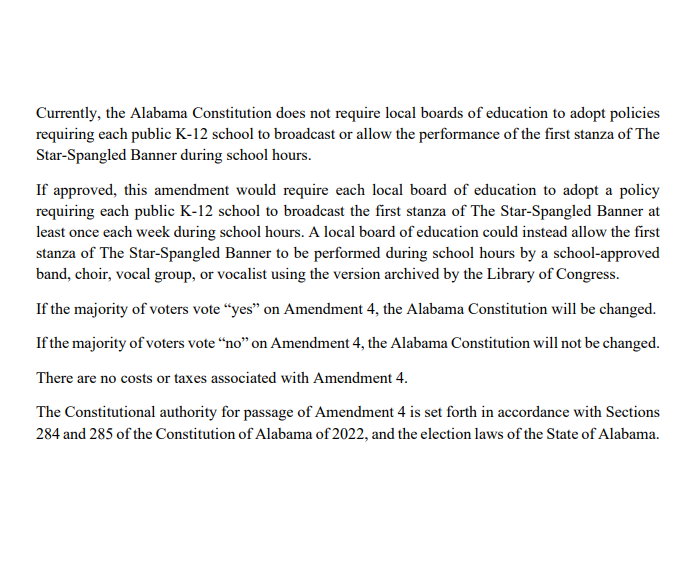
A “yes” vote would require Alabama’s K-12 public schools to broadcast or authorize a performance of the first stanza of “The Star-Spangled Banner” at least once a week during the school day.
Schools could comply by playing a recording or allowing an approved performance by a band, choir or vocalist.
Sen. Gerald Allen, R-Cottondale, sponsored the proposed amendment through Senate Bill 5.
The 2026 legislative session marked the seventh time Allen had introduced legislation addressing the weekly performance of the national anthem in public schools.
A “no” vote would leave the constitution unchanged without imposing the proposed weekly requirement.
The image below shows the Fair Ballot Commission’s explanation of Amendment 4.
Alabama’s Constitution
Alabama voters approved a reorganized state constitution in 2022, replacing the 1901 Constitution, which had accumulated nearly 1,000 amendments.
The new document removed racist and obsolete language and reorganized existing constitutional provisions, including hundreds of amendments affecting individual counties and municipalities. The 2022 constitution retained the state’s constitutional amendment process, allowing voters to continue making changes.
Sample ballots with the constitutional amendments are available on the Secretary of State’s website.