
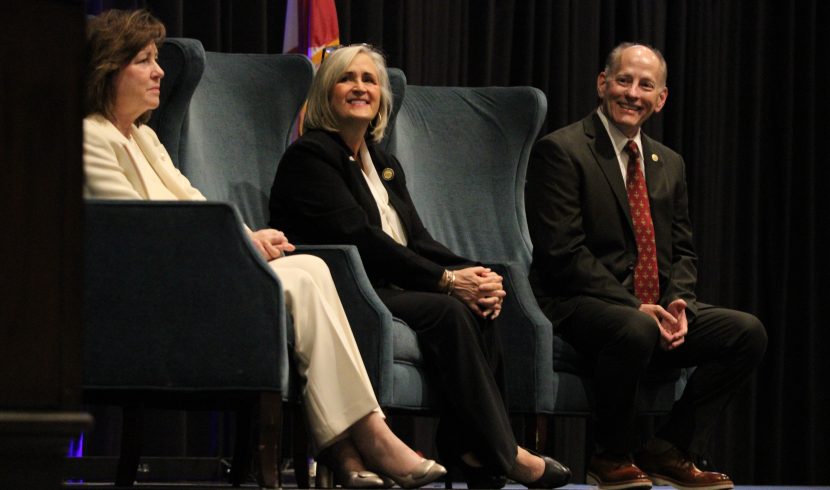
MONTGOMERY, Ala. — The heads of the Alabama Supreme Court, Department of Mental Health and Veterans Affairs concurred Thursday that further outreach and cooperation across all branches of government would be key in sufficiently addressing veterans’ mental health needs.
The panel discussion was the third of four Legislative Issue Breakfast events hosted by Alabama Daily News.
Sworn into office in January, Sarah Stewart, chief justice of the Alabama Supreme Court, campaigned on a pledge to work cohesively with other branches of government to reduce prison recidivism, starting with expanding the state’s drug and veterans treatment courts, which offer alternative pathways through the criminal justice system that can see the accused avoid incarceration.
“We have various mental health courts, veterans courts and a lot of drug courts all over this state, and we need to really try to get that system where everyone is using evidence-based programs that we’re measuring the outcomes so we can tell whether or not these programs are actually working,” Stewart said.
“One of the biggest areas that we’ve had the most success with accountability courts is veterans courts. Those participants are used to discipline, used to rules, and they react really well to that format.”

Addressing the mental health needs of veterans has been a top priority for state leaders this year, with the effort led in part by the Veterans Mental Health Steering Committee, which earlier this year made several recommendations to lawmakers as to how best address veterans’ mental health needs.
Alabama has among the highest veteran suicide rates in the nation, with veterans representing 18% of all suicides in the state in 2020. Veterans overall are far more prone to suicide than non-veterans.
Veterans courts, Stewart proposed, were among the best methods for treating veterans with mental health needs, specifically veterans that have entered into the criminal justice system. And while Alabama’s rural communities often don’t have the resources to have their own veterans court, Stewart said solutions exist.
“One of the things that’s been a challenge for our rural communities is they don’t really have enough participants to make those programs work financially,” she said.
“So very cleverly, like Judge Burt Smithart in Bullock and Barber (counties), and Judge Jeff Kelley in Coffee and Pike (counties), they’ve formed together a regional drug court program, and they want to bring in veterans courts and mental health courts for that region too. That’s the concept of trying to put in regional programs for some of our rural counties that don’t have any much at all at this point.”
Kim Boswell, ADMH commissioner, touted several achievements made this year towards addressing veterans’ mental health needs; a new firearm storage program and additional funding for treating traumatic brain injuries, the former of which has already signed into law, and the latter, included as an appropriation in state budgets.
She also championed the newfound cooperation between her department and the ADVA, while noting that further outreach was still needed for veterans to fully take advantage of the additional resources.
“We do feel like there is a ton of education; we learned a lot in the committee, but we also realized that there are lots of things going on that families, veterans and providers need to understand more,” Boswell said.
Discussion moderator and ADN Publisher Todd Stacy asked Jeff Newton, the new ADVA commissioner, what he considered to be the largest outstanding challenge facing his agency in its efforts to address veterans’ mental health needs. Like Boswell, he cited outreach.
“There are so many resources in the state to take care of veterans; the federal VA, they’ve got vet centers in every big city in the state that are not being utilized fully I believe,” Newton said. “We’ve got one in Mobile, we’ve got one right here in Montgomery that has peer-to-peer counseling for our veterans, and it’s free, but a lot of veterans do not know that’s available to them.”
The ADMH was recently chosen to be awarded nearly $28 million from Alabama’s share of opioid settlement money, with $9 million being earmarked for prevention, treatment and recovery grants, which at least a sizable portion will be used toward a marketing campaign, though largely on the dangers of opioids.
“That’s one of the problems we have,” Newton continued. “When you talk about veteran suicide, research shows that these veterans that commit suicide are not enrolled in VA health care, so we’ve got to change that, we’ve got to get the word out.”