

MONTGOMERY, Ala. – As Alabamians express concerns to local leaders about data center construction, county commissioners have passed a resolution saying they don’t want the power to regulate the projects.
The Association of County Commissions of Alabama took up the data center issue creeping into every corner of the state at its annual convention this week. The group, which represents all 67 commissions in the state, voted unanimously to oppose industry-specific planning and zoning authority.
Their resolution instead encourages a “more comprehensive approach to enhance the county commission’s role in strategic and productive growth in Alabama’s unincorporated areas.”
“If the Legislature were to consider giving counties land use authority to stop data centers, we would be opposed to that,” ACCA Executive Director Sonny Brasfield told Alabama Daily News. “We’re not opposed to having discussions about having comprehensive land use powers in the unincorporated areas, but we don’t want the Legislature to single out one industry and tell counties they can regulate that industry and the use of property for that industry.”
Counties possess only the narrow power enumerated to them by the Legislature, which is unlike the broad power cities have over their jurisdictions. Generally, counties have no zoning or planning authority, meaning county commissioners have no way to block data centers.
Having zoning power over just one industry would bring “serious concerns from a constitutional standpoint,” Brasfield said.
“The practical issues of trying to impose that and defend it in court, the membership has said very clearly they don’t want to be involved in that, in terms of all of the administrative difficulty in trying to single out one industry,” he told ADN.
Though the data center conversation is relatively new, Brasfield said the ACCA has faced calls for industry-specific zoning authority in the past.
He said the most recent examples have come from groups against rock quarries and solar farms. State lawmakers brought legislation to empower county commissioners about the two issues, but both attempts failed.
The ACCA didn’t have a policy in place opposing single-industry zoning power when those issues arose, which led the association to jump on the data center issue now, Brasfield said.
He said the issue boils down to the fact that Alabama has chosen not to grant county commissions “any ability to plan for orderly growth.”
“We’ve taken the position in Alabama that if you move to the unincorporated area, then you should be able to use your land for whatever purpose you wish, and that’s a defensible position,” Brasfield said. “But as long as that’s our position, the county commission can’t help these people. I mean, that’s just the bottom line.”
Lawmakers and agencies’ limited role
Even though county commissions don’t have the power to stop data center developments, advocacy groups against data centers often express their concerns at commission meetings.
A group in Lowndes County has mobilized against a massive proposed data center – Project Red Clay – in the area. That often includes attending Lowndes County Commission meetings to urge a body without the appropriate power to stop the project.
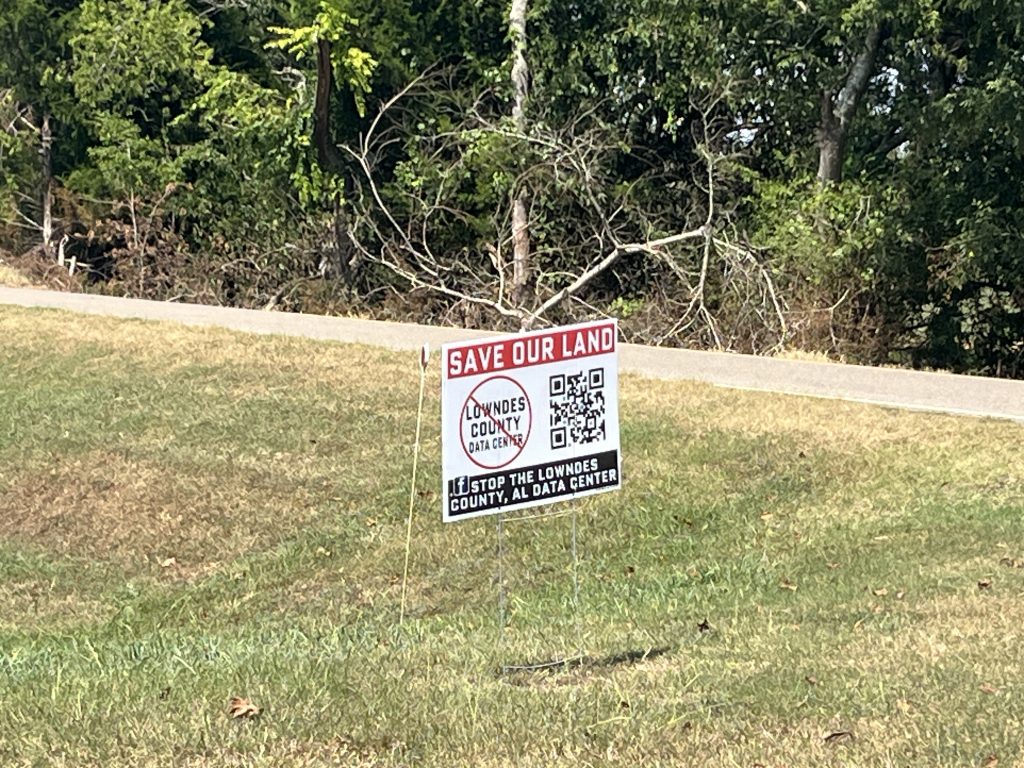
Though the commissions can’t help, Brasfield emphasized that the resolution doesn’t tell the public not to come to commission meetings.
“The county commission can listen, but the county commission can’t stop the establishment of a data center,” Brasfield said.
As some look elsewhere to stop developments they strongly oppose, the Public Service Commission, the body tasked with regulating some of the state’s utilities, has also reminded people of its limited purview.
Commission President Cynthia Almond recognized the hot-button issue and reiterated the PSC’s role in approving the facilities at a meeting last month.
“The commission’s role was not to evaluate or approve the project’s location or siting, we don’t have that authority, but rather to determine whether it satisfied the Renewable Generation Certificate criteria, including whether it would have a positive economic impact on Alabama Power’s customers,” Almond said.
The PSC is also in the process of establishing a policy on how it will evaluate Alabama Power’s large load data center contracts. That general proceeding involved a public comment period, and because of the controversial nature of the projects, the PSC included a disclaimer in its public disclosure.
“To facilitate efficiency, the public is encouraged to refrain from submitting comments outside of the scope of these statutes or the Commission’s authority,” the order reads. “For instance, Alabama law does not grant the Commission jurisdiction over data center siting or environmental regulation.”
The fight over data centers has also gained the attention of several high profile politicians, including both gubernatorial candidates.
Democratic nominee and former U.S. Sen. Doug Jones hosted an event in Lowndes County earlier this month to talk about data centers and his position on them.

Jones has been very public with his distrust of data centers, repeatedly calling for a one-year moratorium on new data center construction. He says this would allow communities time to set up guardrails for the massive facilities.
In addition to statewide guardrails, Jones has called for policy to empower county commissions and municipalities to make their own policies about data centers.
Republican nominee and U.S. Sen. Tommy Tuberville has taken the opposite approach, urging Alabamians to get on board with data centers he calls essential for Alabama’s growth. He says municipalities should think about the tax incentives they can bring to their areas before imposing moratoriums or other policies that could slow their construction.

Tuberville has also suggested that opposition to data centers is the result of propaganda from China and the Democratic party.
The governor’s race between Jones and Tuberville is a rematch of the 2020 Senate contest that first sent Tuberville to Washington. The general election is Nov. 3.