
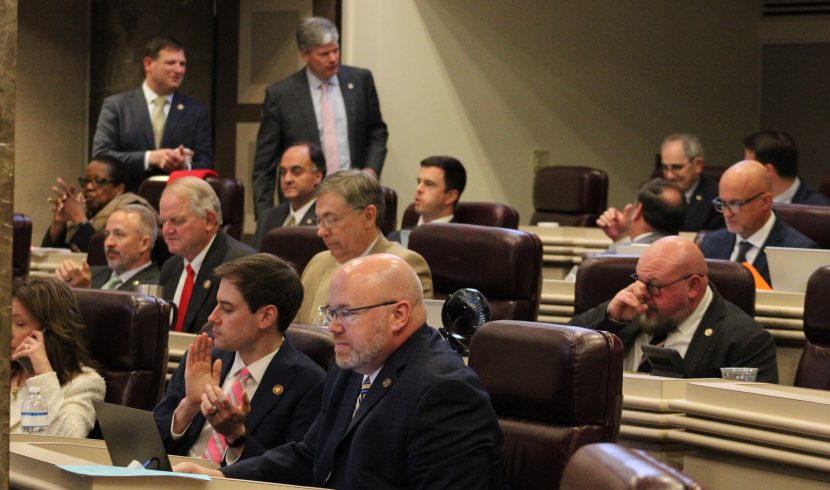
Senate agrees to conference committee on gambling bills
The Alabama Senate on Tuesday agreed to send gambling legislation to a conference committee of Senate and House members to try to work out differences between the two chamber’s versions of the bills.
The proposed constitutional amendment and enabling legislation that would allow for a lottery have been in legislative limbo since the Senate last month drastically scaled back the House’s proposal that would also allow for online and sports betting and up to 10 casinos with table games in the state.
But even the votes to keep discussions going in a conference committee had lukewarm support in the Senate. The vote on the constitutional amendment was 19-14. To pass the Senate, any constitutional amendment needs support from three-fifths of the body — 21 votes.
The six lawmakers assigned to the conference committee are Sens. Greg Albritton, R-Atmore, Garlan Gudger, R-Cullman, Bobby Singleton, D-Greensboro and Reps. Andy Whitt, R-Harvest, Chris Blackshear, R-Phenix City and Sam Jones, D-Mobile.
A timeline for their work has not been established.
There are eight legislative days, likely to be spread out over the next three to four weeks, remaining in this legislative session.
In a statement Tuesday, Senate President Pro tem Greg Reed, R-Jasper, said his chamber is committed to ending illegal gaming operations in the state and giving Alabamians a chance to vote on a lottery, as required by the state constitution.
It’s been 25 years since Alabama voters rejected a lottery proposal.
Senate passes union recognition ban bill
The Alabama Senate on Tuesday voted in favor of a bill making companies ineligible for state economic incentive dollars if they voluntarily recognize a union that has reached majority support among its employees.
Under existing law, a labor union may be recognized by an employer if a majority of employees sign cards pledging to join the union. Senate Bill 231, sponsored by Sen. Arthur Orr, R-Decatur, would make companies ineligible for state economic incentive dollars if they do so. Instead, union’s would have to have secret ballot elections.
Orr said he likes the bill “because it keeps the coercion from the company side or the union side. It keeps it down to a minimum.”
Were a company to have already received economic incentive dollars and still opted to voluntarily recognize a union instead of calling for a secret ballot election, they would be required to pay the state back in full.
Orr shared that Tennessee and Georgia have recently passed similar bills.
The legislation comes as the United Auto Workers get close to unionizing auto plants in Montgomery and Tuscaloosa. Those efforts have been loudly opposed by the state’s GOP and business leaders.
“The takeaway is it does not prevent an organization’s effort,” Orr said on the Senate floor. “All it does is require a private vote if there is an organizational effort that we want to vote for a union up or down. It’s got to be by secret ballot or if you have state incentives, you can stand to lose them if you don’t do it that way.”
The rule would apply to incentive deals brokered between the state and a company after Jan. 1, 2025.
Vaccine exemption bill advances
Members of the Senate voted in favor of a bill Tuesday that would make it easier for parents in K-12 schools to exempt their children from vaccine requirements.
Under Senate Bill 246, sponsored by Sen. Arthur Orr, R-Decatur, and Sen. Donnie Chesteen, R- Geneva, a parent or guardian’s written declaration is sufficient documentation to exempt his or her child from a vaccine requirement for religious reasons.
The parent or guardian may not be required to explain the reason for the exemption, certify the exemption with any third party or otherwise receive approval from the local board of education or any other entity.
“This bill removes that health department step,” Orr said about how the legislation makes the process easier.
This bill would provide that if a public institution of higher education requires students to be vaccinated or tested for a disease, a student may be exempt for medical reasons or because he or she objects for religious reasons.
Orr said Tennessee and North Carolina have similar laws.
Senate debates, carries over ABC tax bill
The Alabama Senate discussed a bill Tuesday that would increase the sales tax on products sold at Alabama Alcoholic Beverage Control stores.
Senate Bill 309, sponsored by Sen. Steve Livingston, R-Scottsboro, changes the additional state sales tax rate assessed in ABC retail stores from 2% to being equal to the combined county and municipal general sales tax rates.
Livingston said the bill would “level the playing field” for individual and private businesses who have to assess the local taxes on the same products. The combined average of the county and municipality tax rates is 5.33%.
Based on fiscal year 2022 data, the bill would increase receipts to county general funds by an estimated $5.1 million and municipal general funds by an estimated $6.7 million.
Minority Leader Bobby Singleton, D-Greensboro, expressed concern with this bill bringing up the possibility of heading toward privatization where everything is made equal.
Livingston showed the different taxes within Montgomery County and explained how some businesses will go out of business because people will go where the cheapest tax is.
The Senate agreed to carry the bill over meaning there wasn’t a vote, and the bill can come up at any time.