
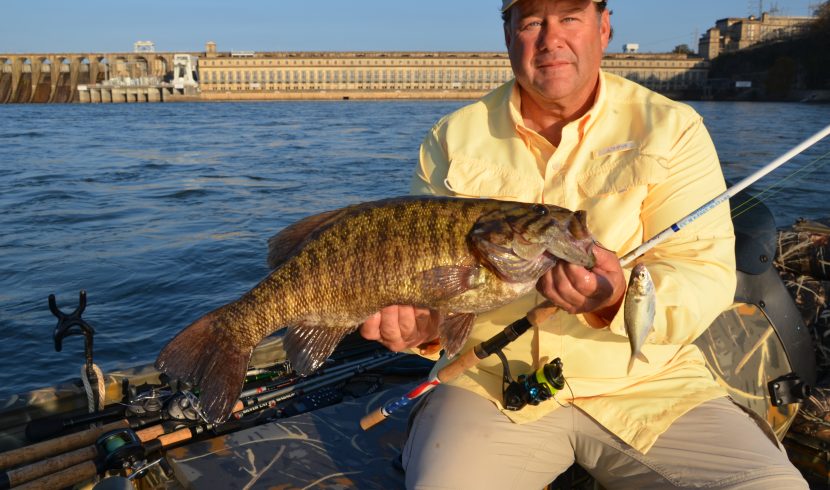
Tempting Bass With Live Bait on Pickwick Lake
Even from a hundred yards away, we could feel the power of the churning white water rushing through gates at Wilson Dam as it pushed the boat steadily downstream. Moments later, we each felt a different power as large fish inhaled our enticements.
“Current is essential to catching fish on Pickwick Lake,” explained Brian Barton, (256-412-0969, www.brianbartonoutdoors.com) a fishing guide from Muscle Shoals. “Anyone fishing when the dam is not generating current is not fishing at the prime time.”
Pickwick Lake runs 53 miles along the Tennessee River between the Wilson Dam at Florence, Ala. to the Pickwick Dam at Counce, Tenn. In all, the riverine impoundment covers 47,500 acres spreading across Alabama, Tennessee and Mississippi.
On any given day, Pickwick fishermen might catch multiple species, but many anglers come for big smallmouth bass. While the lake can produce monster largemouth, Pickwick offers some of the best giant smallmouth action in the nation.
Smallmouth prefer more current and rocks than largemouth bass, but anglers can catch both species or spotted bass anywhere in the lake. The best smallmouth fishing normally occurs near Wilson Dam. Here, the river flows through several channels and over or around numerous rocky shoals, islands, sandbars and obstructions. When the dam gates open, current dislodges small creatures and stirs up baitfish, kicking off a bass feeding frenzy.
“Fishing is always better when the dam is generating current, particularly for smallmouth,” Barton advised. “When the current kicks on, shad school up tighter and that puts bass in a feeding mode. Without current, the fish spread out and can be hard to find.”
Smallmouth might hit practically any lure that would interest a largemouth. However, nothing looks better to any hungry bass than what it already wants to eat and expects to see, a shad!
“Fishing with live bait is a highly effective way to catch big largemouth and smallmouth,” Barton commented. “When bait fishing for bass, people get a bent rod so much more often than when fishing with artificials.”
With the current rolling, Barton pulls up close to the dam and rigs a live shad. Then, he drifts down the river with the current, but stays within a few hundred yards of the dam. For bait, he might use either live gizzard shad or threadfin shad, whatever he catches in the cast net that day. Gizzard shad grow much larger than threadfins.
“I prefer to fish with threadfin shad, but I’ll use whatever we can put in the baitwell,” he said. “On the Tennessee River, shad spawn in April and May. We start seeing tiny hatchlings about a half-inch long in mid-June. They grow through the fall and reach their peak size in the spring before they spawn. In the fall, shad are very easy to catch in the creeks with a cast net. During the fall, I like to use two- to three-inch shad. In the spring, I use bigger baitfish, about four to five inches long.”
Barton fishes with no weight on the line, or perhaps just a small split-shot attached to the line to keep the bait near the bottom, depending upon the current. When drifting, he uses a medium-action spinning rod and a reel loaded with eight- or 10-pound-test high visibility green monofilament line so he can better visually detect strikes. Sometimes, a bass might just slurp in a bait. At other times, they hammer tempting morsels.
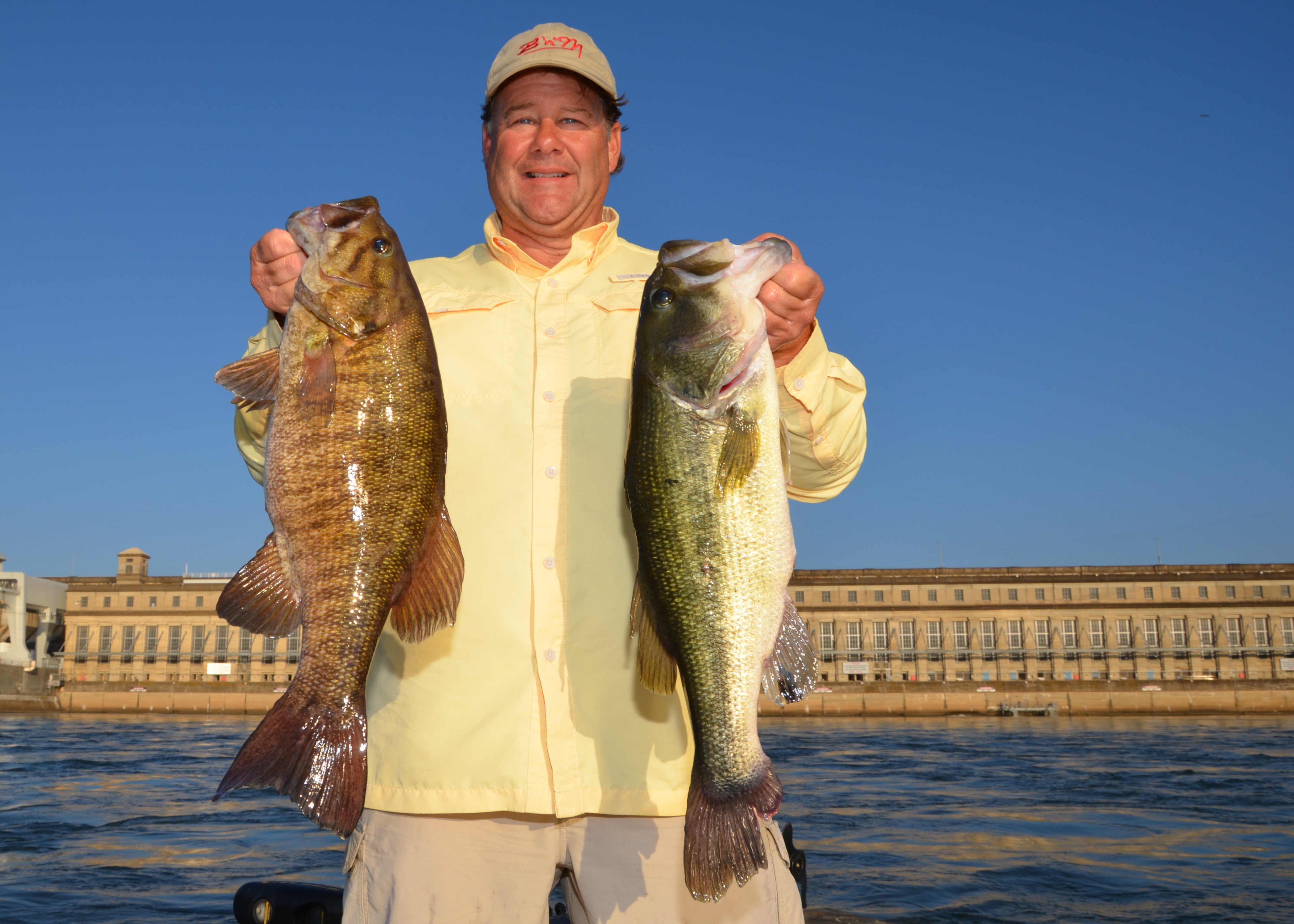
Bait size determines the hook size, not the size of the fish one hopes to catch. With small baits, use small hooks. Use large hooks with large baitfish. A lunker smallmouth or largemouth can easily swallow sizeable baitfish. Ideally, the bait should hover just off the bottom and move at the same speed as the current.
“I match the weight to the current flow,” Barton detailed. “The bait size, line size and weight size all need to match so the rig does what it’s supposed to do. I want the bait to flow along with the current just off the bottom. If I use too much weight, it will stay hung up. If I don’t use enough weight, the bait will float above the strike zone. If I’m using really small baitfish, I’ll use a Number 4 hook. If I’m using a five- to six-inch shad for targeting bigger bass, I use a Number 1 or 1/0 hook.”
When drifting, Barton hooks minnows through the lips. Hooked that way, they move more naturally downstream. However, when he spots bass attacking shad on the surface, he inserts the hook just behind a baitfish’s dorsal fin and under the spine to give it more erratic action.
“Even with live bait, sometimes it’s not as easy to fool big bass as one might think,” Barton remarked. “Sometimes, just changing how to hook on a baitfish can make a big difference in the presentation and whether fish bite or not.”
Smallmouth and largemouth bass both tend to hide behind current breaks. They stay just out of direct current, but face into the flow waiting to grab any temptations washing toward them. If they see something irresistible, they dash out to snatch it before returning to their lairs behind the structures. Drift baits past rock piles, sandbars, humps, fallen logs or other obstructions that might hold fish. Pickwick Lake even contains some ancient, now submerged, Native American mounds.
“Current concentrates fish toward the top or the head of structures, making it much easier to find and catch them,” Barton said. “A smallmouth will nose right into the current. It gets in front of a rock pile and fights the current when it’s in a feeding mode. Largemouths typically like to get behind current breaks to wait for something to come floating by them.”
What works at Pickwick Lake could work in any lake or river with modest current. In placid waters, use a trolling motor to slowly drag the bait over the bottom.
For area information, contact the Colbert County Tourism and Convention Bureau (www.colbertcountytourism.org) or Florence-Lauderdale Tourism at www.visitflorenceal.com.
**********
An avid sportsman, Felsher is professional writer, photographer and radio show host who has written thousands of articles for many publications. He’s always looking for ideas or outdoors adventures that will make good stories. Contact Felsh at [email protected] or through Facebook. He also hosts an outdoors tips show for WAVH FM Talk 106.5 radio station in Mobile.