
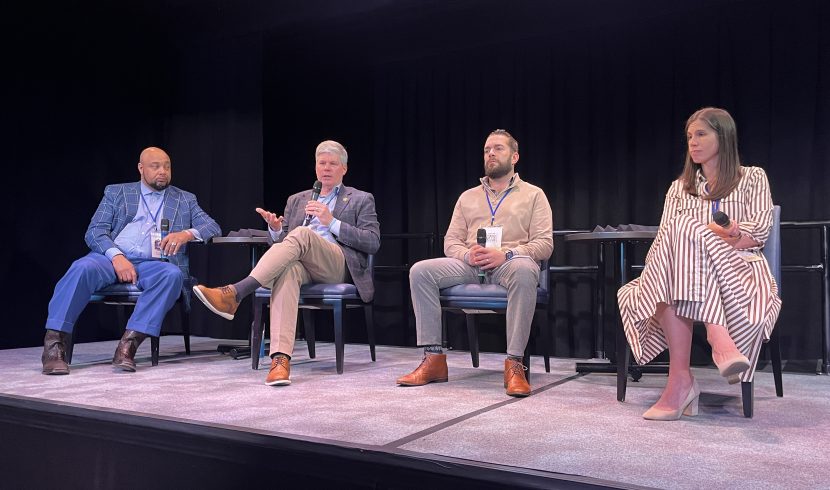
BIRMINGHAM, Ala. – Discussion about relationships, accountability and local funding took center stage Thursday during a legislative panel at the New Schools for Alabama annual conference.
The conference brought together educators, advocates, policymakers and lawmakers to discuss the growth and challenges of public charter schools across the state.
The legislative panel, moderated by Alabama Daily News Publisher Todd Stacy, featured three members of the Jefferson County legislative delegation alongside charter advocate Emily Schultz of Alabama Families for Great Schools.
Alabama’s charter school sector – now with 15 startup schools statewide – is still relatively small, even though the original law was passed 10 years ago. Advocates say the charter law still needs fine-tuning – especially where funding is concerned.
“Public charter schools get access to federal and state revenue associated with each child they serve,” Schultz said. “They do not get access to local revenue.”
That has left charter schools at a disadvantage, she added.
“We wanted no more, no less than what district schools got,” she said. “That has not come to fruition.”
Schultz said the funding gap between district and charter schools can reach $5,000 per student even as charters are held to stricter standards.
“We have increased flexibility in exchange for higher levels of accountability,” she said.
Schultz said advocates hope to amend state law so that local taxes public charter school families pay will follow their children to the charter school they choose to attend.
Lawmakers acknowledged that achieving equity will be complicated by Alabama’s patchwork of city and county tax systems, particularly in Jefferson County – areas they represent – which has 11 city school systems plus the countywide school system.
Rep. David Faulkner, R-Mountain Brook, who serves on the House education budget committee, said accountability remains a top priority, particularly when it comes to spending. That focus has shaped recent education budgets.
“We want to see results,” Faulkner said. “What is that money going to do and how do we know that it’s actually getting the result?”
Rep. Neil Rafferty, D-Birmingham, agreed.
“Accountability is probably one of the most important things,” he said. “We have to actually make sure that what these are going towards – a program, a school, a system – is working for the citizens that are paying into it, that have a vested interest in those communities and those schools.”
During a discussion of how advocates and constituents can engage lawmakers, all panelists stressed the importance of relationships.
“If you connect more with your legislators, build those relationships, then I think your voice can be heard even better,” Rep. Patrick Sellers, D-Birmingham, said.
Faulkner said personal outreach from constituents matters more than mass campaigns.
“Mass emails, form letters – that doesn’t do anything,” he said.
Hearing from a constituent or advocate with whom he has developed trust matters most, he added.
Schultz urged charter leaders in attendance to keep relationships active year-round.
“Please don’t let the first contact you have with the Legislature be when you’re asking them for something,” she said. “Invite them into your schools. Make sure that they know who your students are, what their stories are.”
Despite differing viewpoints, panelists emphasized bipartisanship.
“We are not like Washington,” Faulkner said. “In Montgomery, we work together. Ninety percent of what we do ends up being bipartisan.”