
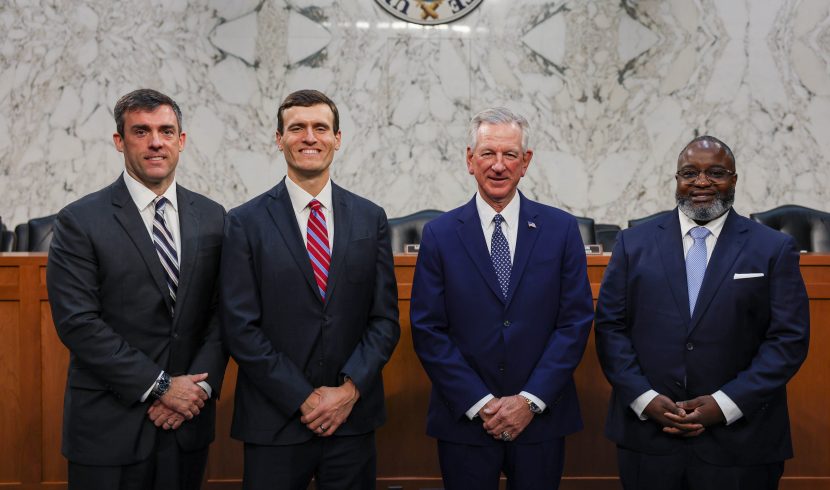
WASHINGTON — Three Alabamians nominated to federal judgeships described what makes them qualified to serve on the bench during a Senate Judiciary Committee hearing Wednesday.
President Donald Trump nominated Alabama Solicitor General Eddie LaCour, Alabama Supreme Court Associate Justice Bill Lewis and attorney Hal Mooty to district court appointments last month. U.S. Sens. Katie Britt and Tommy Tuberville, R-Ala., fully support the nominations.
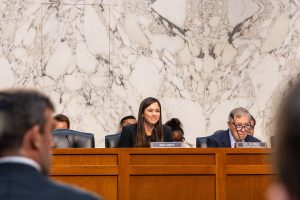
Britt presided over much of the hearing, and she and Tuberville introduced the Alabama nominees. Two Mississippi federal judge nominees were also considered Wednesday.
Britt said the Alabamians have “superb qualifications” and a “devotion to the Constitution and the rule of law.” Tuberville expressed confidence that the three nominees will be “impartial in all interactions on the bench.”
Lewis is nominated to serve as a district court judge for the Middle District of Alabama and LaCour and Mooty have been tapped to serve as district court judges for the Northern District of Alabama.
Britt praised all of the judicial nominees at the hearing and asked each of them what career experiences “make you feel most qualified to serve” in their potential positions.
“After 17 years in private practice and trying cases in federal and state courts, appearing in federal and state courts across the country, I feel like I was born to do this, senator, and serve the public and my country in a manner that I feel like God has set me on a path to be back in the courtroom, but for a lifetime appointment, serving the public in a country that’s given me so much,” Mooty, a partner at Bradley Arant law firm, said.
Lewis, a previous judge for the 19th Judicial Circuit in Elmore County, said handling one of the busiest circuits in the state prepared him to “manage dockets efficiently” and ensure everybody has their voices heard. He also served as an appellate judge in Alabama.
“I was in a position where I was able to be analytical,” Lewis said. “I was able to research cases. It also gave me the opportunity to see how other judges in the state did things, what worked, what didn’t, and how they treated people as well.”
In response to Britt’s questions, LaCour highlighted his experiences working in venues across the country and litigating three cases in front of the Supreme Court.
“I think that’s given me a good experience in terms of being able to get a new issue, get up to speed quickly, try to get the right answer, and then move on,” LaCour said. “I think that’s a really important skill for a judge to have, to be able to master an area of law quickly.”
LaCour has been a key player in Alabama’s redistricting efforts. In 2023, he argued before the Supreme Court in Allen v. Milligan when the Court rejected the 2021 state legislature-drawn congressional map for diluting Black voters. The Alabama Legislature then redrew the map and a lower court subsequently threw it out, ruling it violated Section 2 of the Voting Rights Act.
A congressional map that includes two majority Black districts, drawn by a special master, is now in place until 2030. Alabama officials are currently appealing the case to the Supreme Court again.
The committee’s top Democrat, Sen. Dick Durbin of Illinois, questioned LaCour over his involvement with the case, asking him to comment on “public reporting and testimony” showing that LaCour played a “significant role” in helping the Alabama Legislature draw the 2023 map that the federal court ruled suppressed Black voters.
LaCour defended the legality of the 2023 congressional map, despite a federal court striking it down.
“We have arguments that we have advanced in the case as to why that 2023 map is consistent with Section 2 of the Voting Rights Act and with (the) equal protection clause’s demands that states not use race to sort voters into different districts, ” LaCour said. “When it comes to defiance of court orders, I don’t think any court order has been defied in that case.”
Turning to Lewis, Durbin asked him if his involvement with political organizations, such as the Elmore County Republican Party and Alabama GOP’s State Executive Committee, went against Alabama’s judicial ethics codes.
“It is a recommendation, but I also checked with the ethics and of course, the (Judicial Inquiry Commission), which is our regulatory agency, and they permitted me to do that,” Lewis said.
Alabama Republicans, including Gov. Kay Ivey, have praised the nominees.
“They are excellent, conservative legal minds, and I know they will serve our country well,” she said in a post on X.
The Judiciary Committee will now have to vote on the nominees before a full Senate vote. With a Republican majority, Alabama’s nominees are expected to be confirmed to their lifetime posts.