
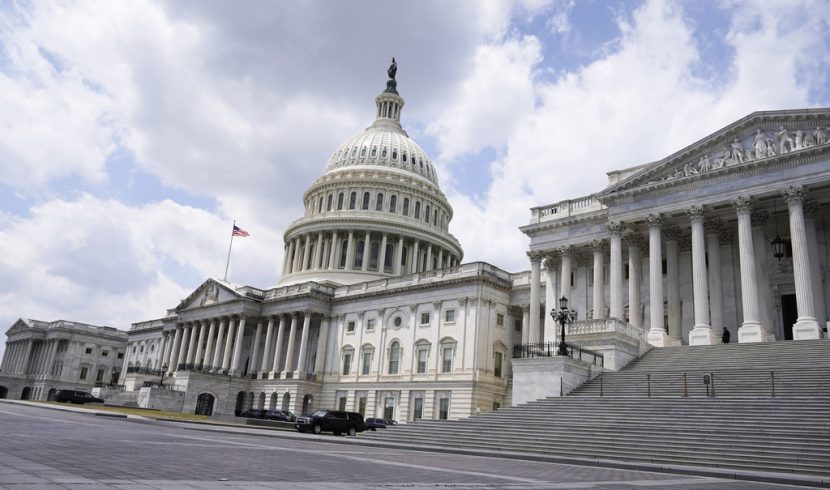
Alabama’s seven-member delegation in the U.S. House were deeply divided in their votes on the $95 billion aid package that the chamber passed over the weekend, with the package’s most controversial component being the $61 billion in military and economic assistance for Ukraine.
Split between several bills, the aid package included the aforementioned $61 billion for Ukraine, $26 billion for Israel, which includes more than $9 billion in humanitarian aid for Palestinian refugees, and about $8 billion for U.S. allies in the Indo-Pacific region, largely Taiwan.
Having passed in the House on Saturday, the package is expected to be voted on in the Senate as early as today, with President Joe Biden already pledging to immediately sign the package into law upon its final passage.
By far the most defiant of the Alabama delegation was Republican Rep. Barry Moore, R-Enterprise, who in the weeks leading up to the vote, had urged for additional border security funding to be tied to any foreign aid package.
“A vote for the foreign aid package rule is a vote to put America last,” Moore wrote in a social media post.
“Biden, (Senate Majority Leader Chuck) Schumer and House Democrats are celebrating this legislation because it provides every cent of foreign aid they asked for and does not require them to take any action to secure our own border. I voted no.”

Moore was joined by Reps. Jerry Carl, R-Mobile, Dale Strong, R-Huntsville, and Gary Palmer, R- Birmingham, in voting against the $61 billion Ukraine aid. However, Moore was the sole congressman from Alabama to also vote against the $8 billion for Taiwan.
Moore also supported amendments to the Ukraine aid bill that would weaken the package, including one from Rep. Kat Cammack, R-Florida, that would strip away all non-military funding from the bill. The amendment failed, but was supported by Reps. Moore, Carl, Robert Aderholt, Strong and Palmer.
Carl had also spoken strongly against additional aid to Ukraine, and, much like Moore, tried to tie border security funding to its passage. Carl filed an ultimately unsuccessful amendment to the Ukraine aid bill that would have halted its expenditures until the passage of the Secure the Borders Act, a $118 billion spending package to enhance border security.
“Today I voted to secure the border and protect critical allies around the world, without giving another dime to Ukraine,” Carl said Saturday in a statement.
“Protecting America should be our No. 1 priority, and that starts with securing our southern border. We should do this while supporting and protecting our allies abroad when they are under attack. We have a moral duty to support Israel, and China’s aggression towards Taiwan isn’t slowing down.”
Strong took a similar position to Carl and Moore, and said he could “not in good conscience vote to send billions of taxpayer dollars to Ukraine while our own borders are being invaded” in a statement on Saturday.
Conversely, the two strongest supporters of the entire aid package were Republican Rep. Mike Rogers, R-Saks, and Democratic Rep. Terri Sewell, D-Birmingham, both of whom voted in favor of all three aid bills, and against all amendments that would have weakened any of the bills.
“The national security package passed by the House provides urgently needed resources to help Ukraine defeat Putin, deliver humanitarian assistance to civilians in Gaza, defend Israel in its proxy wars with Iran, and deter aggression by China against our Indo-Pacific partners,” Sewell said Saturday in a statement.
“To be clear, it should never have taken this long for House Republican leadership to meet the national security needs of the American people and our allies. House Republican inaction has allowed the U.S. to stand idly by as Ukraine is pushed to its breaking point.”
Where the Alabama delegation unanimously agreed was on aid to Israel, with every member voting in favor of the $26 billion in aid. The day before the vote, however, in an interview on Rightside Radio, Palmer expressed one concern he held with the aid bill for Israel.
“The Israel bill, I think part of the problem that some people have with that is that there’s humanitarian aid for Gaza, and it’s been misrepresented by some as a payment to Hamas, which is not true,” Palmer said.
“That said, I don’t support the aid because money is fungible, and they’ll just substitute money from somewhere else.”
Nevertheless, the Alabama delegation all voted in favor of the aid to Israel, as did the vast majority of the entire body, having passed with a vote of 366-58.
On the aid for Ukraine and Israel, the two largest bills in the package, a recent CBS News YouGov survey shows that both parties were, at least partially, out of step with their party’s base.
For Democratic voters, 32% – down from 47% last October – said that the U.S. should send more weapons and supplies to Israel amidst the Israel-Hamas conflict. Conversely, more than 82% of the 210 Democratic House representatives that cast a vote on the bill voted in favor of it.
For Republican voters, 39% said the U.S. should send more weapons and aid to Ukraine versus 61% that were against it. On the aid bill for Ukraine, more than 47% of GOP House members voted in favor of it, versus close to 53% against.