
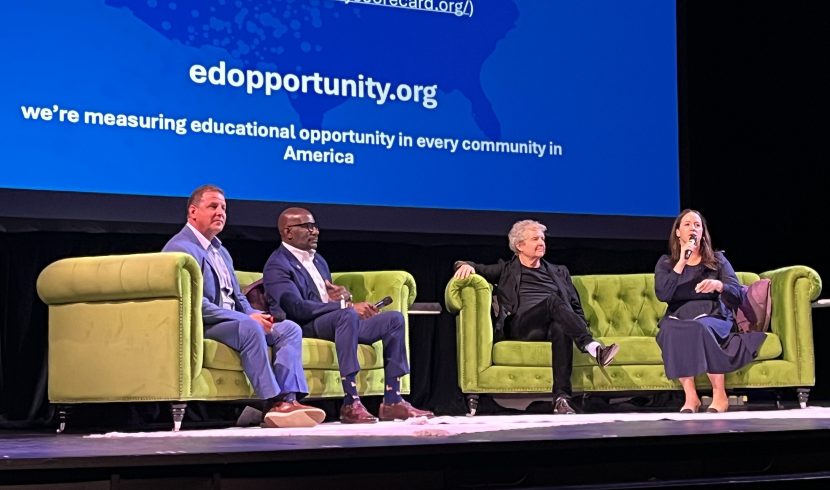
BIRMINGHAM, Ala. – Hundreds of state and community leaders, educators and education advocates gathered Friday to learn how best to improve schools and expand opportunities for Alabama students.
The annual A+ Opportunity Summit, held in downtown Birmingham, was not only a learning opportunity but also a chance to celebrate the success Alabama schools have shown, particularly in post-pandemic academic measures.
“The good news is, what we’ve seen today is that research is showing that Alabama is actually leading the nation in recovery after the (pandemic),” A+ President Mark Dixon said. “We’re recovering more quickly, our students are doing better, and there’s a lot of great work going on in our schools.
“So we’re trying to learn about that success and also learn how we can accelerate that, because we still have a long way to go to make sure that we have great schools for every child.”
The organization presented its inaugural Caroline Novak Champion for Children Award, honoring its founding president, to House Education Budget Chairman Danny Garrett, R-Trussville, and Senate Education Budget Chairman Arthur Orr, R-Decatur, for their role in passing the state’s Renewing Alabama’s Investment in Student Excellence, or RAISE Act.
“We’re happy to be here to recognize the progress that’s been made, because when you look at the Numeracy Act, the Literacy Act, the RAISE Act, the CHOOSE Act – all the things we’re doing, even right now looking at outcome-based funding for higher education – it’s taking Alabama from the bottom and moving us up,” Garrett told Alabama Daily News.
The RAISE Act, passed unanimously by lawmakers last spring, updates and expands Alabama’s K-12 public-school student funding formula – implemented in 1995 – by adding $550 million over the next three years to target student needs.
Garrett credited A+ Education Partnership for its role in educating lawmakers and advocating for the change, as well as school superintendents for embracing the shift and thinking outside the box.
“I get calls every week from superintendents saying, ‘Hey, we’ve got an idea, we’ve got a program,’” he said. “And that’s encouraging.
“That’s the kind of thinking we need, and we’re excited about that.”
Stanford researcher Sean Reardon presented data amassed and analyzed for the Education Recovery Scorecard showing that Alabama is outperforming the rest of the country in returning to pre-pandemic academic success.
Acknowledging Alabama’s historic struggles in achievement compared with other states, Reardon held up the state’s students for their resilience during the pandemic.

“While both Alabama and the country saw some declines during the pandemic, the decline was smaller in Alabama and the recovery was faster,” he said. “So while Alabama still lags the country as a whole, that disparity is much, much smaller than it was just five years ago.”
Nationally, many states are still struggling to return to pre-2020 levels of student achievement, particularly in math, making Alabama’s faster rebound stand out in recent national comparisons.
Two Alabama districts – Birmingham and DeKalb County – have gained national attention because of their recovery efforts highlighted in Reardon’s work.
Birmingham Superintendent Mark Sullivan said that success is due in part to the district’s expansion of the regular 180-day school year.
“Our goal was to push in on the 185 days students are out of school to get more learning,” he said.
The district created “intersessions” for times when students would typically be out of school – week-long periods where those who were struggling could come back and get extra help.
“We did that three times a year,” he added. “That’s 15 extra days – and then we did it for 20 days in the summer.
“We pushed kids over 200 days of instruction.”
DeKalb Superintendent Wayne Lyles – whose district is in rural northeast Alabama – said he attributes much of his students’ success to the district’s commitment to in-person learning during the pandemic.
They also focused on targeted interventions through extended learning opportunities similar to Birmingham’s and emphasized teacher growth through coaching and professional learning.
“When your teachers grow, your students are going to grow in return,” Lyles said.
“I challenge my staff and students just to get a little better every day. And I think, you know, we’re on a long journey, but if we take a few steps each day, we’re going to continue great things for county schools, for Birmingham and for the state of Alabama.”