

BIRMINGHAM, Ala. – Every Friday around lunchtime, church buses pick up nearly 100 students at Hokes Bluff Middle School. The ride lasts only a few minutes, taking students to nearby First Baptist Church, where they spend about 40 minutes receiving Bible instruction.
Retired teacher Cindy Harbison is there to greet the students and lead their Bible lesson.
“I just see the look on their faces,” she told Alabama Daily News. “I can tell they want to be here.”
Harbison spent her career teaching young children, working as an intervention teacher through sixth grade and later teaching child growth and development at Jacksonville State University.
Now 70, she volunteers as a LifeWise Academy teacher. Her granddaughter attends Hokes Bluff Middle, and this year Harbison teaches her alongside other seventh- and eighth-graders.
The Friday routine began in February, when Hokes Bluff became one of the first LifeWise Academy programs operating in Alabama. It has grown to 98 students this school year.
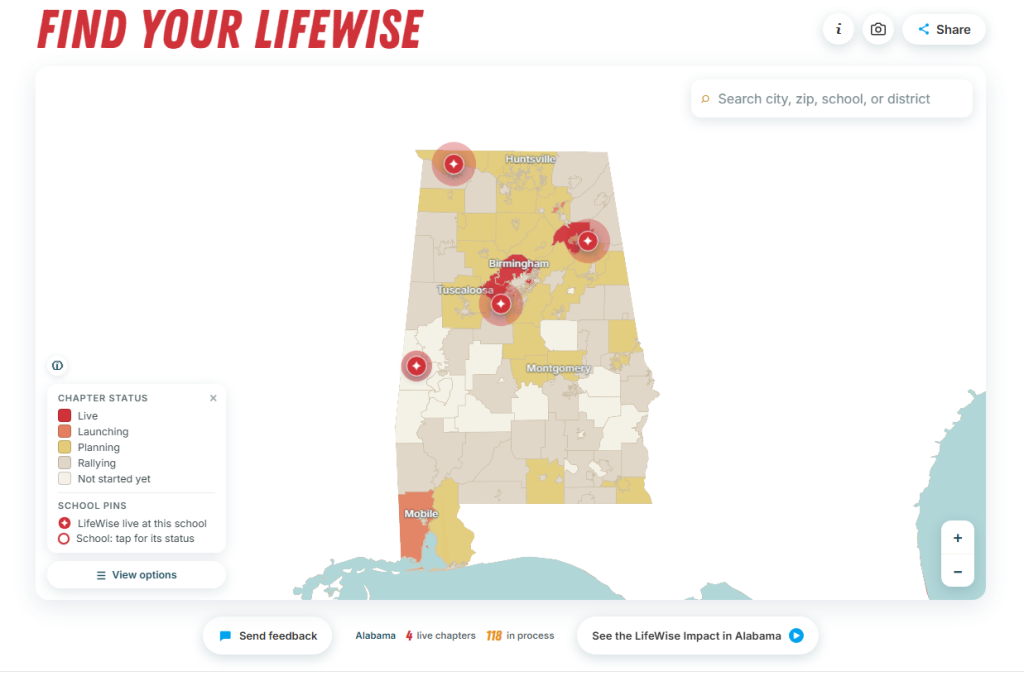
And Hokes Bluff is no longer an outlier. LifeWise says four programs are now operating in Alabama, with 15 more approved by schools and working toward launch.
That growth is being driven by a national model designed to help local communities launch quickly.
LifeWise, an Ohio-based nonprofit, has developed a 10-step process for communities interested in bringing Bible instruction into the public school day. Local organizers handle much of the work on the ground, while LifeWise provides coaching, curriculum, training and organizational support.
The growth also comes just months after Alabama lawmakers strengthened the state’s released-time law.
Lawmakers in April changed Alabama law from saying school boards may allow students to leave campus for religious instruction to saying boards shall allow parents to choose released-time religious instruction for their children, with limited exceptions.
The law took effect July 1.
Released-time religious instruction
Released-time religious instruction itself is not new. In 1952, the U.S. Supreme Court upheld a New York program that allowed public school students to leave campus during the school day for religious instruction. The decision in Zorach v. Clauson is cited in Alabama’s law.
Alabama put a state framework around the practice in 2019. The Alabama Released Time Credit Act allowed local school boards to adopt policies permitting students to leave campus for privately provided religious instruction and, in grades where credit is earned, receive elective credit for participating.
This year’s change went further, requiring school boards to allow parents to choose released-time religious instruction, subject to some exceptions.
In practice, the law requires schools to let eligible students leave campus for religious instruction, but places most of the responsibility on parents and the sponsoring organization.
Parents must opt in, students cannot miss required instructional time or legally required interventions, and the religious group is responsible for transportation, liability and background checks.
At least two districts – Jefferson County and Etowah County – were already allowing students to leave campus for religious instruction before this year’s change.
What school-day Bible instruction looks like
The Hokes Bluff Middle School group meets once a week on Fridays during “Eagle Time,” a study-hall-type period immediately after lunch, according to program director Karen Roberts.
Harbison said the Bible lesson lasts 30 to 40 minutes, with the full outing taking about 45 minutes including loading and unloading the buses.
Harbison said students are eager to participate, volunteering to read Scripture aloud, answering questions about what they have read and taking part in activities intended to connect Bible lessons to their lives.
“They want to read the scripture,” she said. “It amazes me that when I ask them a review from what we learned the week before … they remember so much about the scripture.”
Hokes Bluff Middle enrolled 270 students last school year, meaning LifeWise participation is equal to more than one-third of last year’s school enrollment.
Hokes Bluff is one of two programs highlighted in a video on the LifeWise Academy YouTube page. Harbison and Roberts are featured.
The other chapter is in Jefferson County Schools, which now has students from McAdory Elementary and Middle Schools, according to Jefferson County Superintendent Walter Gonsoulin.
New programs launching
A third LifeWise program launched last week in Livingston, serving students from University Charter School.
Program director Elisa Colgrove said in a social media video that 76 first-, second- and third-grade students enrolled for the program’s first week, with more than 70 children attending.
The video, posted Sunday, offered a detailed glimpse of what students were taught.
Colgrove taught second- and third-graders, where they studied the creation story in Genesis, learned how to locate passages in the Bible and completed activities illustrating the days of creation.
She said students also began memorizing scripture and focused on gratitude as the week’s LifeWise character quality. Colgrove said teachers connected the lesson to ways children could show gratitude to God and to people in their lives – thanking a grandparent for picking them up, a parent for preparing dinner or a teacher or friend for helping them.
The class concluded with a prayer of protection and blessing over the students.
“The whole point of LifeWise is to learn the Word of God and then live it out,” Colgrove said.
Florence City also launched its LifeWise program last week for students at the district’s four elementary schools in first through sixth grades.
A LifeWise letter distributed to Forest Hills Elementary school families in August said students could participate for about 40 minutes once a week during their enrichment period. Students there could walk across the parking lot or street to Forest Hills Baptist Church, with a shuttle van available when weather prevents walking.
Discussion of the program in a Florence-area Facebook group showed the vast majority of posters were supportive of the program.
One poster, however, asked basic questions about who was behind LifeWise, what denomination it was associated with, what curriculum would be used and what children would actually be taught.
Those questions and many others have followed LifeWise as it has expanded nationally.
Critics have questioned whether released-time programs blur the boundary between public schools and religious organizations, whether participating students lose educational opportunities and whether children who do not participate feel excluded.
How Alabama’s law works in practice will vary by school system – including when students leave campus, what nonparticipating students do during that time and how families are informed about the program.
LifeWise’s rapid national growth
Nationwide, LifeWise Academy has grown exponentially in recent years.
The organization says it served students from just two public schools in 2018. That grew to five schools in 2019, eight in 2020 and 36 in 2021.
Growth accelerated from there: 133 schools in 2022, 331 in 2023, 585 in 2024 and more than 1,000 by the end of 2025. LifeWise reported more than 60,000 students enrolled across 36 states as of Dec. 31.
The organization is aiming considerably higher. Its 2025 Impact Report says its next goal is to reach 10% of the nation’s public schools by 2030.
A social media post from a fundraising dinner held in Birmingham in April shows LifeWise has a goal in Alabama of having 100 chapters in three years.
The LifeWise model relies on local churches, volunteers and organizers, but the national organization supplies curriculum and a structured launch process designed to move communities from initial interest to fundraising to launching the program.
Its expansion strategy also operates at the state level. The Impact Report describes a four-step approach: establish a state committee, raise seed funding, hire a state director and, “if needed,” pass legislation.
The report listed Alabama among its targeted states. LifeWise is now advertising to fill the Alabama state director position and says an Alabama board continues to support expansion in the state.
While a scan of social media shows other Alabama chapters that are very close to launching, including Hartselle City Schools and Winston County, a map on the LifeWise website shows 118 Alabama chapters in various stages of launching.
For now, the details of what released-time instruction looks like are being worked out community by community – during enrichment time in Florence, during Eagle Time at Hokes Bluff and according to whatever schedule each local school can accommodate without cutting into required instruction.
Harbison said one important point to make is that participating students are not leaving core academic classes to attend LifeWise Bible classes.
“They’re not missing math. They’re not missing English. They’re not missing science,” she said. “It’s not taking away from their education.”
For Harbison, the reason she keeps volunteering is simple.
After decades in classrooms and another eight years working as a substitute teacher after retirement, Harbison said she still loves to teach.
And now, she said, she is teaching what she believes matters most.
“There’s nothing more important that I can teach them than the Word of God,” Harbison said. “This can change their life forever and give them hope.”