
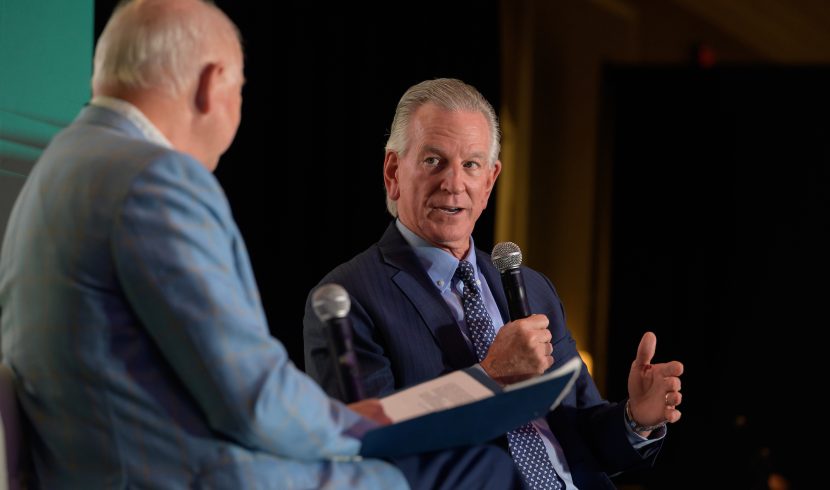
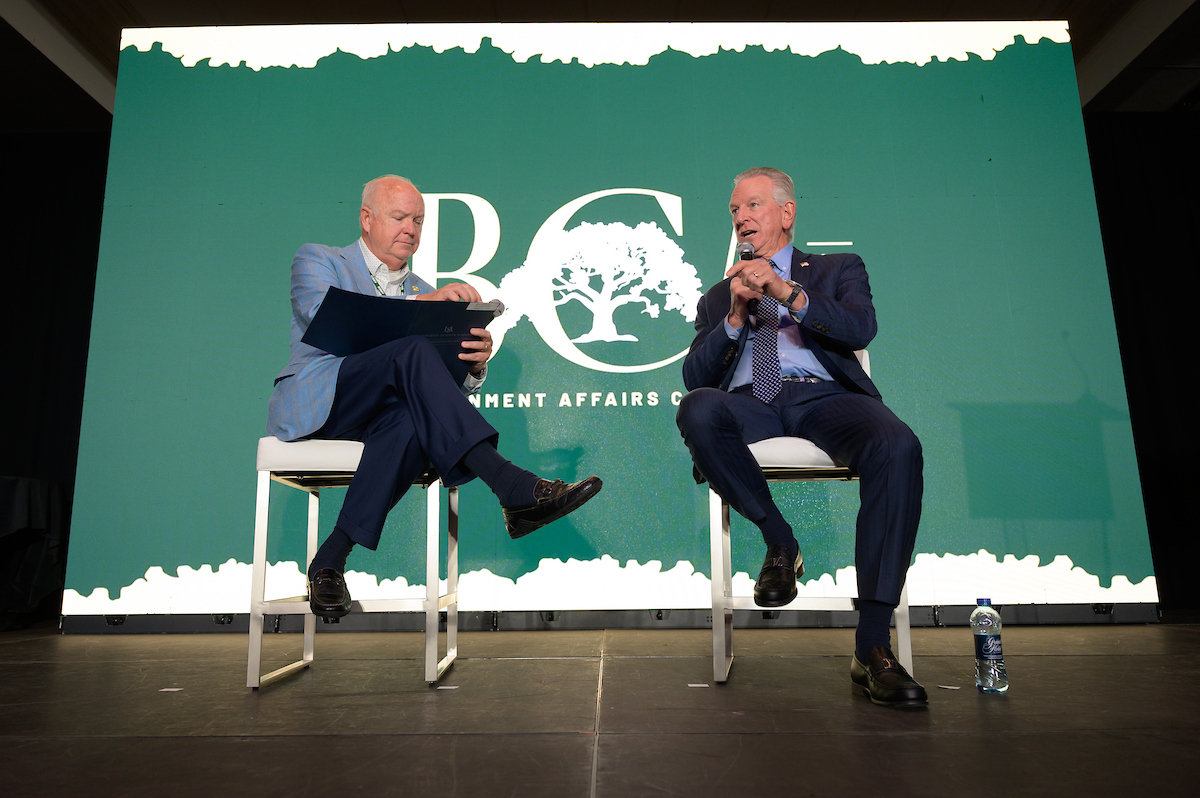
POINT CLEAR, Ala. – Republican gubernatorial candidate and U.S. Sen. Tommy Tuberville talked about hot-button campaign issues and reflected on his time in the Senate during an on-stage discussion with University of South Alabama President and former Congressman Jo Bonner.
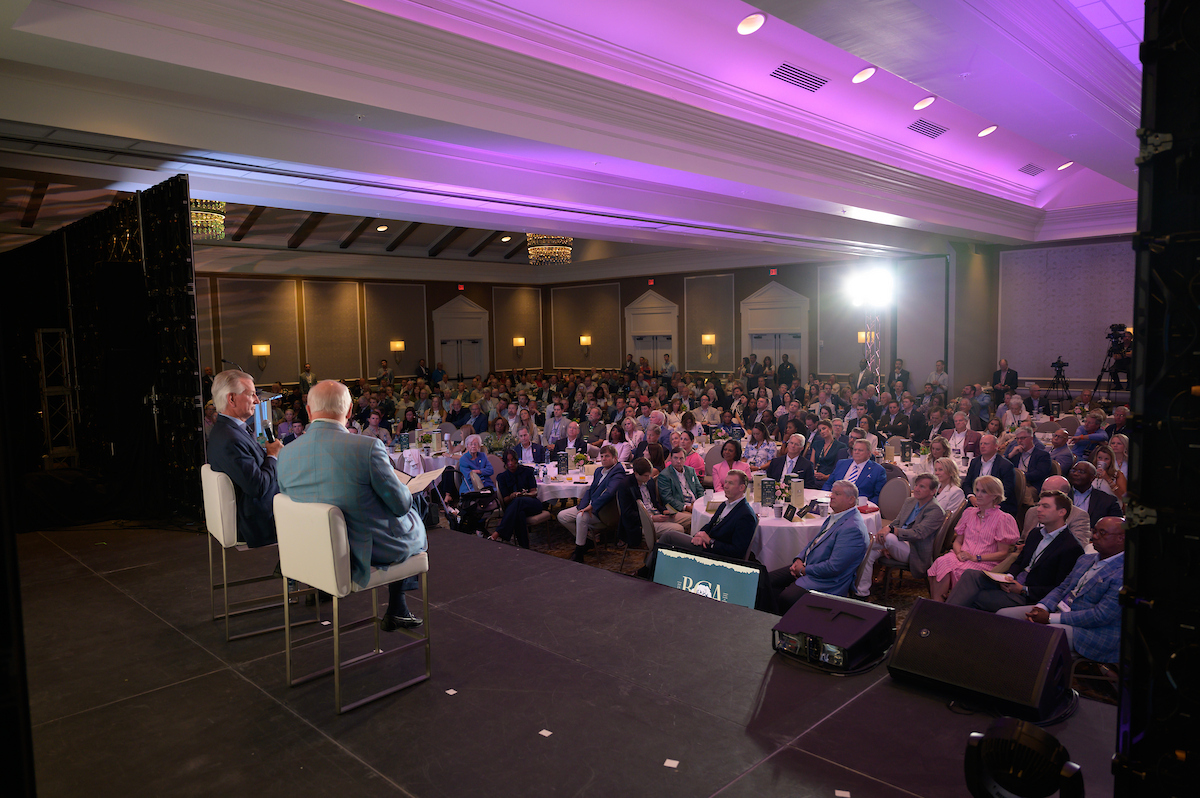
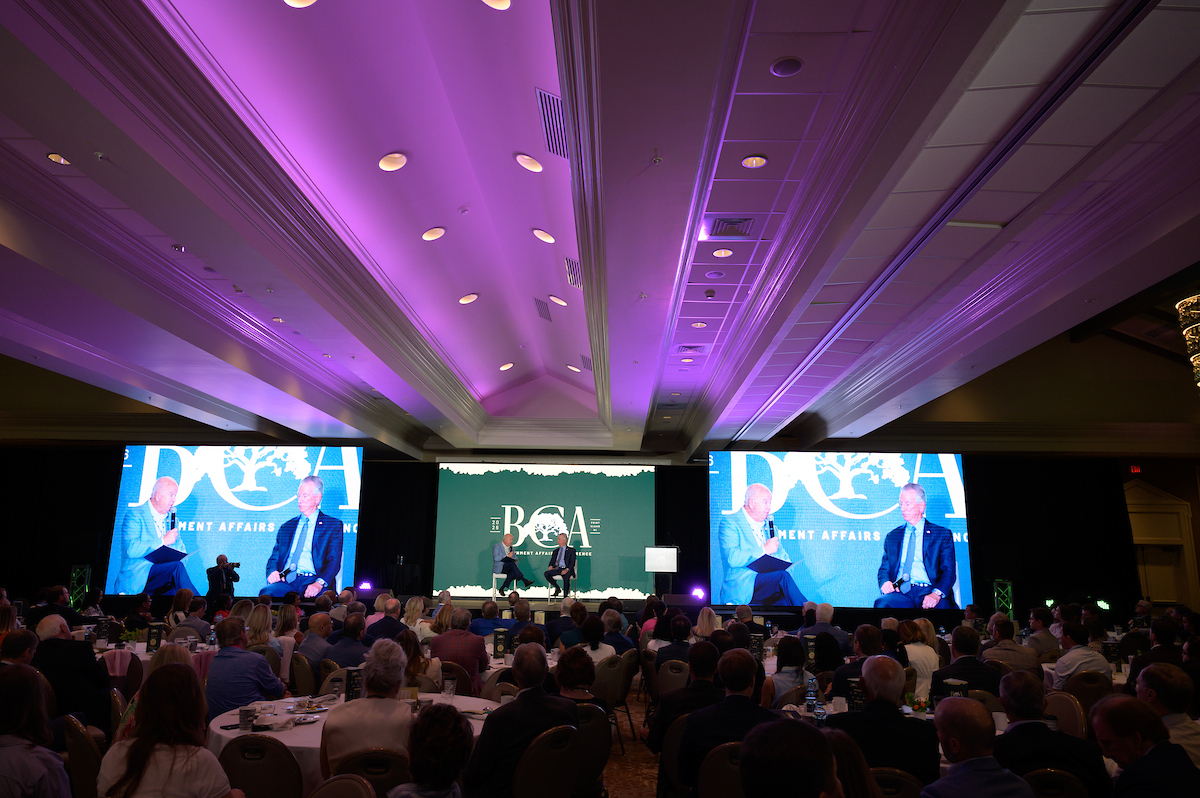
The panel was part of the Business Council of Alabama’s Government Affairs Conference in Point Clear. The morning program came after a busy week in Washington with the Senate voting into the night. U.S. Sen. Katie Britt was originally slated to join the panel but was unable to make it to the conference in time.
Tuberville used part of his time hitting on several of the most salient issues emerging in the governor’s race, including data centers, utility rates and artificial intelligence.
Data centers
Tuberville doubled down on his recently stated support for data centers, saying the large energy-intensive facilities are essential for Alabama’s growth.
He said municipalities should think about the tax incentives they can bring before imposing moratoriums or other policies that could slow their construction.
“They don’t come in and just put them up,” Tuberville said. “You’re going to make tax money. You’re going to be able to pay your law enforcement more. You’re going to be able to pay your teachers more. You’re going to be able to build things that you’ve never been able to build. Don’t get (your) cart before the horse.”
He said that even if some places decide not to allow data centers, Alabama has “a lot of rural areas to put them.”
Reiterating comments he made last month, Tuberville also suggested that opposition to data centers is the result of foreign and partisan influence.
“The deal is we’re getting a lot of negative propaganda from China,” Tuberville said. “We’re getting a lot of negative propaganda from Democrats because they take the opposite side of what we take.”
Democratic gubernatorial nominee Doug Jones has proposed a one-year moratorium on all data centers to give Alabamians time to ask questions and to allow for guardrails on the facilities. Tuberville said, “that’s the exact opposite of what we need to do.”
He said that President Donald Trump has encouraged Alabama to welcome data centers but not in a way that places the burden on Alabamians. Extending Alabama Power’s two-year rate freeze will also help with the public perception of data centers, Tuberville said.
“Actually, if we do it right, we can get the rates to drop because these companies will come in and put in their own power to these data centers, so it’s 100% the future,” the gubernatorial nominee said.
Without embracing data centers and artificial intelligence, Alabama will fall behind, he said. Data centers will help the state be able to “take care of the elderly, the veterans and the kids that need food,” according to Tuberville.
SNAP and artificial intelligence
Hitting on another emerging issue, Tuberville suggested that the impending cost-sharing requirement of the Supplemental Nutrition Assistance Program can be prevented by rooting out fraud with artificial intelligence.
“Starting next year, it’s going to cost us 200 million dollars if we don’t get our error rate down,” Tuberville said. “Error rate means that we got people on there that’s not supposed to be there. So, my opinion is the way we can handle fraud in Washington, D.C. and fraud in the state is AI because the human mind can’t keep up with all that money.”
Alabama Department of Human Resources officials have said payment error rates do not always fairly reflect how well the agency is administering the program and have stressed that they are not a measure of fraud. Payment errors can result from unreported household changes, worker mistakes or missing paperwork. Some are counted even when the household received the correct benefit amount.
The federal government is now shifting up to 15% of SNAP benefit costs, once known as food stamps, to states, depending on how accurately they administer the program. That change was made in Trump’s 2025 One Big Beautiful Bill Act.
Based on Alabama’s fiscal year 2025 error rate and Alabama’s $1.77 billion in SNAP benefits paid out last year, the state would be responsible for about $177 million in additional costs in fiscal year 2028. Under a separate change in the law, Alabama must also cover an additional $39 million in administrative spending annually starting Oct. 1. That cost is coming regardless of what happens with the error rate.
State lawmakers have urged Tuberville and others in the delegation to pursue a waiver allowing Alabama more time to absorb the major revenue hit that is expected next year.
Tuberville said the state needs to get the error rate down as the law intended.
“What’s going to happen is we’re going to run out of money,” he said. “Everybody said we don’t need to take these people off food stamps. Wait a minute, we got to make sure we can take care of people because we are in debt up to our ears.”
Citing Alabama’s low workforce participation rate, Tuberville suggested that training people and getting them to join the labor force will improve the situation.
“We’ve got to do our job statewide in the future to train people to get them out, get them going, and also make sure they understand that getting a helping hand is not a lifetime handout,” Tuberville said. “It is a few weeks, a few months. You can get back on your feet and get going again.”
He also mentioned implementing AI into K-12 education to prepare students for the future workforce.
Reflection on time in the Senate
As his time in Washington comes to a close, Tuberville reflected on what he’s learned in the past almost six years.
He said he learned almost everything he knows about politics, especially how to build trust with people, from former U.S. Sen. Richard Shelby.
“There’s a lot of trust that goes on up there, and so most of the things that I learned that I used for the last few years, even after Senator Shelby, is how he handled himself,” Tuberville said. “You got to use the rules to your advantage, and my God, that guy did. He knew how to use it and did it well.”
He thanked his staff, fellow U.S. Sen. Katie Britt and Shelby for their help during his time in Congress. Tuberville said that despite any mistakes he’s made, he hopes Alabamians will think he did a good job.
“The one thing I hope people notice, I didn’t go up there to be a senator,” he said. “They all call me Coach. I ran because I want to help people, and that’s what this is all about. It’s about helping people, and as Governor Ivey said, help everybody. You do it for everybody.”
Republican U.S. Rep. Barry Moore and Birmingham attorney Everett Wess will face off in the Nov. 3 general election to replace Tuberville.