
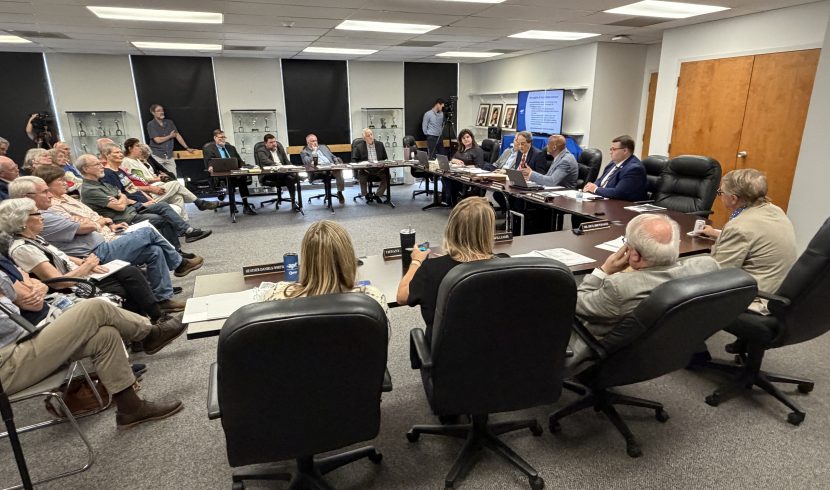
BIRMINGHAM, Ala. – Alabama Public Television’s governing bodies moved Tuesday toward hiring a political polling and consulting firm for a statewide public opinion survey, despite an unfinished contract, disagreement over funding and uncertainty about what they were voting to approve.
The survey grew out of earlier discussions about ending or reducing APT’s ties to PBS.
In November, Gov. Kay Ivey urged the Commission not to disaffiliate from PBS without first surveying Alabama residents. Commissioners later agreed to continue with PBS, and by April, meeting minutes described the proposal more broadly as a public opinion survey.
During four hours of meetings Tuesday, members disagreed over what they were voting to approve and whether the survey remained connected to previous efforts to reduce or end APT’s PBS affiliation.
The Alabama Educational Television Commission oversees APT’s operations and programming. The related Alabama Educational Television Foundation Authority manages donated and other funds used to support the network. All commissioners, who are appointed by the governor, serve on the Foundation board, which includes additional members.
The Foundation Authority took up the funding question after the Commission meeting. Acting chair William Green said they were deciding only whether its Rainy Day Fund would pay for the survey if APT ultimately reached an agreement with McLaughlin & Associates.
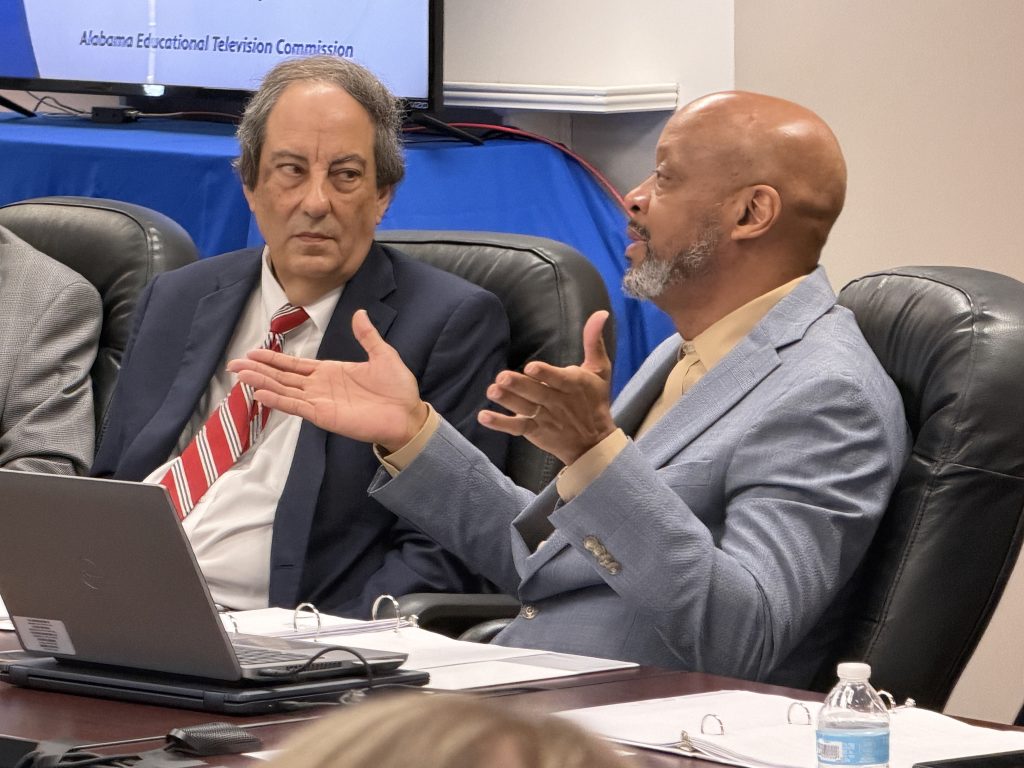
“We’re not committing ourselves to any contract,” Foundation board member Dick Brewbaker said.
Green agreed, saying the final price was unknown and the project might not proceed if questions about the agreement could not be resolved.
Ferris Stephens, who chairs the Commission and serves as a Foundation board member, then offered a broader motion. It called for APT to hire and contract with McLaughlin, pay for the survey from the Rainy Day Fund and budget for a similar poll about a year later.
Contract extends beyond survey
APT Chief Financial Officer Melissa Austin said staff received the proposed contract July 16 and had not completed a thorough review.
The $47,400 proposal, plus possible travel expenses, called for a survey of 600 people lasting about 20 minutes and containing 45 to 50 questions.
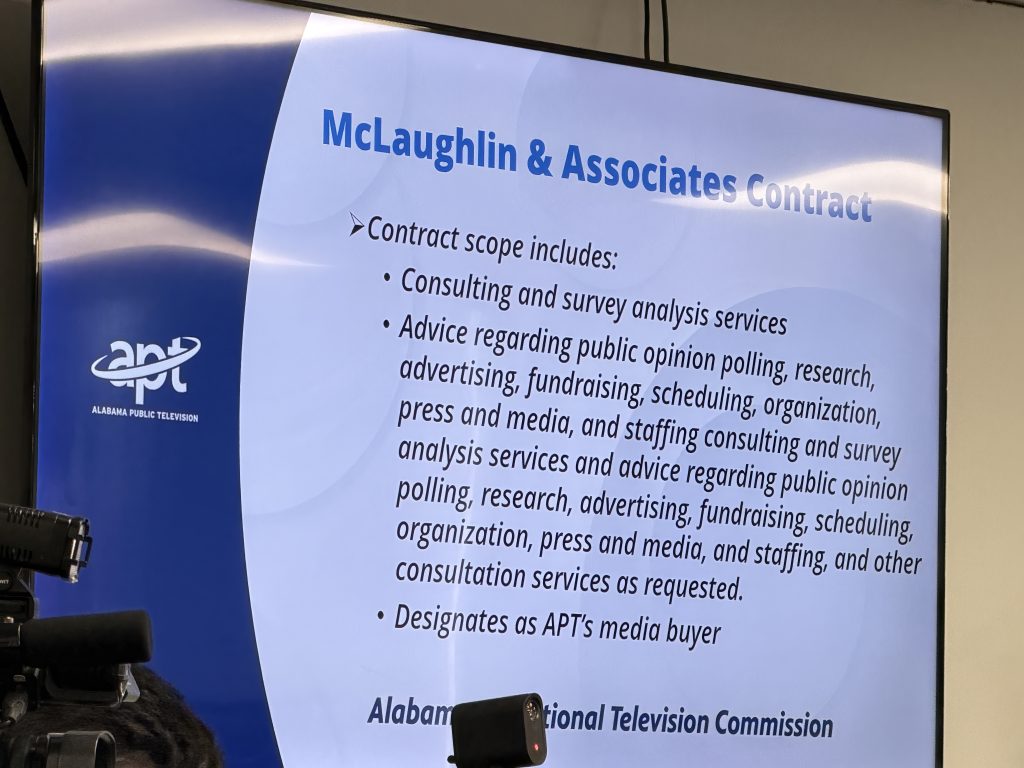
But the agreement went well beyond conducting and analyzing a poll. It included consulting on advertising, fundraising, scheduling, staffing, press and media strategy, along with language designating McLaughlin as APT’s media buyer.
It also covered questionnaire development, sample construction, phone and text interviews, reports, statistical analysis and continuing consultation.
The contract referred to using a voter file for text surveys, although Austin said McLaughlin had agreed to survey all Alabama adults, not only registered voters.
Stephens called the document a “boilerplate” contract and said the unrelated provisions did not concern him.
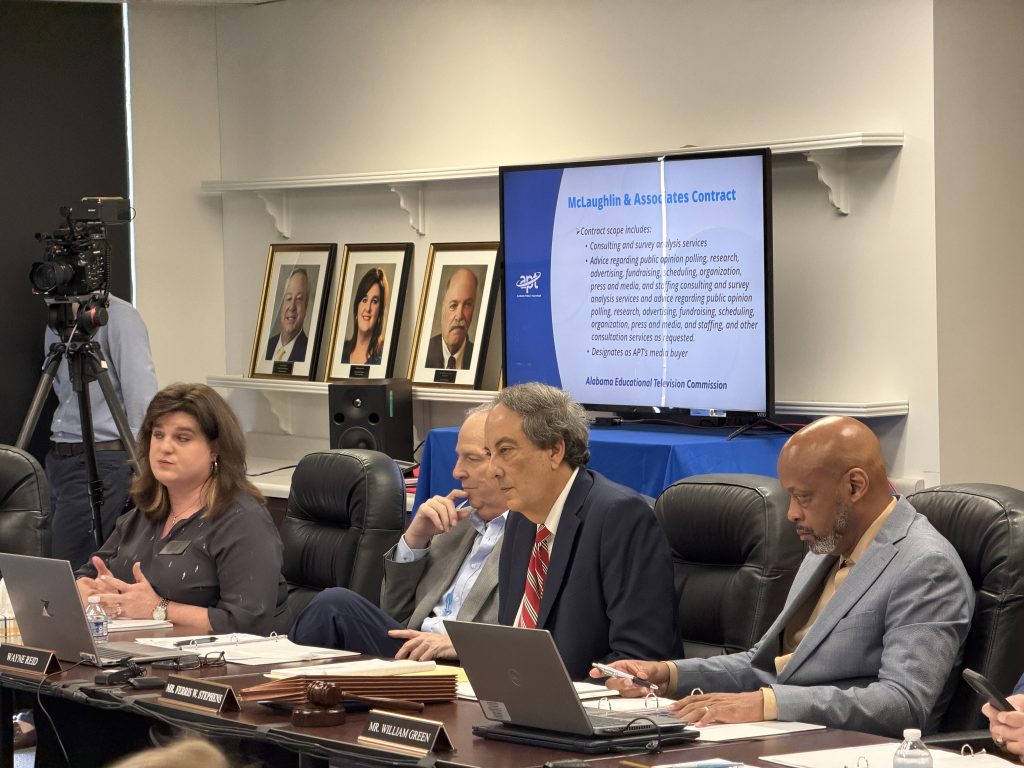
Austin and Green said the final agreement should cover only the survey and analysis APT intended to buy. Green said removing the additional services could reduce the price to as little as $27,500.
The Foundation approved Stephens’ motion 6-2, with Pete Conroy and Logan Glass voting no. The board plans to approve a final cost not exceeding $47,500 at its next meeting.
Emergency fund questioned
The Foundation’s investment policy describes the Rainy Day Fund as a reserve for emergency purchases that cannot be covered through the current budget, new revenue or spending cuts.
The policy says the fund can be used for proration, transmission outages and the loss of APT’s federal operating grant. APT lost that grant after Congress ended funding for the Corporation for Public Broadcasting.
When Conroy asked whether the board was calling the poll an “emergency survey,” Stephens did not say it met the policy’s definition.
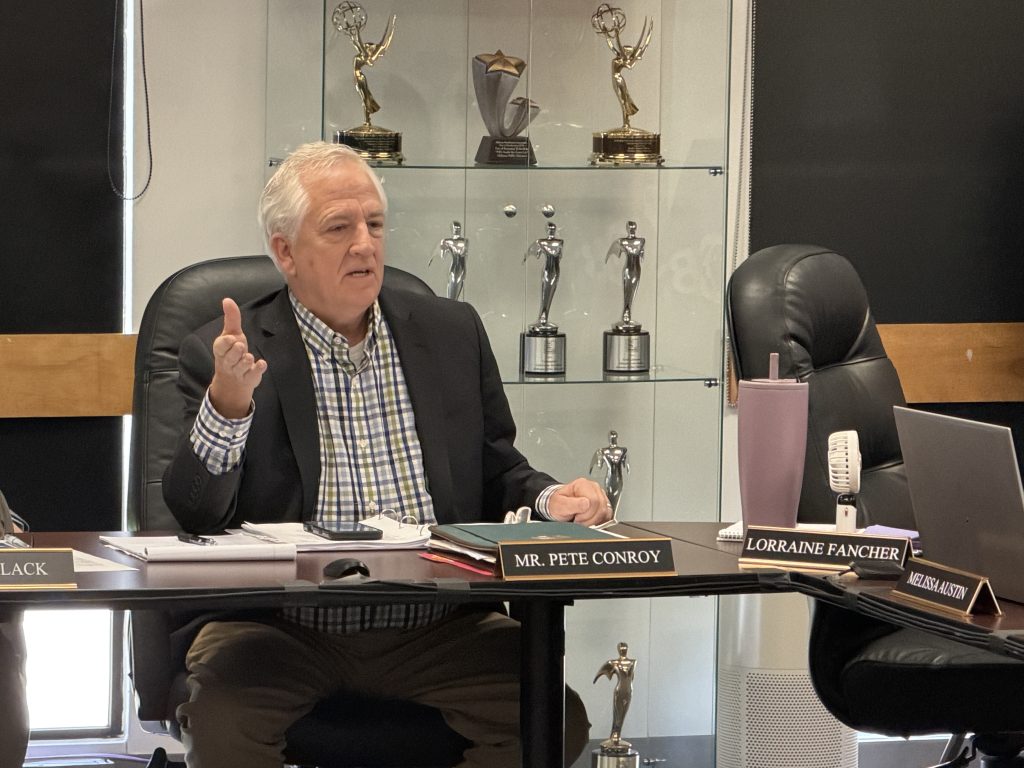
“I was about to say the policy is determined by the foundation itself, and by the same authority that created – whoever it is created that policy in 2010 – has also the authority to also use it any way they want by this very same authority,” Stephens said.
The Rainy Day Fund held about $4.7 million at the end of the third quarter. The Foundation’s endowment held just under $6 million.
Austin asked whether the survey could instead be included in the next budget, noting that the Rainy Day Fund was not used after federal cuts led to 11 layoffs.
Brewbaker said the fund could have covered the jobs only temporarily unless federal support was expected to return.
The approved motion calls for the first survey to be paid from the Rainy Day Fund and a similar poll to be included in the fiscal 2027 budget.
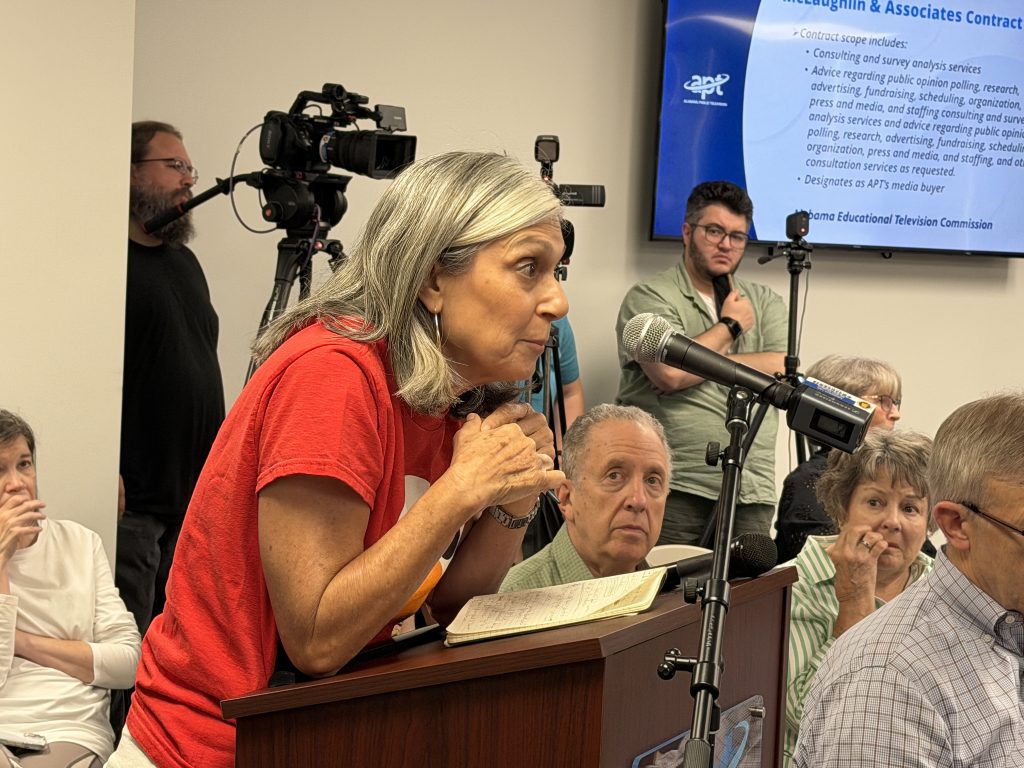
During public comment, longtime APT supporter Elaine Witt criticized using Foundation reserves outside the normal budget process.
“That is contempt for your donors,” Witt told the board.
PBS connection disputed
Public commenters argued that the survey was unnecessary after the Commission agreed to remain affiliated with PBS.
Green repeatedly said the poll was not intended to determine whether APT should leave the network.
He later acknowledged in an interview that disaffiliation “probably did come up at first,” when commissioners were considering PBS costs and the loss of federal support.
Green said commissioners later learned PBS supplies about 90% of APT’s programming and could not realistically be replaced. He said the survey now is intended to learn what Alabama residents want to watch and how APT can better serve them.
At the same time, Green said he would like to reduce APT’s reliance on PBS programming from about 90% to 30% or 40% over five years so the station would be better prepared if PBS ceased to exist.
Stephens said the survey would help the Commission fulfill its statutory duties. Alabama law directs the Commission to “survey, study and appraise” the need for an overall plan for noncommercial educational television.
Conroy said he did not accept that PBS affiliation was no longer part of the survey’s purpose.
“I’m certain that it has something to do with his desire to disaffiliate with PBS,” Conroy said of Stephens. “There are a lot of disingenuous things happening today.”
September meeting approved
Another dispute emerged when Stephens pushed to move the Commission and Foundation’s next meeting to Sept. 29 rather than wait for its regular fourth-quarter meeting later in the fall.
Staff said some employees needed for the discussion would not be available that day. Conroy objected that the meeting would fall in the same quarter as Tuesday’s meeting and would not replace the required fourth-quarter meeting.
The majority approved the earlier date anyway. The boards are expected to consider a revised contract and final survey price then.
Afterward, Conroy offered a blunt assessment of the day.
“I’ve never seen so many shenanigans and political trickery as took place during today’s meetings.”
Trish Crain is a contract employee of the Alabama Public Television Educational Foundation.