
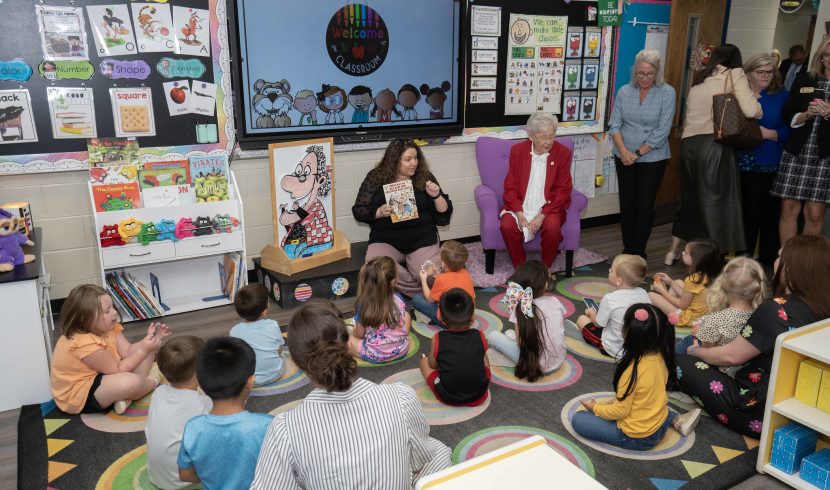
BIRMINGHAM, Ala. – Alabama will add 64 First Class Pre-K classrooms for the 2026-27 school year, expanding a nationally recognized program that currently serves 24,168 children in 1,521 classrooms statewide. The new classrooms could serve as many as 1,152 children.
But even with the new classrooms, thousands of children could remain on waiting lists, a problem researchers at the University of Alabama outlined in a 2025 study.
Most of the new classrooms will be located in counties recently identified by researchers as having particularly high unmet demand for First Class Pre-K.
Forty-nine of the 64 classrooms, or 77%, will go to counties included on a 20-county priority list developed as part of an access study commissioned by the Alabama Department of Early Childhood Education last year. Not every priority county received a new classroom, however, and some counties received more than one.
Gov. Kay Ivey announced the new classrooms Wednesday, saying the expansion would allow more children to enter kindergarten prepared to learn.
“Providing Alabama’s children with a strong start remains one of our state’s most important investments,” Ivey said in a news release. “These new First Class Pre-K classrooms will help more children enter kindergarten ready to learn and succeed, while strengthening the foundation for Alabama’s future.”
Children who attend high-quality pre-K programs generally enter kindergarten with stronger early language, literacy and math skills than comparable children who do not attend preschool, national and Alabama-specific research has found.
Those foundational skills help children follow classroom instruction, communicate their needs and begin learning to read and work with numbers.
The state has increased both the number of classrooms and the amount of financial support provided to individual programs in recent years. During the 2022-23 school year, lawmakers increased appropriations to allow for a 30% increase in classroom grants to help meet rising costs.
New classrooms have recently been eligible for grants of up to $125,000, while annual awards for continuing classrooms vary based on the state’s grant structure and program circumstances.
Tracye Strichik, executive director of VOICES for Alabama’s Children, said recent appropriations demonstrate lawmakers’ sustained commitment to the program.
Lawmakers allocated nearly $210 million to the Office of School Readiness, which administers First Class Pre-K, for fiscal year 2027, about $12.4 million more than the $197.4 million appropriated for the current fiscal year.
The additional funding has supported classroom expansion, higher grant awards, teacher recruitment and improvements that have helped Alabama maintain the quality of its program, she said.
“As we continue to expand access, the next challenge is addressing barriers such as available classroom space, transportation, before- and after-school care, and workforce capacity so more Alabama families can benefit from this nationally recognized program,” Strichik said.
Those barriers were also identified in the University of Alabama access study.
While Alabama has maintained its record on meeting quality benchmarks, access remains the program’s central challenge.
The National Institute for Early Education Research, which has recognized First Class Pre-K for meeting its high-quality standards, has also pointed to access as the central remaining challenge for Alabama’s program.
In its most recent State of Preschool report, NIEER found that Alabama served 24,238 children during the 2024-25 school year, or about 40% of the state’s 4-year-olds. Enrollment declined by 402 children from the previous year, even as state spending per enrolled child increased.
Quality-wise, Alabama met all 10 of NIEER’s research-based quality benchmarks for the 20th consecutive year. The benchmarks include teacher education and training requirements, limits on class size and staff-to-child ratios, early learning standards, health screenings and systems for monitoring classroom quality.
The state’s long-running record on quality distinguishes Alabama nationally, but NIEER’s figures show that a majority of Alabama’s 4-year-olds still do not participate in First Class Pre-K.
Using 2024-25 data, the University of Alabama researchers found that access varied widely by county, ranging from 19% of 4-year-olds in Shelby County to 95% in Marengo County.
Urban and fast-growing suburban counties generally had lower enrollment rates and larger waiting lists, in part because demand had grown faster than the availability of classroom space.
Researchers identified 20 counties with both below-average enrollment and above-average waiting-list rates and recommended prioritizing them for future expansion.
Although the new awards are heavily concentrated in counties identified as having high demand and relatively low access, not all 20 priority counties received a classroom in this round.
The study found that approximately 4,100 children were on waiting lists in the priority counties. Researchers estimated that eliminating the entire waiting list in the 20 priority counties would require 229 classrooms and would still raise statewide access only to about 48%.
A subsequent ADECE fact sheet recommended adding approximately 250 classrooms as part of a broader effort to raise statewide access from roughly 41% to 50%.
Moving beyond that level, researchers said, would require larger investments in facilities, teacher salaries, transportation, extended-day care and workforce development.
Alabama has previously identified serving 70% of the state’s 4-year-olds as a long-term goal. Reaching that level would require substantially more than adding classrooms through annual grant rounds, the study concluded.