
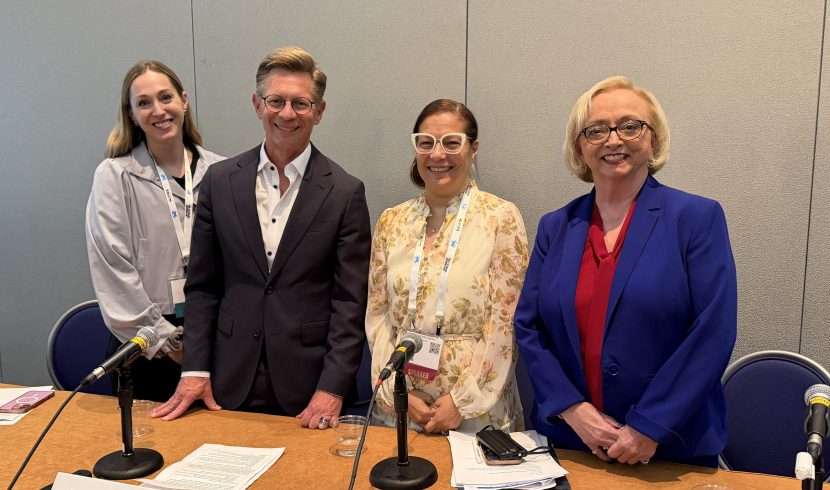
BALTIMORE – Alabama’s statewide approach to improving elementary math instruction and achievement was one focus of a national discussion Thursday about how states are using their authority to shape education.
State Superintendent Eric Mackey joined the education chiefs of Maryland and Rhode Island at the Education Writers Association’s National Seminar in Baltimore, where the three discussed the role states play in instruction, accountability and student outcomes.
Mackey spent much of the discussion describing Alabama’s approach to improving math instruction and achievement, work that has gained national attention in recent years.
Rather than relying on each local school system to develop its own strategy, Alabama has rewritten its math standards, selected instructional materials, expanded professional development and begun placing math coaches in every K-5 school, he explained.
Alabama also is requiring universities to change how they prepare elementary teachers to teach math, he added.
Until now, Mackey said, elementary teacher candidates could satisfy their math requirements by taking general college courses that did not necessarily prepare them to teach elementary math.
Beginning this fall, their required courses will focus specifically on elementary mathematics and how to teach it.
“We’d rather have a fourth-grade math teacher who really deeply understands fourth-grade math and how to teach fourth-grade math than to have two levels of college calculus,” Mackey said.
Alabama’s ability to carry out that kind of statewide initiative led Mackey to reflect on the state’s longstanding belief in local control.
“I used to think that we were a local control state,” Mackey said.
But after working with education chiefs from around the country, he said he came to see Alabama as more state-directed than he once realized.
He noted that the Legislature sets teacher salary schedules, educators across the state participate in the same health insurance plan, and the state sets academic standards and directs major programs.
That structure can be beneficial when statewide change is needed, he said.
“I think it is faster to do statewide change when your folks are already used to the state directing your programs,” Mackey said.
By contrast, Mackey said Alabama’s education governance is more fragmented than in some other states, with separate departments overseeing pre-K, K-12 schools, two-year colleges, universities and workforce development.
He said putting more of those systems under one roof might make it easier for them to work together, though he acknowledged it might not work as well in practice as it sounds.
Maryland State Superintendent Carey Wright, who previously led Mississippi’s public schools as the state achieved dramatic gains in literacy, said accountability systems are another powerful way states direct local action.
“Accountability to me drives behavior,” Wright said. “Whatever behavior you want to see happen in schools, you insert that in your accountability system.”
Rhode Island Education Commissioner Angelica Infante-Green described her state’s attendance dashboard, which brings schools, families, elected officials and other agencies into efforts to reduce chronic absenteeism, as another example of a state coordinating action around a shared problem.
The panelists also discussed the Trump administration’s promise to return education authority to states. They said states already held most of that authority, and little has changed.
“Nothing has been returned to the states,” Infante-Green said. “We’re doing the same work that we have always been doing.”
Mackey said three federal laws still govern most of the state’s federally funded education work: the Every Student Succeeds Act, the Individuals with Disabilities Education Act and the Perkins career and technical education law.
None has changed, he said, and there is no proposal in Congress to change them.
Mackey said that even when states gain some flexibility through federal waivers, they still must meet the same responsibilities and accountability requirements already in those laws.
Although the chiefs agreed that the federal government has not meaningfully expanded states’ authority, Mackey said federal decisions still can have major consequences for schools.
He pointed to a federal decision last year to withdraw previously approved commitments involving pandemic-relief funds. Education chiefs from Republican- and Democratic-led states pushed back together, he said, and federal officials eventually reversed the decision.
“What’s right is right, what’s wrong is wrong,” Mackey said. “It doesn’t matter what party’s in charge.”
“When we all stick together and focus on this – it’s about students and schools, it is not about party affiliation – we can move things,” he said. “But we have to work on it together.”