
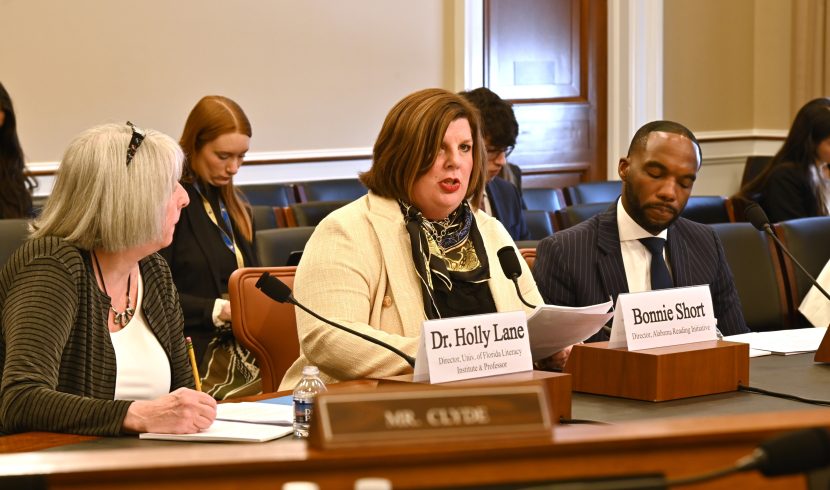
WASHINGTON — Alabama’s efforts to improve literacy were on full display on Capitol Hill Tuesday as Bonnie Short of the Alabama Reading Initiative detailed to House appropriators how the state’s efforts have helped students become better readers.
As states look to overhaul how they teach students to read, lawmakers examined the “science of reading” and the federal government’s role during a House Appropriations subcommittee hearing, led by Rep. Robert Aderholt, R-Haleyville.
The “science of reading” approach involves five pillars for teaching children to read: phonemic awareness, phonics, fluency, vocabulary and comprehension.
Alabama’s reading gains have garnered national attention recently as the state’s fourth-grade reading ranking has risen from 49th in 2019 to 34th in 2024. A fact that was mentioned repeatedly during Tuesday’s hearing.
“This record of success also underscores the importance of a bottom-up approach to education reform, rather than a top-down mandate from Washington,” Aderholt said.
Short, who testified in front of the subcommittee, said Alabama’s success has stemmed from strong collaboration between education leaders and state leadership.
“…it comes from coherent policy paired with long-term, job-embedded implementation supports that help educators deliver strong instruction, identify risk early and respond quickly when students need additional support,” Short said.
Alabama’s reading policy has focused on improving five key areas. Those include strengthening core literacy instruction, investing in professional learning, targeting assessments, providing students additional support and maintaining literacy coaches, Short said.
Aderholt asked the witnesses, who also included Larry Saulsberry of Huntsville City Schools and Holly Lane from the University of Florida Literacy Institute, what specific literacy investments can yield the highest return for taxpayers.
“One of the strongest elements is the ongoing professional development we have with local reading specialists or coaches in the building of every kindergarten through third-grade school,” Short said. “We also have regional specialists that go in side by side.”
In answering Aderholt’s question, Lane said that teachers and district administrators need more on-the-ground training, such as what’s available in Alabama, on the best evidence-based approaches for teaching students how to read. A deeper understanding of the science behind reading methods on a national scale could also help other states to replicate the success seen in southern states, she added.
“Every state is attempting to do what Mississippi and Alabama and Louisiana have done, at some level,” Lane said. “Most don’t even know where to begin because there’s so much that needs to be done.”
The Alabama Literacy Act of 2019 requires third-grade students to pass a reading assessment before moving on to fourth grade. The law also prescribes support for students in kindergarten through third grade who are struggling and training for teachers on how to help them. It also requires college teacher preparation programs to provide elementary teacher candidates with training in the science of reading.
Saulsberry, who leads literacy initiatives in Huntsville, said literacy investments in students beyond the third grade are also important.
“We’re working to close reading gaps by continuing the implementation of student reading improvement plans beyond grade three, thus funding support is needed to ensure access to high-quality instruction, resources and interventionists for fourth and fifth graders.”
Gov. Kay Ivey has earmarked $45 million in state funding in her FY27 budget proposal for help for older elementary students to learn to read. That’s funding the State Board of Education has requested in recent years.
As the Trump administration has fought to dismantle the Department of Education and strip funding from grant programs, Democrats honed in on how important federal dollars are for educational research, which helped bring about the “science of reading” approach.
“If you want to continue understanding how kids learn to read, we need to make sure that we’re providing the funding for that research,” Lane, who has received grants to study literacy instruction, said.
The ranking member, Rep. Rosa DeLauro, D-CT, also emphasized that there is a “federal role” in ensuring that practices that are “working nationwide….providing the biggest and broadest effect on reading” are implemented across the country.
At the end of the hearing, DeLauro also called for Congress to reconvene the National Reading Panel to study and update the best methods for teaching students how to read. In 2000, the panel evaluated and released a report on reading instruction.
Alabama Daily News’ Trisha Powell Crain contributed to this report.