MONTGOMERY, Ala. – Alabama’s economic outlook is changing, and budgets will get tighter.
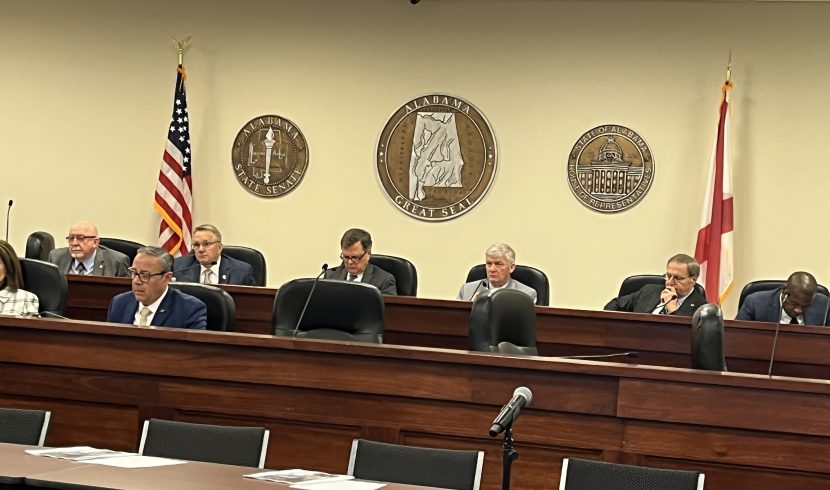
That was the message from the state’s top financial officials, who shared a somewhat gloomy forecast with a joint committee of lawmakers on Wednesday in Montgomery.
Senate Education Budget Chairman Arthur Orr said he sees cloudy skies looming, but can’t yet predict what’s coming.
“You don’t know exactly how dark the clouds will get, or how strong the rain may be, but we do see clouds on the horizon.”
Senate General Fund Budget Chairman Greg Albritton shared Orr’s view, using a different analogy.
“We’re coming to where the lane changes are, and the lanes are being closed, and the lights are shining,” he said.
General Fund woes
The General Fund budget – which pays for Medicaid, corrections and other state agencies – is where the most immediate pressure is.
Finance Director Bill Poole told lawmakers Gov. Kay Ivey’s proposed $3.69 billion General Fund budget calls for level funding of all state agencies when it comes to operations and maintenance. It reflects a $28.5 million drop from the current year’s $3.71 billion budget.
The tightening is due to an expected 4.2% decline in revenue for FY27, which begins Oct. 1, 2026. The drop isn’t in core revenue streams, Poole said, but instead comes from a sharp decline in interest earned on the state’s deposits.
Interest was not historically a large part of the general fund’s revenue, between $10 million and $60 million from 2016 to 2022. But since 2023 – when federal pandemic relief funds were distributed to states and sat waiting to be spent – interest earnings have brought in between $400 million and $560 million each year. The current year’s interest revenue is expected to be $374 million. The estimate for 2027 is $124 million, officials said.
In the future, interest is expected to move more toward historical levels and there is no replacement for those funds, Poole said.
“That is going to be the challenge as this correction that we forecast for some period of time occurs,” he said.
The only increases Ivey proposed for the General Fund are a 2% raise for state employees, expected to cost $16 million, and a $28 million increase to cover rising health insurance costs.
Click here for Poole’s presentation.
The General Fund is also facing pressure from federal funding changes, including potential cuts to public health and new cost shifts in programs like the Supplemental Nutrition Assistance Program, formerly known as food stamps. Because those federal changes are still being finalized, officials said, the total impact is not yet known.
Legislative Services Agency Deputy Director Kirk Fulford told lawmakers Alabama will have to absorb about $40 million in additional SNAP administrative costs as more of the burden shifts from the federal government to the state. Poole said Ivey’s budget proposal includes funding to cover that expense.
Education funds stable, still growing
There was better news on the education side, which funds pre-K, K-12, higher education and other education-related agencies. While the years of unusually large revenue growth are over, Fulford said the Education Trust Fund is still growing.
“Coming back down off the ‘sugar high,’ we’ve got a moderate revenue growth of 2½%,” he said. With income and sales taxes making up 93% of ETF revenue, Fulford said that means the fund closely follows the broader economy.
“When the economy is going great, you’ll see it (in the ETF), but when the economy goes bad, you’ll also see it there, and you’ll see it really quick,” he said. The state has built up about $3 billion across multiple education reserve funds that can be tapped when needed, and he expects some of that money to be used for education priorities.
Click here for Fulford’s full presentation.
Against that backdrop, Ivey proposed a $10.5 billion education budget for FY27, the largest in state history.
Under state growth limits, the budget can increase by no more than 5.75% – or $570 million – over the current $9.9 billion budget, and Ivey’s proposal hits that ceiling.
The state’s K-12 schools and higher education would each receive a 5.8% increase over the current year, while other education agencies would see a 5.2% increase:
- K-12 schools: $7.1 billion, up from $6.7 billion
- Higher education: $2.7 billion, up from $2.6 billion
- Other agencies: $646 million, up from $615 million
Lawmakers also face several big decisions within the education budget, including how to sustain early literacy and numeracy programs, how to handle a $380 million request from the teachers’ health insurance program, and whether to provide another round of teacher pay raises.
Ivey’s proposal addresses all three: a 2% teacher pay raise costing $99 million, and $210 million toward the PEEHIP request. That leaves the PEEHIP board to determine how to cover the remaining $170 million if lawmakers keep the proposal intact.
One of the largest single increases in the budget is a $100 million allocation for the CHOOSE Act education savings account program for the 2027 budget year, which covers the first part of the 2027-28 school year. That brings the total CHOOSE funding to $250 million, on top of $150 million lawmakers had already set aside for 2027-28, when all students become eligible for the $7,000 voucher for private schools regardless of income.
Four-year universities would receive between a 4% and 8% increase in operating funds, while the state’s two-year college system would see an overall 5.75% increase.
Ivey also proposed a $420 million supplemental allocation of surplus revenue from the 2025 tax year, including:
- K-12 schools: $274 million
- Higher education: $109 million
- Other education funding: $36 million
Fulford and Poole praised lawmakers for budgeting conservatively during the recent years of strong revenue growth, but warned that caution is becoming even more important.
With federal funds now making up about 40% of General Fund agency spending, Fulford said even small federal changes could quickly overwhelm Alabama’s state revenues.
“‘(Fiscal) ’27 is going to be tough enough,” Fulford said. “‘’28 is going to be really tough.”
Those challenges will be front and center Jan. 26, when state agency heads present their General Fund budget requests to lawmakers.
Updated 12 p.m. to clarify the amount of interest on state deposits could change.