
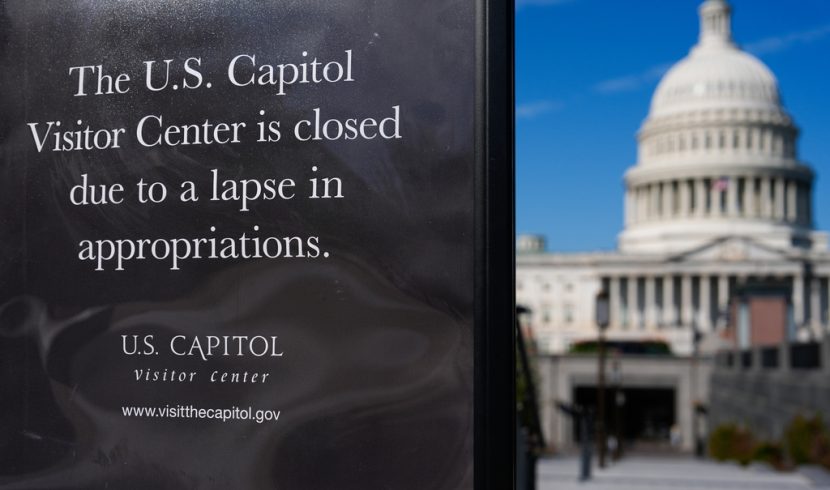
We’re twenty-seven days into the longest full government shutdown in history and you’ll be hard pressed to find a convincing argument we’re anywhere near the end. You won’t get one here.
Sure, things change fast. But elected officials work on a predictable political incentive structure, and there simply isn’t any compelling reason for one side to capitulate to the other. Both sides think they’re winning.
Democrats insist they have the moral high ground: they’re leveraging the shutdown to extend expiring subsidies for health insurance.
Senate Minority Leader Chuck Schumer gaffed that “Everyday gets better for us,” and polling shows he might be
right—though not by a lot. For their part, House Republicans have the rhetorical advantage.
Their oft-repeated mantra of “we’ve done our job” has the dual political advantages of being simple to say while also being true, in so much that House Republicans passed a Continuing Resolution, or CR, to keep the
government operating until Nov 21.
Representatives took that vote on September 19 and promptly left town. They haven’t been back since. (Many House staffers, to their credit, are working through the shutdown despite not receiving pay.)
On the other side of the Capitol, Senate leaders are flirting with the definition of insanity. Headed into last week, the Senate had voted eleven times on the same House-passed CR. Democrats blocked each
attempt.
In the real world, people who repeat the same thing over and over expecting a different result go somewhere to get help. In Congress, that’s how you prove a point.
So, Senators filed into the chamber on Wednesday to log their 12 th failed vote, and then Thursday headed to Reagan National Airport hoping unpaid air traffic controllers had shown up for work.
Another person jetted out of town last week: President Trump, whose role in the shutdown has been fascinating to watch. Typically, the president and administration officials would be amongst the loudest voices clamoring to reopen the government they run. This go around, Trump himself has been largely disengaged, deferring to Speaker Mike Johnson and Majority Leader John Thune.
Meanwhile, his administration views the shutdown as an opportunity to advance its anti-bureaucracy agenda. Boarding Air Force One for a six-day trip through Asia amid a shutdown would have been unheard of before.
Things are different now. The bottom line: We know the shutdown won’t end before Trump’s return Friday. Beyond that, not much is likely to happen until something changes the current political dynamic.
Entering November, there are a host of potential pain points on the horizon that just might. Here are a few to watch:
– Missed paychecks start adding up. Wednesday is officially payday for the government, so by the end of the week approximately 2.3 million full time civilian employees will have missed a month’s pay. Eighty percent of those workers live outside the National Capital Region, and if stories of missed mortgages, late rent payments, or lost childcare spike, pressure to compromise may increase. Active-duty military personnel were paid mid-October using a one-time transfer of funds from defense R&D accounts. Late Friday, a donor ponied up $130 million to help cover the next check, but that only comes out to about $100 per servicemember. Paying the military via charitable gift is not a good look for America.
– Sticker shock from health insurance enrollment. Nov. 1 starts open enrollment for Affordable Care Act marketplaces, through which 24 million Americans now enroll in health coverage. “If the extra Obamacare subsidies expire, people making more than $65,000 will have to pay the full cost of their insurance,” The New York Times reports. In 2025, that averaged $7,428 a year. It’ll be higher in 2026 for most. Democratic leaders may calculate that the shutdown and the sticker shock together have sufficiently propelled health care to the top of voters’ minds headed into mid-term season, claim victory, and move on.
– SNAP benefits stop. The USDA is warning that funding for food stamps will run out in November. Forty-two million Americans receive an average of $188 per month in Supplemental Nutrition Assistance Program benefits, of which 750,000 are Alabamians. Some Members of Congress are urging the USDA to tap a contingency fund to provide additional assistance, though the funds available won’t go far.
– Military impacts become more obvious. Beyond the issue of pay, the cascading negative effects on the military may become more apparent. Maintenance on aging equipment and property is being deferred. The execution of new contracts and the renewal of existing ones is slowing. Defense spending directed to small businesses is likely to drop off, harming firms and resulting in laid off workers. Military Reserve components are cancelling scheduled drill activities for the second time, removing a source of income for Reservists. The training gap caused by these delays will require some units to double up or extend drills in the spring, impacting family schedules and small businesses across the country.
– Widespread FAA flight delays. It hasn’t happened yet, but widespread disruptions caused by out-of-work FAA employees would complicate people’s lives and impede economic activity. A broken travel system is just the sort of thing that generates a flood of angry calls to congressional offices. Transportation Secretary Sean Duffy said yesterday that air traffic controllers “are wearing thin” and warned of more delays. Looking ahead, November 30 is expected to be the heaviest travel day of the year.
– Major market disruption. The stock market is remarkably resilient in the face of government shutdowns, with the S&P 500 rising during past shutdowns more than it fell. Elected officials have considerable leeway when 401k balances are up week after week, but that patience will erode should any of the above factors contribute to economic hardships that become kitchen table issues. One problem: a lack of reliable economic data. Furloughed Bureau of Labor Statistics workers were brought back to work to produce a key inflation report, but only because it was required to calculate cost-of-living adjustments for social security. BLS is unlikely to release Consumer Price Index data in October, and reports on employment, wages, and retail sales are in jeopardy.
– Something bad happens. There is always the possibility that an adversary makes an aggressive geopolitical move that shocks the senses and forces Congress to hastily reopen the government in the name of national security.
– Trump decides to be the hero. A very senior Democratic Member of Congress told me last week that some on his side of the aisle believe Trump may return from overseas to play the role of hero, casting aside House Republicans and demanding the government open its doors. That sounds like wishful thinking to me.
Perhaps a compromise can be made when the political calculations change, but Democratic leaders surely know that shutdowns rarely produce results. That didn’t happen in 2013 (Republicans sought a repeal of Obamacare), 2018 (Democrats wanted legal protections for DACA “dreamers”), or in 2019 (Republicans pursued border wall funding). Technically, the end game will be enactment of a law that appropriates government funding for a period of time, akin to that which the House already passed. But as the shutdown drags on, the November 21 end date of the House-passed CR becomes less appealing. Why vote today just to find yourself in the same situation a few weeks later? That means that House Republicans could eventually be called back to Washington to vote anew.
If so, listen for the siren song from some corners of the caucus to jettison further Fiscal Year 2026 spending talks and pass a year-long CR—the second in a row. Though politically attractive to some, doing so would negate a year’s worth of work setting funding to match current challenges, cancel scores of congressionally directed spending projects, and curtail some of the Administration’s top priorities.
Stephen E. Boyd is a Partner at Horizons Global Solutions. Previously, he served as a Senate-confirmed Assistant Attorney General at the U.S. Department of Justice, Chief of Staff for Alabama members in both the U.S. Senate and U.S. House of Representatives, and as a Communications Director of the Senate Committee on the Judiciary. He resides in the Washington, D.C. area. Opinions expressed herein are his own. Contact Stephen at [email protected].