
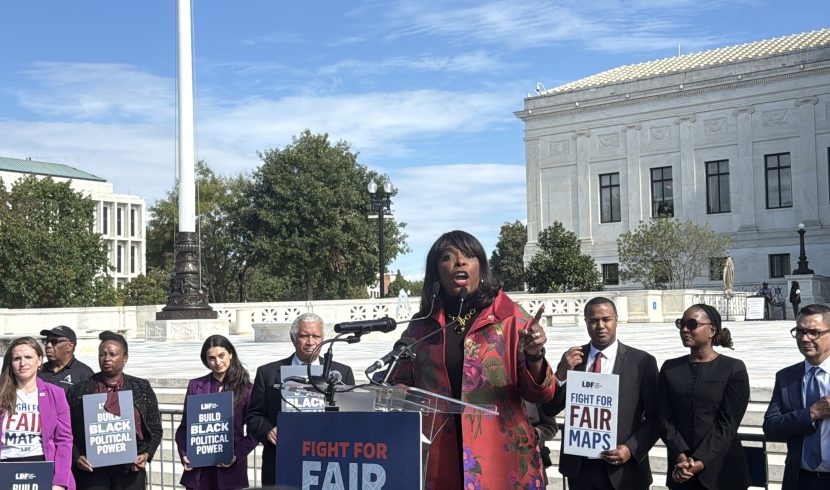
WASHINGTON — From inside the courtroom, to the steps of the Supreme Court, to standing outside the U.S. Capitol, Congresswoman Terri Sewell spent Wednesday making her case for maintaining the Voting Rights Act in its current form as the Supreme Court appears poised to place further limits on using race when drawing congressional maps.
The Court’s decision in a Louisiana redistricting case could change how race is applied, if at all, to drawing congressional maps. If the Supreme Court finds Section 2 of the Voting Rights Act unconstitutional, it could potentially jeopardize Alabama’s two Black-majority districts and reshape the makeup of Congress.
Last year, Rep. Shomari Figures, D-Mobile, was elected to the U.S. House after another redistricting fight in the courts led to the creation of Alabama’s newly redrawn 2nd Congressional District.
“We won in the Milligan case, and now I have a colleague by the name of Shomari Figures who stands proudly with me as a part of Alabama’s congressional delegation,” Sewell, D-Birmingham, said at a press conference after she listened to the case inside the Supreme Court. “That wouldn’t have happened without a legal fight.”
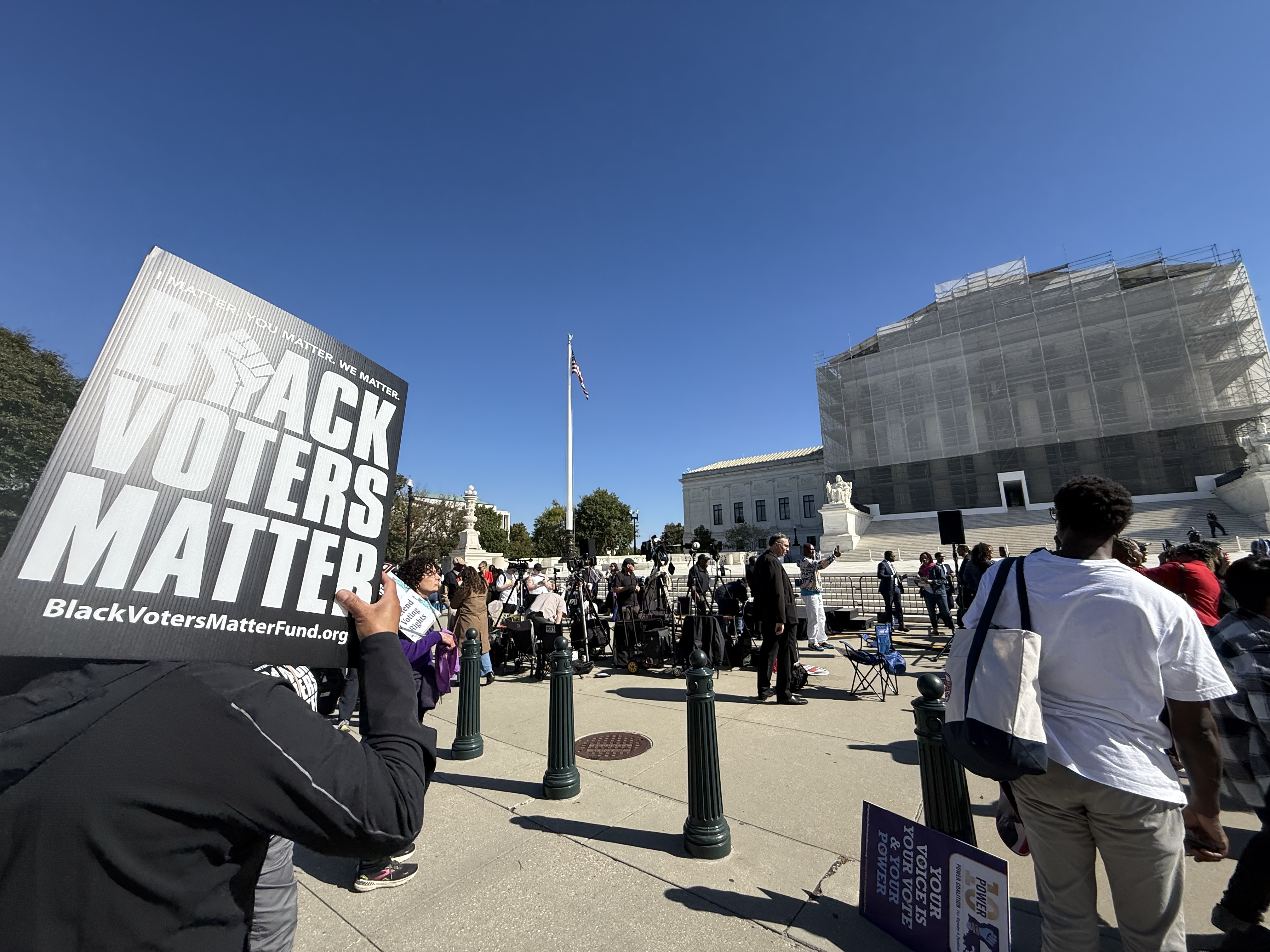
During oral arguments on Wednesday, the conservative justices seemed skeptical of the constitutionality of Section 2 of the landmark 1965 Voting Rights Act, which broadly prohibits race-based discrimination in voting laws.
Two years ago, the Supreme Court upheld Section 2 and struck down Alabama’s congressional map for diluting Black voters in the case of Allen v. Milligan.
But this case is different. Brought by non-Black voters in Louisiana, the plaintiffs argue that deliberately using race to draw majority minority districts goes against the 14th Amendment’s equal protection clause, sometimes referred to as “one man one vote.”
Alabama Attorney General Steve Marshall said Wednesday’s arguments demonstrated that conflict.
“The argument today showed again the impossible position states face in redistricting, where partisan actors can sue a state to demand race-based districts to obtain partisan goals,” Marshall said in a statement to ADN. “Just like the Supreme Court declared race-based college admissions unconstitutional two years ago, it should declare race-based redistricting unconstitutional now.”
Chief Justice John Roberts and Justice Brett Kavanaugh, who sided with the Court’s liberal justices in the Alabama decision, appear likely to change course.
On Wednesday, Kavanaugh suggested that using race as a factor in drawing congressional districts could have a time limit instead of allowing it to continue “forever.”
“This court’s cases in a variety of contexts have said that race-based remedies are permissible for a period of time and sometimes for a long period of time, decades in some cases, but that they should not be indefinite and should have an endpoint,” Kavanaugh said.
“Saying that Section 2 is somehow unconstitutional would be a blow not just to my district, but to fair representation across this country,” Sewell told Alabama Daily News.
Sewell pointed to a recent federal court decision in Alabama that ordered the state to use the current map, drawn by a special master, until 2030, which could keep Alabama’s current districts standing until the next census.
“I do believe that our map, at least, there’s something in writing that suggests from the courts that our map will stay the same until 2030,” Sewell told ADN.
But if the Court undercuts Section 2, it could significantly disrupt how congressional lines are drawn across the country.
Alabama and 15 other GOP-led states filed an amicus brief in September explaining their support for why Section 2 is unconstitutional.
As Sewell listened to Wednesday’s oral arguments in the courtroom, she said it was reminiscent of sitting between late Reps. John Lewis and Sheila Jackson Lee during the Shelby County v. Holder case more than a decade ago. In that 2013 decision, the Court struck down a provision of the Voting Rights Act that required states with a history of discrimination to receive federal approval before changing voting laws.
“It felt very eerily similar that you had conservative judges going out of their way to make their point and helping the plaintiffs make their point,” Sewell told ADN.
The Trump administration sided with Louisiana officials in the redistricting case. During the arguments, Roberts separated the current case from Alabama’s in 2023, arguing that precedent didn’t control what could come from the current case.
But as Sewell joined her Congressional Black Caucus colleagues outside the Capitol after the oral arguments, she invoked the late John Lewis’ words on the Selma Bridge, spoken shortly before his death, ‘Never give up. Never give in. Keep the faith, and let’s keep our eyes on the prize.”’
Alabama leaders are currently appealing to the Supreme Court a federal court’s ruling that deemed the state’s 2021 and 2023 congressional maps discriminatory.
A Supreme Court ruling in the Louisiana case is expected by the end of June.
The Associated Press contributed to this report.