

BIRMINGHAM, Ala. – Alabama political leaders and the state’s high school sports association are at odds over how to apply athletic eligibility rules to students using CHOOSE Act funds, with the AHSAA saying the program counts as financial aid and legislators arguing it does not.
On Thursday, Gov. Kay Ivey and House Speaker Nathaniel Ledbetter announced legal action against AHSAA. Lt. Gov. Will Ainsworth said he’ll pursue legislation addressing the matter.
At stake is whether student-athletes who use state education savings account funds must sit out a year when they change schools. The dispute has sparked confusion for families and frustration among lawmakers who say AHSAA is defying legislative intent.
By classifying CHOOSE Act education savings accounts as financial aid, AHSAA is applying a longstanding bylaw that forces transferring students who use any form of financial aid to wait a year before playing sports – a move legislators insist was never meant to apply to ESAs.
The AHSAA’s interpretation means a student who uses CHOOSE Act funds to change schools is ineligible for sports for a year, even if the transfer would not otherwise affect eligibility.
The CHOOSE Act, approved by lawmakers in 2024, creates education savings accounts funded by the state that parents can use for a range of educational expenses. That can include tuition, fees, textbooks and a curriculum for homeschooling students, along with educational services. Around 37,000 students applied for ESAs and 23,000 were deemed eligible.
The amount of the ESA varies by the type of education a student pursues:
- $7,000 ESAs for eligible students in private or participating public schools
- $2,000 ESAs for homeschoolers, up to $4,000 per family
For this year and next year, the program is limited to families earning less than 300% of the federal poverty level – about $95,000 for a family of four. The law states that all families will be eligible beginning in 2027–28, but that will depend on how much money lawmakers make available.
The clash highlights not only the high stakes for students hoping to play sports this fall but also the growing tension between lawmakers and the private association that governs high school athletics, including at some private schools, in Alabama.
The eligibility issue surfaced in recent weeks, according to Rep. Danny Garrett, R-Trussville, the CHOOSE Act’s sponsor. He said parents began calling with concerns that their children – many of them middle-schoolers – were being sidelined right as football season began.
Garrett said multiple discussions were held with various officials but the AHSAA would not change its position.
The AHSAA Central Board met Thursday about this and reaffirmed its stance, issuing a statement:
“Effective July 2024, the CHOOSE Act – like the Accountability Act before it – was formally recognized in the AHSAA Handbook as a form of financial aid. Under longstanding bylaws, any student who transfers to a member school and receives such aid is ineligible for athletic participation for one year. This policy, established by our member schools, promotes competitive equity and deters recruitment.”
Garrett called the association’s interpretation wrong.
“CHOOSE Act money is a parent redirecting their tax dollars to follow their child wherever they go,” he said. “That’s not financial aid.”
Ivey, in her statement, agreed, saying the law she championed never sought to bar students from playing sports.
“We wrote and passed the CHOOSE Act to give every child a true choice in their education, and that very much includes participation in athletics,” Ivey said.
She and Lebetter filed a lawsuit in the Montgomery Circuit asking the court to rule that the AHSAA’s interpretation of the CHOOSE Act is faulty and blocking the organization from further action to make players ineligible.
ESAs vs AAA
Garrett contrasted ESAs with Alabama Accountability Act (AAA) scholarships, which rely on outside donations redistributed through nonprofit scholarship-granting organizations.
When the CHOOSE Act was debated in February 2024, Rep. Joe Lovvorn, R-Auburn, introduced an amendment modeled on the AAA. Though the word “rules” – which is included in the AAA – after “athletic eligibility” was omitted, Garrett told House Speaker Nathaniel Ledbetter that the intent was clear: Nothing in the school choice law was meant to override existing AHSAA eligibility rules.
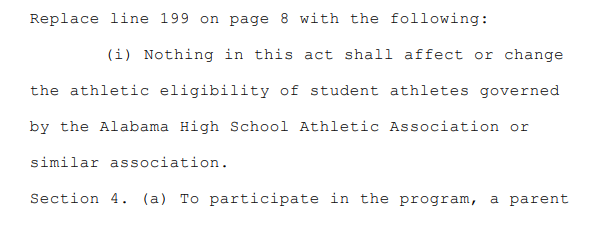
“We wanted to communicate that we’re not going to allow the wild, wild West, where they can transfer all around,” Garrett said about the amendment. “Their rules stay in place. But we also said that CHOOSE Act funds were not going to impact eligibility under their existing rules.”
Garrett maintains the amendment was meant to ensure CHOOSE Act students followed the same transfer rules as everyone else – not to create new restrictions.
The AHSAA counters that the financial aid rule was already in place before the CHOOSE Act passed and that debate on the amendment – recorded in the Alabama Channel’s archive – shows lawmakers intended whatever rules existed to apply.
Garrett insists AHSAA’s decision to lump CHOOSE Act money together with AAA scholarships came after the law’s passage in March 2024, undermining legislative intent.
State Sen. Chris Elliott, R-Josephine, blasted the move as “obtuse” and “arbitrary,” accusing the association of ignoring both lawmakers and Gov. Kay Ivey.
“How in the world do these folks think they can absolutely defy what the Legislature and the governor and the legislative services agency and…the cacophony of voices that have said you’re wrong?” he asked.
Elliott said he plans to take up the issue in the legislative session, which starts Jan. 13. He noted his history of filing bills – some punitive – aimed at reining in the AHSAA.
“They’re using this as a political tool, and that is an incredibly dangerous game for them,” he said.
Lt. Gov. Will Ainsworth echoed that sentiment Thursday, posting on social media that he’ll pursue legislation addressing the issue.
The same Alabama High School Athletic Association responsible for making sure teams do not break the rules is BREAKING THE LAW by denying eligibility to CHOOSE Act students. I’ll offer legislation to strip AHSAA of its power and give it to an entity that will follow the law.
— Will Ainsworth (@willainsworthAL) September 4, 2025
Tensions over high school sports
The fight over CHOOSE Act funds is the latest clash in years of tension between lawmakers and the AHSAA. Last year, Rep. Brock Colvin, R-Albertville, filed a bill to exclude English learner students from enrollment counts used for athletic classification as part of a multi-bill immigration reform package backed by Ivey. The bill did not pass.
According to SI.com’s reporting in March, 10 states, which they did not list, allow high school students to transfer and retain athletic eligibility.
Tennessee requires students using ESAs to attend a private school to sit out for a year in the sport they played previously unless they make a bonafide move.
Florida, which has liberal school choice policy, including open enrollment, allows immediate athletic eligibility regardless of why a student transfers as long as the student participates in the sport at the new school before the sport season begins.
Arkansas recently clamped down on high school transfers using school choice mechanisms, requiring a sophomore, junior or senior who transfers using school choice provisions to sit out for a year unless they make a bona fide move.
Arkansas television station KARK reported in April that the change was made because school choice enabled “many players” to switch schools year after year.