
Montgomery, Ala. — Alabama lawmakers this year took a penny off the state’s sales tax on groceries and gave paid parental leave to teachers and state employees.
They put more money toward funding K-12 students who cost more to educate, like those with special needs or whose first language isn’t English. And the state can now borrow an additional $500 million for new prison construction.
The Legislature threw a financial lifeline to small-town pharmacies and OK’d a new form of health plans for farmers and the self-employed.
They passed a few anti-illegal immigration bills, a stated GOP priority coming into the session. And most of Gov. Kay Ivey’s No. 1 goal for the session, a multi-bill anti-crime package, including a contentious bill expanding police immunity in the final minutes of the 2025 legislative session.
There was no banner issue to this year’s session, as there have been in recent years when economic development bills, federal COVID-19 relief spending, a gas tax increase and gambling dominated the conversations. But not every session needs a theme.
“Sometimes, it’s just work,” Sen. Greg Albritton, R-Range, told Alabama Daily News.
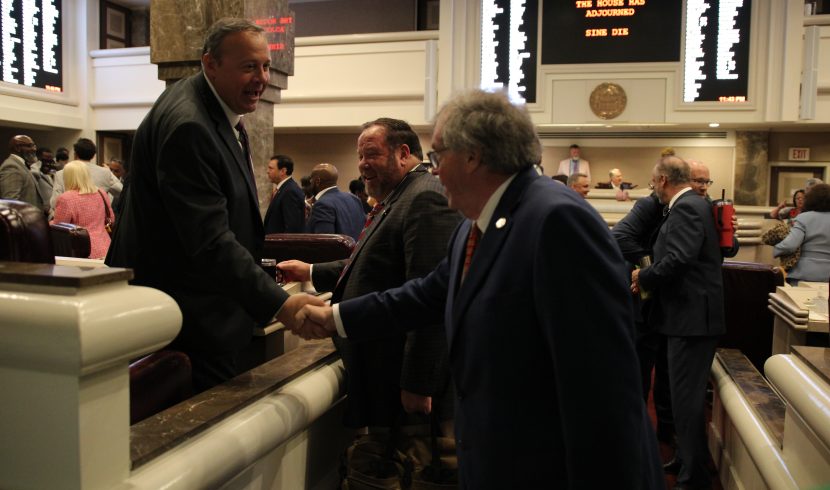
Just minutes after the House adjourned for the session just before midnight Wednesday, House Speaker Nathaniel Ledbetter, R-Rainsville, praised the legislation lawmakers managed to send to Ivey’s desk this year.
“We helped the people of Alabama,” Ledbetter said, shortly after midnight just outside the House floor. “Like I said on the floor today, we passed bills that are going to affect generations — children and families who haven’t even been born yet.”
Here’s a look at some of the major new laws of the 2025 session.
Reduction in tax on food, other tax bills
For the second time in three years, lawmakers knocked a penny off of the state’s sales tax on most grocery items, bringing it to 2% starting Sept. 1. The cut, sponsored by Rep. Danny Garrett, R-Trussville, is worth about $122 million per year. They also ended the “pink tax,” removing the sales tax from feminine hygiene products, maternity items and baby goods, including diapers and formula. That goes into effect Sept. 1. Rep. Neil Rafferty, D-Birmingham and Sen. Arthur Orr, R-Decatur, previously had sponsored the bill before getting to final passage this year.
The tax cut on groceries came instead of extending a 2023 law that took the state’s income tax off of hourly workers’ overtime earnings. That bill cost more than expected, more than $300 million annually. Republicans said the grocery bill, though fiscally smaller, would reach more people.
Parental leave and workers’ comp
Alabama teachers and state employees now have paid parental leave. Mothers will be granted eight weeks after the birth of a child, and fathers, two weeks. Teachers and state employees would receive 100% of their base pay while on leave, with the benefit extending to parents adopting a child less than three years old. Sen. Vivian Figures, D-Mobile, and Rep. Ginny Shaver, R-Leesburg, paired up on the bill after other versions were debated last year.
A separate bill from Sen. Sam Givhan, R-Huntsville, set up a workers’ compensation program for teachers. The bill creates a Public Education Employee Injury Compensation Board to oversee claims and manage a fund for injured K-12 and community college employees, including teachers, bus drivers, and support staff.
Currently, school employees injured on the job must pay medical and related expenses out of pocket and seek reimbursement through the state Board of Adjustment, a process that can take weeks or months. Supporters say the new system will provide faster, more reliable assistance.
Pharmacy payment bill
After two years of pleas from pharmacy owners who said they’re being driven out of business by unfair reimbursement rates, the state will now require pharmacy benefit managers to reimburse independent pharmacies for drugs an amount equal to or above what is paid by the Alabama Medicaid Agency. That currently includes a dispensing fee of $10.64 per prescription. Sen. Billy Beasley, D-Clayton, sponsored the bill.
“We helped local and hometown pharmacies all over the state stay in business,” Senate President Pro Tem Garlan Gudger, R-Cullman, told reporters about the session’s successes.
:… We cut the grocery tax faster than anyone thought we would. Those two bills alone would be enough for us to be able to go home and say we had a great session.”
Alfa health plans
The Alabama Farmers Federation will soon be able to sell its health plans without many of the state and federal rules that apply to traditional health insurance.
Alfa said the plans will provide less expensive coverage to farmers who currently pay prohibitive premiums. Opponents said the legislation allows Alfa to play by a different set of rules, including being able to deny coverage to people with pre-existing conditions.
The bill pitted Alfa against some of the other large lobby groups in the state, including Blue Cross and Blue Shield of Alabama.
Alfa and bill sponsor Rep. David Faulkner, R-Mountain Brook, agreed to several amendments, including agreeing not to raise premiums or cancel coverage because of a major medical event, to win support for the bill. About a dozen other states allow similar plans. Orr carried the bill in the Senate.
Anti-crime bills
The bill to watch Wednesday was a key piece of Gov. Kay Ivey’s priority anti-crime package. House Bill 202, to expand law enforcement officers’ civil and criminal immunity, was approved in the session’s final minutes Wednesday night. Rep. Rex Reynolds, R-Huntsville, sponsored the bill.
A significant part of Ivey’s anti-crime package was Senate Bill 116 to ban at the state level devices known as Glock switches, firearm modifications that allow semi-automatic weapons to fire at rates similar to that of fully-automatic weapons. Ivey signed it earlier in the session. The bill was heavily supported by law enforcement and the state’s largest cities and had been carried by Rep. Phillip Ensler, D-Montgomery, before becoming a GOP priority.
Other enacted legislation in the eight-bill package were:
House Bill 199 expands electronic monitoring for juvenile delinquents.
Senate Bill 115 enhances criminal penalties for impersonating an officer.
Senate Bill 118 places a constitutional amendment on the 2026 statewide primary election ballot that would expand the list of criminal offenses for which judges may deny bail, including acts of shooting into occupied dwellings and conspiring to commit murder.
Senate Bill 119 enhances criminal penalties for various crimes when a firearm is involved.
And while not a stand alone bill, lawmakers approved in the state General Fund budget an additional $3 million for the state’s Metro Area Crime Suppression Unit, a coalition of federal, state and local law enforcement officers tasked with improving public safety and reducing crime in Montgomery, and with the additional funding, potentially in other metro areas.
The only bill in the package not to pass was House Bill 188, establishing a scholarship program for law enforcement officers and their families.
Immigration bills
Republicans filed nearly a dozen bills targeting illegal immigration early in the session, but only a few crossed the finish line. More recently, leadership has said they became less of a priority because the Trump administration is tackling immigration at the federal level.
The Legislature gave final passage Wednesday to Senate Bill 53, by Sen. Wes Kitchens, R-Arab,to mandate local law enforcement verify arrested individuals’ immigration status and criminalize the transportation of undocumented immigrants into the state.
Two of them, Senate Bills 158, by Sen. Will Barfoot, R-Pike Road, and Senate Bill 63, by Sen. Lance Bell, R-Riverside, which would strengthen laws prohibiting undocumented immigrants from voting and require law enforcement to collect DNA samples from undocumented immigrants in custody, respectively, were signed into law by Ivey earlier this week.
Borrow $500 million for prison construction
Lawmakers last month gave final approval to a possible additional $500 million loan for prison construction. Lawmakers previously approved the building of two new 4,000-bed prisons. But the first one under construction in Elmore County has cost more than expected, just over $1 billion, leaving state leaders looking for more money for the prison in Escambia County. Albritton, who has advocated for more prison construction funds for multiple sessions, sponsored the bill.
As of late January, the prison in Elmore County was fully funded, and 60% of the funding for the prison in Escambia County had been identified.
Speaking on behalf of the bill on the House floor, Rep. Rex Reynolds, R-Hazel Green, said ideally, the state would be able to generate enough revenue and not need to sell the additional $500 million in bonds, an increase from the already-authorized $785 million.
Veterans department reorganization
Early in the session, the Legislature reorganized the chain of command within the Alabama Department of Veterans Affairs and allowed the governor to appoint the department’s commissioner.
The bill, sponsored by Sen. Andrew Jones, R-Centre, had Ivey’s support after messy conflicts surrounding the department last year, including inter-agency disputes, a debunked state ethics complaint and the dismissal of the veterans affairs commissioner.
Some veterans groups opposed the bill and some Republicans voted with them. The bill passed the House 56-39 and 21-9 in the Senate.
‘What is a woman’ bill
After failing in previous sessions, lawmakers sent to Ivey, and she signed, the “What is a woman” bill declaring there are only two sexes and putting their definitions in state statute.
“In Alabama, we believe there are two genders: male and female,” Ivey previously said. “There is nothing complicated or controversial about it.”
Sen. April Weaver, R-Brierfield, and Rep. Susan DuBose, R-Hoover, sponsored the bill. Opponents said it seeks to marginalize transgender Alabamians.
Juneteenth
Juneteenth will be an official state holiday starting this year after a bill by Rep. Rick Rehm, R-Dothan, became law.
Ivey has designated each year in recent years June 19 as the celebration of the last emancipated slaves in the U.S. The bill makes it an official holiday for state workers. It’s been a federal holiday since 2021.
Budgets
Passing the state’s two operating budgets is the only thing lawmakers are constitutionally required to do each year.
They sent Ivey record 2026 $3.8 billion General Fund and $9.9 billion education spending plans.
In both budgets, conservative budget leaders said they tried to balance record revenues with expected future downturns.
“I would have liked to have seen some further (spending) restrictions,” Albritton, the Senate General Fund committee chairman, said. “Some of (my proposals) were a little more stringent, but we couldn’t get there.”
In the education budget, there is now $166 million to be distributed to K-12 schools to serve harder-to-educate populations, including special needs students and those in poverty or just learning English. The new weighted funding formula was approved this session and will begin in the upcoming school year.
“This should have a considerable impact on educational progress for years to come,” said Sen. Arthur Orr, R-Decatur, the chairman of the Senate education budget committee. He said the new money is a starting point.
“I believe the Legislature is committed to this and will have to be financially. We’ve got to make these investments to see future educational achievement increases across the state, particularly in these hard to reach populations.”
Birmingham Water Works Board
A controversial bill to reorganize the board of the Birmingham Water Works was signed into law last week, with the bill’s supporters arguing that the board has been fraught with mismanagement for years.
Senate Bill 330, sponsored by Sen. Dan Roberts, R-Mountain Brook and Rep. Jim Carns, R-Birmingham, shifts the utility from a city controlled board to a regional body, shrinking its membership from nine to seven, and reducing the number of appointments made by city officials from six to two. Remaining appointments will now be made by a broader mix of state and local leaders and officials.
Its opponents, the fiercest of whom were lawmakers representing Jefferson County, pointed to the disproportionate influence neighboring counties would have on BWW given their population and number of BWW customers.
Portable benefits for gig workers
The Alabama Legislature approved a bill this year that will establish a form of portable benefits for gig workers such as Uber and DoorDash drivers, with discussions having started as early as August of last year.
The law, another collaboration from Rafferty and Orr, now allows for independent contractors to maintain portable benefit accounts that follow them to other contract work, and allow for companies to contribute to said accounts. It was designed to address the struggle for Alabama’s tens of thousands of gig workers – most of whom do not have employer-sponsored health insurance – who fall into the coverage gap, with incomes too high to be eligible for Medicaid but too low to afford health insurance on the private market.
Smartphone content filter
Starting in October, all smartphones and tablets will be required to have obscene content filters automatically enabled for minors via Senate Bill 186, by Sen. Clyde Chambliss, R-Prattville, sent to her desk for final approval on May 1.
The legislation was designed to better guard minors from obscene, sexual and graphic content accessible via smart devices. Enforcement mechanisms are strict, with manufacturers facing civil penalties of up to $5,000 per violation, capped at $50,000, for noncompliance.
Hemp regulations
Ivey on Wednesday signed House Bill 455 by Rep. Andy Whitt, R-Harvest, regulating THC products in the state. It puts a THC cap of 10 milligrams per serving for edibles and beverages, bans any smokable hemp products, prohibits use for those under age 21 and limits THC product availability to specialty shops or dedicated areas of grocery stores of at least 14,000 square feet.
It will also impose a 10% tax on the sale of all THC products, establish a licensing requirement for retailers and impose severe civil and criminal penalties for retailer violations.
Shark alert system
The state of Alabama will have a new shark-alert system starting in October after Gov. Kay Ivey this month signed off on Lulu’s Law, named after Alabama teen Lulu Gribbin, who lost her left hand and right leg in a shark attack last year at a Florida beach.
Under legislation sponsored by Faulkner and Roberts, geographic-based alerts will now be broadcast to phones in close proximity to confirmed shark attacks, a collaboration between the Alabama Department of Conservation and Natural Resources and other local and state agencies.
Gun storage law
Signed into law in April, the Houston Hunter Act, sponsored by Sen. Keith Kelley, R-Anniston, established a legal framework required for gun and ammo stores, as well as law enforcement officers, to temporarily hold lawfully possessed firearms at the request of the owner for a given period of time.
The law is named after Houston Tumlin and Hunter Whitley, two Alabama veterans lost to suicide by firearm. First floated last summer during a meeting of the Alabama Veterans Mental Health Steering Committee, the bill is designed to facilitate the separation between an individual and their firearm in potential moments of crisis.
Alabama Daily News’ Alexander Willis contributed to this report.