
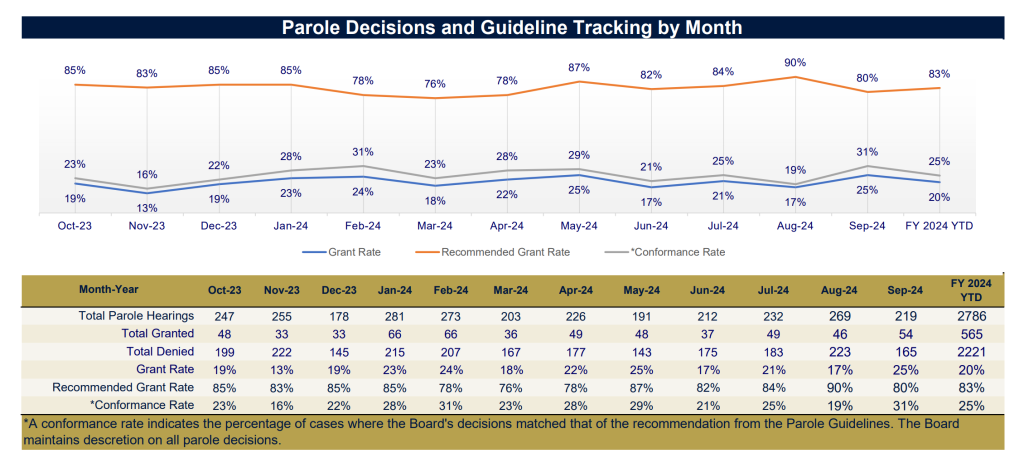
MONTGOMERY, Ala. — The Alabama Bureau of Pardons and Paroles ended fiscal year 2024 with an average parole grant rate of 20%, its highest rate since 2019 after four consecutive years of declining rates.
During fiscal 2024, which began Oct. 1, 2023 and ended Sept. 30, 2024, the ABPP held a total of 2,786 parole hearings, and of the 2,221 inmates eligible for parole, granted conditional release to 565, according to its September report.
The ABPP has faced mounting public and legal pressure over its shrinking parole grant rates. A lawsuit filed against the state in late 2023 alleged the parole system to arbitrarily deny inmates’ release as a means to maintain an adequate supply of prison labor for the state.
In October, a panel of lawmakers grilled ABPP Chair Leigh Gwathney over the board’s inability to conform with its own parole guidelines, guidelines that are developed by the board and generate a recommended grant. For the past two years, the recommended grant rate has been greater than 80%.
While a significant increase over past years, particularly fiscal year 2023 which saw a parole grant rate of just 10%, the ABPP still came short of its recommended grant rate for the year of 83%, for a conformance rate of 25%.
Rep. Chris England, D-Tuscaloosa, has been among the most vocal critics of the ABPP, and over the years has sought to reform the board through legislation that would require the ABPP to produce a report explaining any deviations from its parole guidelines.
While England’s bills have failed to garner enough support among state lawmakers to reach Gov. Kay Ivey’s desk, England has attributed the board’s sharp increase in releasing inmates to the mounting public and legal pressure, as has Lauren Faraino, an attorney representing the plaintiffs in the aforementioned lawsuit against the state.
While the ABPP dramatically increased its parole grant rate in fiscal year 2024, racial disparities among parole grant rates, which were also named in the lawsuit, still persisted, and increased when compared to 2023. White inmates eligible for parole were granted release at a rate of 24%, and Black inmates, 17%, an increased disparity of 2023 where 10% of white inmates were released versus 7% of Black inmates.
Another disparity that persisted, though slightly improved, involved inmates’ risk assessment level. The lawsuit alleged that inmates with a low-risk assessment were granted release at lower rates than inmates with a moderate-risk assessment due to low-risk inmates being better suited for the state’s prison labor system, which often contracts with fast food establishments.
In fiscal year 2024, the ABPP granted parole to 22% of inmates with a low-risk assessment, and to inmates with a moderate-risk assessment, 24%. In 2023, low-risk inmates were released at a rate of 8% to moderate-risk inmates’ 11%.
The ABPP has also continued its streak of granting parole to a greater number of eligible inmates into fiscal year 2025. A new report showed that in October, the first month of the fiscal year, the board had a parole grant rate of 28%, the single-highest monthly parole grant rate since at least 2020, boosting the board’s conformance rate to 35%.
Though only a single month of data, the racial disparity also decreased in October, with white inmates being released at a rate of 30%, and Black inmates, 27%.
While the first month of fiscal year 2025 suggests the ABPP may continue increasing its parole grant rate, Cam Ward, ABPP director, believes it’s unlikely the parole grant rate will ever eclipse the state’s previous parole grant rate peak of 55% without major reforms to state law.
The state hit that rate in 2017 before a dropoff every subsequent year; to 53% in 2018, 31% in 2019, 20% in 2020, 15% in 2021, 10% in 2022, and just 8% in 2023.
The decline has been attributed to several major reforms enacted in the last decade, such as Senate Bill 67 in 2015, sponsored by Ward when he was a state senator, which introduced standardized risk and needs assessments that classified more inmates as high-risk, and subsequently less likely to be released on parole.
Additional reforms in 2019 to the parole board, along with the appointment of Gwathney as the board chair, have also been named as having contributed to the state’s shrinking parole grant rate.