
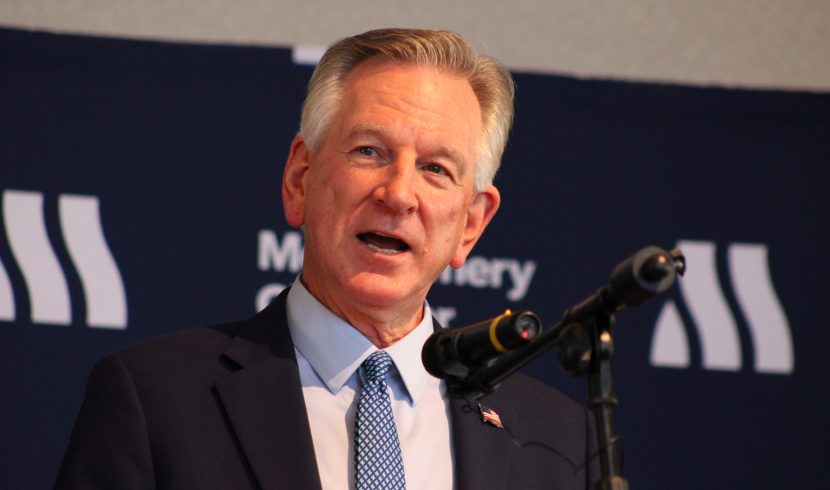
WASHINGTON – Among the 22 U.S. senators that voted against the latest spending package last week that averted a government shutdown, Sen. Tommy Tuberville this week spoke against the package’s $460 billion price tag, as well as what he considered to be the package’s hurried introduction.
“The first bill is 1,000 pages long; we just got the first bill on Monday, and then we had to vote on it on Friday, and that’s not enough time to go over a bill,” Tuberville told Alabama Daily News Tuesday morning.
“Right now, we’re borrowing $80,000 a second in this country. You and your kids are going to have to pay this back; $80,000 a second, $4.6 million a minute that the federal government is borrowing to spend on your behalf on a lot of things that make no difference (in) future of this country.”
The spending package includes six annual spending bills that were signed into law by President Joe Biden on Saturday, spending bills that fund several federal agencies, including the departments of Agriculture, Transportation and Veterans Affairs, among others.
Sen. Katie Britt, a member of the Senate appropriations committee, voted for the spending package that includes $786 million for Alabama projects, including at Redstone Arsenal, Maxwell Air Force Base and Fort Novosel.
“As I have emphasized since taking office, my priority has been and continues to be restoring regular order to the appropriations process and passing accountable, prudent bills that live up to our promise to the American people,” Britt said in a written statement. “Instead of going to New York or California, more of Alabamians’ hard-earned taxpayer dollars will be coming home because of the strategic wins we were able to secure in this legislation.”
Now five months into the current fiscal year, Congress has thus far avoided a government shutdown through a series of stopgap bills that allowed federal agencies to receive funding for just weeks or months at a time.
The passage of the spending package on Friday, done just hours ahead of a March 8 deadline, has avoided a government shutdown, at least until March 22, the deadline for lawmakers to pass the second of two annual spending packages.
On the first six-bill spending package, Tuberville took issue not only with its inclusions, but the manner in which it was brought up for a vote as a package, rather than allowing senators to vote separately on its individual components.
“(The package has) a lot of the giveaways, a lot of the things that have nothing to do with infrastructure, health care (or) education, (and) all this omnibus we’re doing is adding to the debt; we should build a budget individually in the 12 areas that we have in appropriations right now,” Tuberville told ADN.
“Right now, if you look at what the Democrats want to do, they want to throw them all in there together, add their two cents’ worth in it, and pay off all these intercity governors and mayors that are dead broke that don’t know how to run any type of business, much less a city or a state.”
Despite his issues with the bill, Tuberville did vote in favor of an amendment that would prohibit the U.S. Secretary of Veterans Affairs from reporting information to the Department of Justice for the purpose of preventing veterans from buying firearms. Sponsored by Sen. John Kennedy, R-La, that amendment passed largely along party lines in a slim vote of 53-45.
As for the second and final spending package for the current fiscal year, which unless passed by the end of March 22 will lead to a partial government shutdown, Tuberville said he hopes to reign in spending as much as he and his Republican colleagues can.
Lawmakers have suggested that the second spending package, which funds the Departments of Defense, Homeland Security, and Health, among others, will likely face even greater scrutiny among lawmakers.
Given the spending on defense, an opportunity exists for Republicans to attempt to prevent the Pentagon from reimbursing travel costs for service members who travel to receive abortions, something Tuberville had fought for last year by blocking military promotions in the Senate for nearly 10 months straight.