

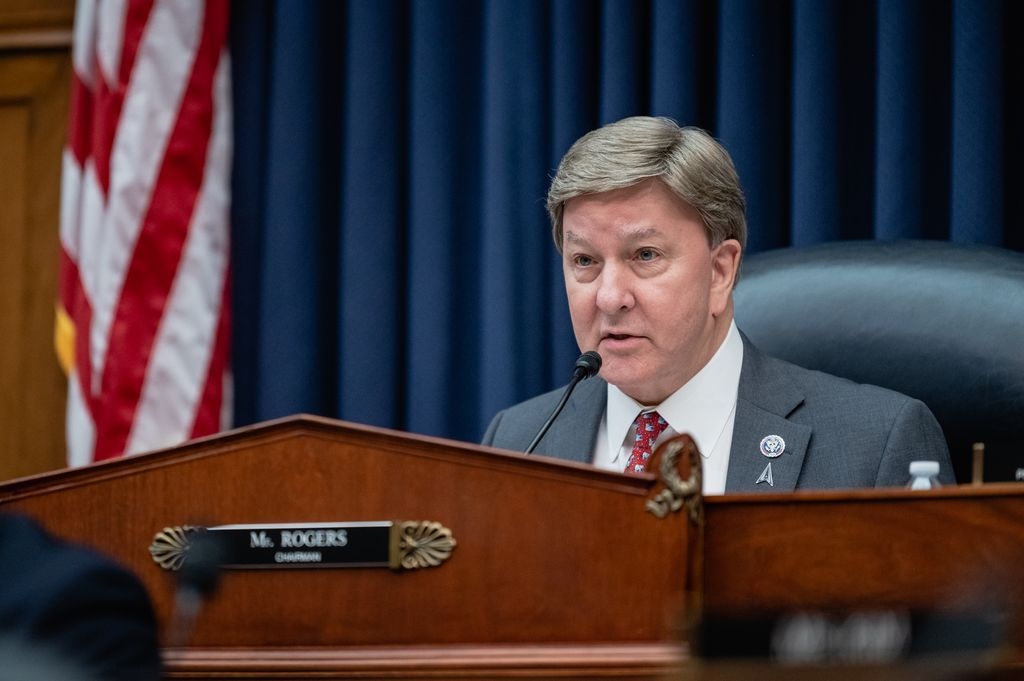
WASHINGTON — Defense funds in the House Republicans’ third party-line spending bill fall far short of Trump’s original request, but House Armed Services Chairman Mike Rogers said it’s a necessary start to fill the Pentagon’s coffers in the wake of military operations in Venezuela and Iran.
The House Budget Committee on Thursday advanced along party lines a $95 billion budget framework that includes $60 billion for the Pentagon and $13 billion for intelligence.
But that $60 billion is nowhere near the $350 billion in defense money that Trump originally asked for in a reconciliation bill as part of his total $1.5 trillion Pentagon budget request.
Yet Rogers said not advancing the budget resolution would be “irresponsible” as the Pentagon grapples with the escalating costs of the Iran war.
“This money, we got to backfill the hole that’s been created with our munitions stockpile problem, and in the operations in Venezuela, in Iran,” Rogers, R-Saks, told reporters. “If we don’t get this money, there is going to be a very large hole in this year’s spending package that has got to be filled.”
If the third reconciliation bill can clear Congress, Rogers, a big proponent of increased defense spending, is hopeful that a fourth-party-line bill could help make up the difference in defense funds.
Reconciliation allows Republicans to bypass the Senate filibuster and pass the package without Democratic votes.
But the budget blueprint is already facing steep hurdles from Republicans in the House and Senate, making a fourth bill even trickier to pass before the end of the year.
In an election year, though, the chairman added that a party-line bill is the best option to bolster defense funding.
“Assuming we get this $60 billion and we don’t get the balance of that $350 billion, that leaves about $190 billion must-haves that I don’t know how I’m going to deal with,” Rogers said. “But as Peter King used to say, ‘I’ll jump off that bridge when I get to it.’’
U.S. Rep. Dale Strong, who represents defense-heavy Huntsville, emerged from a GOP closed-door meeting with Vice President JD Vance, who urged Republicans to support the package, and said he is still assessing the blueprint but is open to supporting it.
“What we do in Huntsville, Alabama, is obvious. It doesn’t matter which project it is, we’re a part of practically every missile project that protects the Western Hemisphere, and we’ve got to be sure to fund it,” Strong, R-Huntsville, told Alabama Daily News.
Money for farmers, elections
The budget resolution also includes $12 billion for farm aid and $10 billion for election measures, such as funding a state grant program to implement strict voter ID rules under the SAVE America Act.
“We’re moving forward with a narrow, streamlined package to deliver on some of America’s top priorities,” House Speaker Mike Johnson said.
The budget framework does not include any budget cuts to offset the spending, angering fiscal hawks. With a razor-thin majority, securing near-total GOP support on the resolution is paramount for Republicans to pass the final package.
“There is no will to spend less or honestly pay for massive spending,” Rep. Warren Davidson, R-Ohio, wrote on social media. “Deficits, Debt, and Debasement all the way to the crash site. Nothing stops this train. Make a plan.”
After meeting with House Republicans on Wednesday, Vance minimized those concerns, offering up the savings that could come from the White House’s anti-fraud task force.
“Ultimately, we decided this legislation, for a whole host of procedural reasons, was not the place in order to codify some of the things that we’re doing in the anti-fraud task force,” Vance told reporters. “What we’re doing with this legislation is getting Save America through and, of course, getting some critical support to our troops and to our farmers.”
It’s an idea that U.S. Rep. Barry Moore, R-Enterprise, told ADN is a good path for finding savings.
House Republican leaders expect the full House to vote on the budget resolution next week. It needs to pass both chambers before committees begin drafting legislation on how to spend their portion of the $95 billion. Both chambers would then have to vote on the final reconciliation package before it becomes law.
Rocky Senate path
If the budget resolution clears the House next week, there is no guarantee that the Senate will easily follow suit.
Senate Majority Leader John Thune, R-S.D., said a party-line bill is an “option, but it’s not certainly the only option” to fund Republican priorities ahead of the midterms.
“It all, in the end, comes down to whether you have the math, whether you can get 50 votes to pass it in the end, and whether you’ve got 50 votes to defeat any poison pill amendments that might be offered, and so those are all questions that will have to be answered in due time,” Thune said during his weekly press conference.
In a fiery floor speech, retiring Republican Sen. Thom Tillis of North Carolina warned Republicans that if the SAVE America Act ends up in reconciliation, he would oppose it.
“Let’s get the government funded. Let’s use reconciliation if we need to, but let’s not clog it up with another piece of policy airdropped by a member of this Senate or the White House that will undermine this bill,” Tillis said forcefully on the Senate floor.