
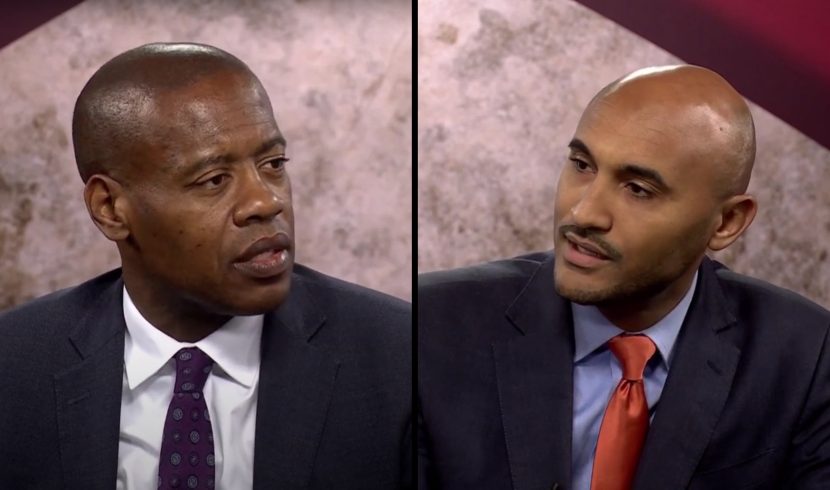
MONTGOMERY, Ala. — The two remaining Democratic candidates in the race to represent Alabama’s newly-drawn 2nd Congressional District made a renewed pitch to voters Friday while appearing on Alabama Public Television, during which both candidates took shots at their opponent on the issue of living within the district.
With the crowded race of nearly 20 candidates vying to represent AL-2 having been narrowed down to four candidates in early March – two Democrats and two Republicans vying to become their respective party’s nominee – the remaining candidates have narrowed their messaging to include more targeted critiques of their opponents.
In the Democratic primary, Shomari Figures received 43.5% of the vote during the March 5 primary election, while Minority Leader Anthony Daniels, D-Huntsville, received 22.4%. As the two highest-polling candidates, and with no candidate receiving more than 50% of the vote, both are set to face off in a runoff election on April 16.
One constant throughout the race has been the topic of residency; more specifically, whether or not candidates actually reside in the district they’re running to represent.
Regarding Figures and Daniels, Figures does reside within the district – in Mobile – but has come under fire from Daniels for only having lived in the district since last October after stepping down from a federal position in Washington, D.C. to run for office.
Daniels has also received criticism from Figures on the residency issue given that Daniels main residence is in Huntsville, almost 200 miles north of the district he’s running to represent. Though Daniels said he has a home in Montgomery and spends considerable time here as the Democratic leader in the Alabama House.
In two separate interviews with Capitol Journal’s Todd Stacy, both candidates elaborated on the significance of residency in the race.
Watch the full interviews below.
“There’s a stark difference in the geographical locations of the remaining candidates in the race; myself being in the district, from the district, raised in and living in the district, Mr. Daniels living in Huntsville, which is obviously not in the district,” Figures said.
“Voters care about that because they need to know that the candidate that they’re sending to Washington, D.C. is going to prioritize the cities and towns in this district and not have to worry about competing with resources going to other parts of the state.”
Daniels, when asked to respond to Figures’ criticisms, which have been featured prominently in his campaign advertisements, argued that through his work as a state lawmaker, his connection with District 2 was greater than Figures’.
“I pay taxes in Alabama, I have a home here in Montgomery, (and) as Minority leader, I’m in Montgomery more than I’m in Huntsville,” Daniels said.
“So I think at the end of the day, the voters want someone that can deliver for the district, not someone who just moved to the district in October, registered to vote in the district on Nov. 3, and is still paying taxes and owning a home outside of the district.”
Figures has not attempted to downplay his recent history of living in the nation’s capital, but has instead argued that his commitment now to move to the district was what really matters when discussing the issue of residency in the race.
“At the end of the day, it’s about being committed and dedicated to the voters of this district, and there’s only one way to show people that you’re committed and dedicated to them: that’s being willing to actually move and live among them,” Figures said.
“This is not the time that voters want a sort of transactional nature of leadership – that if you vote for me, then I’ll move into your district, then I’ll show you I care enough to live among you – they want to see that commitment beforehand. I think the fact that we made that move has resonated significantly with voters.”
Conversely, Daniels highlighted that, regardless of where his primary residence was, not only had he spent more time within the district than Figures had in recent years, but that he had also delivered material gains for the district’s residents as a state lawmaker, citing his bill that cut taxes on overtime pay as a prime example.
“I live in Alabama, I have a home here in Montgomery, we’re in session four months out of the year, and so I understand the issues in the community,” Daniels said.
“I’ve been able to deliver to the community, and I don’t live in Washington, D.C., I don’t pay taxes in Washington, D.C., I pay taxes in Alabama.”
Daniels also suggested Figures’ experience in Washington – where he worked with the U.S. Department of Justice – may be more of a liability than an asset, pointing to $1.7 million in campaign contributions from the cryptocurrency-backed Protect Progress PAC.
“I know that my opponent is behind those (residency) attacks, but he has to explain why he took ($1.7 million) from a cryptocurrency PAC, and what is their interest?” Daniels said.
“You move here in October, you register to vote in November, and then you get $2 million from an outside group that you were responsible for regulating? I don’t know about that.”
Figures was not afforded an opportunity to respond directly to why he had received such strong support from Protect Progress PAC, but did continue to lean into his experience in Washington in his pitch to voters.
“I think our messaging has been consistent throughout this campaign in that we’re the candidate that’s best equipped to get to Washington, and best positioned in this district for success long-term,” Figures said. “We’ve been in Washington, we know how Washington works.”