

MONTGOMERY, Ala. — A nonprofit organization hosted nine Alabama mayors recently in Selma for a roundtable discussion to advocate for city leaders to codify an expanded definition of antisemitism into city statute, thereby strengthening hate crime laws against Jewish residents.
The organization, Combat Antisemitism Movement, or CAM, hosted the mayors at Selma University on March 8, the 60th anniversary of ‘Bloody Sunday,’ with some mayors telling Alabama Daily News that they were considering introducing city ordinances as advocated for by CAM.
“Most definitely,” said Union Springs Mayor Roderick Clark Thursday when asked by ADN if he was considering introducing city ordinances as a result of the event.
The roundtable discussion saw CAM share a document dubbed the ‘Municipal Antisemitism Action Index,’ which includes dozens of city level policy proposals such as anti-BDS policies, stipulating cities not do business with companies that boycott Israel, the recognition of Jewish residents as a minority group, and the adoption of an expanded definition of antisemitism, which could result in enhanced criminal penalties in some circumstances.
“It’s kind of a framework for all municipalities (as to) what they can do to help combat antisemitism and hate in their community in four areas; legislation, law enforcement, education and community initiatives,” explained Lisa Katz, chief government affairs officer for CAM, speaking to ADN recently.
“Unfortunately, we’ve seen antisemitism increasing across the world, even before Oct. 7 (2024) but certainly since then, and the south and Alabama is not immune from that.”

Other policies advocated for by CAM for Alabama municipalities to adopt include the establishment of antisemitism task forces, increased security for synagogues, Jewish schools and community centers, the inclusion of Holocaust and Jewish American Heritage education in public schools, and disciplinary actions for teachers who engage in “Holocaust and/or Oct. 7 denial and distortion.”
The definition of antisemitism CAM is pushing for city leaders to adopt is known as the International Holocaust Remembrance Alliance working definition of antisemitism, which includes 11 key points largely made up of examples of discrimination of Jewish people based on race or religion.
“We would like every city in America to adopt the IHRA definition of antisemitism,” Katz said. “You can’t fight something until you define what it is, so this allows municipalities to define what antisemitism is, and then that definition can be incorporated into hate statutes, into any DEI initiative, (and) it’s also something that law enforcement can look to and then recognize what antisemitism is when they see it.”
While the definition has been adopted by many countries and organizations, and is currently being advocated for being adopted federally by U.S. Sen. Katie Britt, the definition has seen some pushback from human rights groups, including from a number of progressive Jewish organizations, as conflating criticism of Israel with antisemitism.
Examples of contested definitions of antisemitism as defined by the IHRA include claiming the existence of Israel to be “a racist endeavor,” drawing comparisons of Israeli policy to Nazi Germany, and applying a double standard to Israel regarding its policy. Such slogans as “free Palestine” or “from the river to the sea, Palestine will be free” – chanted at dozens of pro-Palestine protests across American college campuses last year – would also likely be deemed antisemitic under the IHRA definition.
Among the pushback to codifying the IHRA definition of antisemitism includes a letter to then-President Joe Biden signed by 1,200 Jewish professors, including University of Alabama professors Luke Herrine and Jared Margulies, warning of the potential ramifications.
“The IHRA definition of antisemitism wrongly and dangerously conflates criticism of the Israeli state with antisemitism; this suggests criticism of a political entity is the same as discriminating against or being hostile or violent towards Jews,” said Margulies via an email to ADN on Friday.
“Actual antisemitism is defined in the Jerusalem Declaration on Antisemitism as ‘discrimination, prejudice, hostility or violence against Jews as Jews.’ In contrast, The IHRA definition lists 11 examples of antisemitism, seven of which are about criticism of Israel and Zionism. It is therefore very easy to see that the IHRA definition is really an attempt to weaponize actual antisemitism to silence criticism of Israel.”
Also speaking to ADN, Herrine expanded on his opposition to the IHRA definition of antisemitism Friday in an email, describing the effort to codify the definition into law or statute as “anti-American” and a threat to free speech.
“The campaign for its adoption is part of a larger campaign to punish and silence critics of Israel, Israeli policies, and US support for both, whether or not those critics are antisemitic (or, indeed, Jewish),” Herrine told ADN. “That campaign is an anti-American effort to quell dissent. And it is a campaign that not infrequently makes common cause with open Nazi-salute-making antisemites. Adoption of the IHRA definition has been widely criticized by many leading scholars of antisemitism and, indeed, by one of the original drafters of the IHRA definition itself.”
To the definition’s critics, however, Katz says they’re wrong.
“We can criticize the policies of any government, the difference is when you’re holding Israel to a standard to which you don’t hold any other country; that’s antisemitism,” she told ADN. “When you’re equating Jewish people with the policies of a government, that’s antisemitism. Saying ‘free Palestine,’ ‘globalize the intifada,’ that’s saying kill all the Jews, that’s antisemitism.”
Montgomery Mayor Steven Reed, who in addition to participating in the roundtable in Selma had attended and spoke at CAM’s Mayors Summit Against Antisemitism last year in Beverly Hills, California, said he would potentially be introducing policy proposals in Alabama’s capital city.
“For us, we’re looking into that, and once we have our arms wrapped around it and have a better understanding, then it’ll be something that we present to our city council to ask for their support on,” Reed told ADN. “So there potentially could be some policy initiatives.”
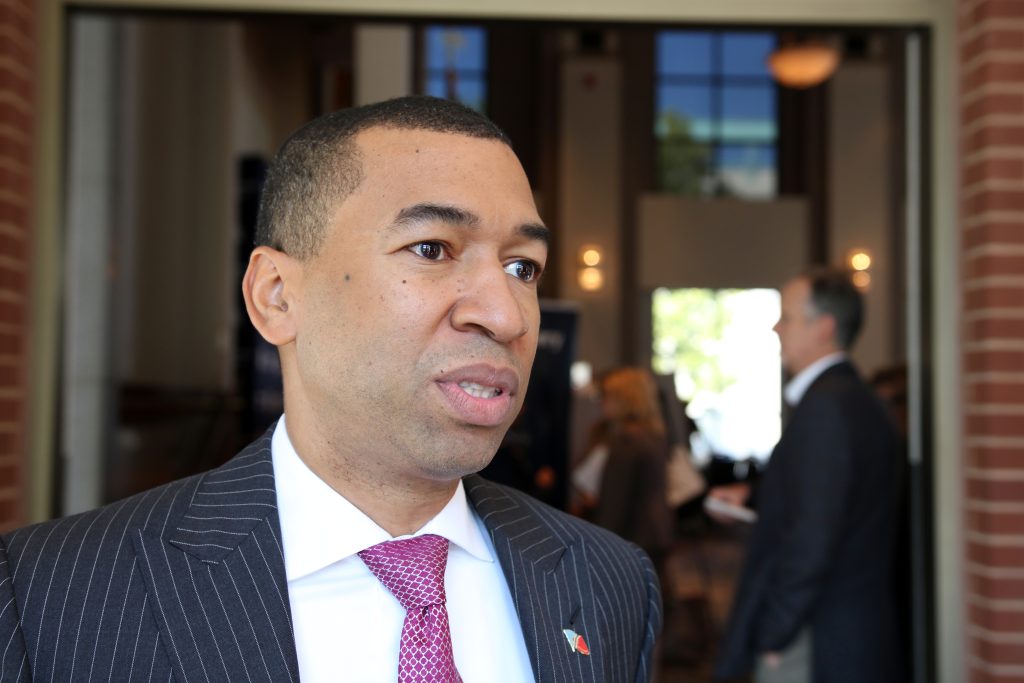
Among potential policy proposals Reed named was to host more events in recognition of Jewish American Heritage Month in May. He also said expanding city statute around hate crimes targeting Jewish residents is also being considered.
“We also want to make sure that our city hate crime laws recognize antisemitism, maybe strengthen some laws that we already have on the books around this topic as well,” he said. “So we’re taking a look at this, and once we have done that with our policy advisor and others, we’ll bring it before our city council for them to consider as well.”
Orbuty Ozier, mayor of the town of Gordonville in south Alabama, also expressed that she and town leadership would be considering several of the policy proposals advocated for during the roundtable event, of which she attended. However, she noted that further research and discussion on the potential impacts of said policies was necessary before making any commitments.
“There are some policies in there that they want us as a municipality to consider, and I believe some of them we will,” Ozier told ADN Friday.
“But before we make total commitment, I have to know, along with my council, that we are going to be ready and prepared to deal with the good and the not-so good that comes from that. If a policy is written and made for positive actions, yes, but if they’re not for positive actions, no. In the end, it has to help bring about more unity.”
On the matter of adopting the IHRA definition of antisemitism, as well as its critics’ concerns that codifying it into law or city statute may threaten free speech in some instances, Reed said that he and the Montgomery City Council would work to find a path forward that both protects Jewish residents and preserves citizens’ First Amendment rights.
“We don’t want to trample anyone’s First Amendment rights, and we certainly don’t want one aspect of this to kind of taint the entire effort that we have against antisemitism,” Reed said.
“So I would hope that there is more discussion that maybe some of this can be mediated between those who think it’s a bridge too far, and those who think it has to be strong, and we’ll find some common ground.”
Efforts to codify the IHRA definition of antisemitism federally are ongoing. In 2019, President Donald Trump signed an executive order to direct federal agencies to consider the IHRA definition in instances involving Title VI of the Civil Rights Act, and regular efforts have been made by members of Congress to further codify the definition into law. The White House’s efforts to combat antisemitism as defined by the IHRA have also been the justification for the arrest and attempted deportation of Palestinian student activist Mahmoud Khalil, a permanent resident and green card holder who was the lead negotiator during the 2024 Columbia University pro-Palestine protests, which sought to have the university divest from Israel amid the Israel-Hamas conflict.
While highly unusual for permanent residents to have their green cards revoked without a criminal conviction, and Khalil having not been charged with a crime, Secretary of State Marco Rubio, who signed off on the decision to arrest Khalil, has argued that Khalil’s participation in the protests constituted a threat to the United States’ foreign policy agenda of fighting antisemitism.