
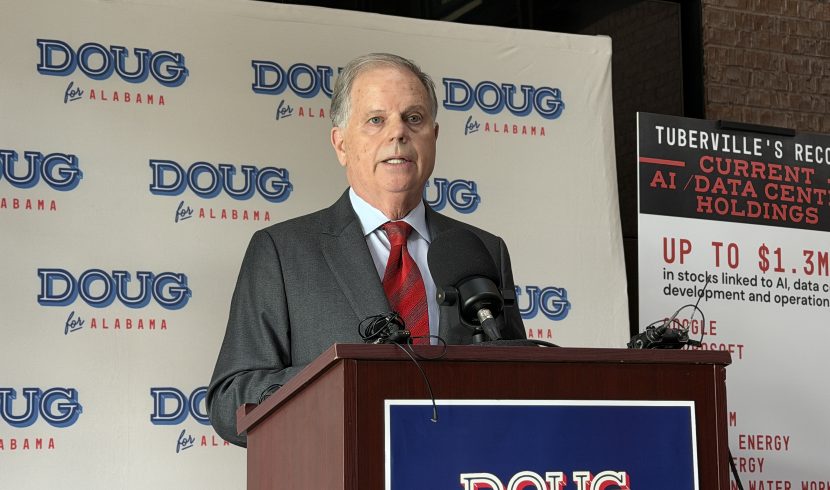
BIRMINGHAM, Ala. – Democratic gubernatorial candidate Doug Jones on Wednesday challenged Republican Tommy Tuberville to sell investments tied to artificial intelligence and data centers and support stronger state ethics laws.
Jones held a Birmingham press conference to argue that Tuberville’s investments raise questions as Alabama considers building more large data centers.
Jones pointed to Tuberville’s federal financial disclosure reports, which he said show more than 1,300 stock trades during Tuberville’s time in the U.S. Senate. Jones said more than 250 of those trades involved companies connected to artificial intelligence or data center development.
Because federal disclosure reports list ranges rather than exact dollar amounts, the total value of the trades is unclear. Jones claimed the AI- and data center-related trades were worth between $5.2 million and $14 million.
Tuberville has said Alabama and the United States need to move quickly to build data centers to compete with China. He also has dismissed some concerns about data centers as misinformation coming from China.
Jones pointed to what he called a contradiction in that argument: Tuberville made 14 trades involving Alibaba, a Chinese technology company involved in AI and data centers, while serving in the Senate.
“He tells you we have to do data centers so that we can beat China on AI,” Jones said. “But as a senator, he was personally invested in one of China’s leading AI and data center companies at a time when the data center and AI boom was taking off.”
Jones said Tuberville’s most recent financial disclosure shows investments in companies including Google, Microsoft, Oracle, Apple and Qualcomm, along with utility and telecommunications companies that could benefit from data center growth.
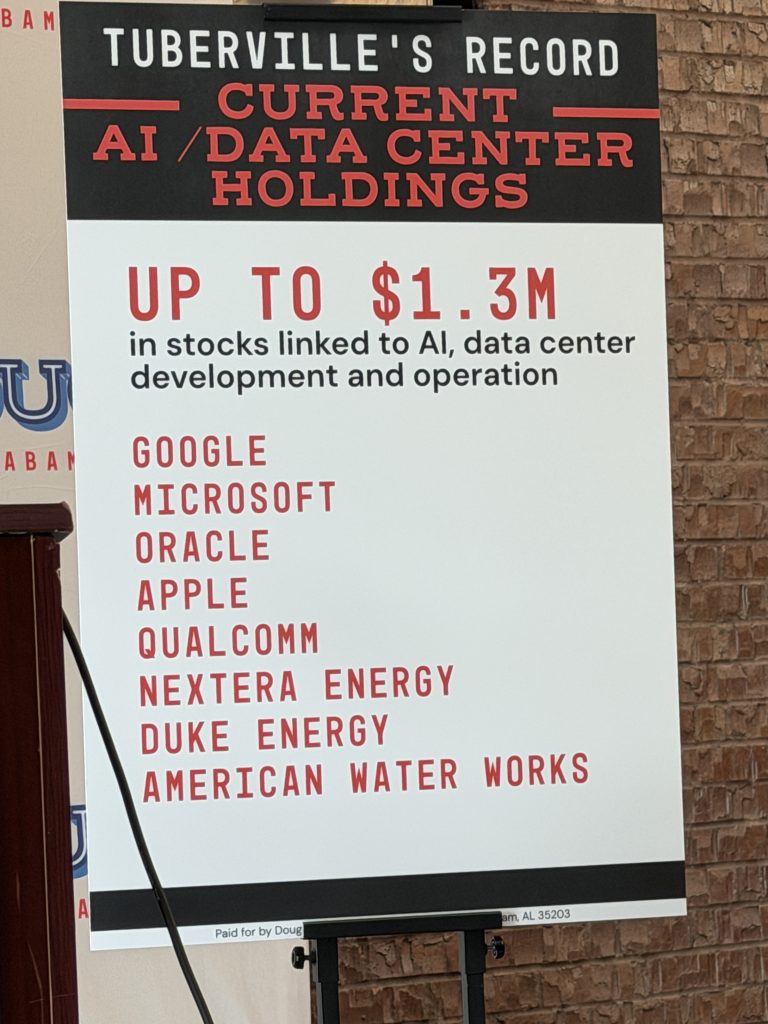
While Jones did not accuse Tuberville of breaking the law, he called on Tuberville to sell “every share of stock, every option, every position tied to AI, data centers and the utilities that serve it.”
“If he wants to be the governor of Alabama, he cannot be a shareholder in the industry he is asking Alabama to bet its future on,” Jones said.
Jordan Doufexis, Tuberville’s campaign chair, said that Jones is “grasping for attention” and that Alabamians are more concerned about who has a plan to protect Alabama families.
“We expect these desperate attacks from Doug, but like so much of what he says, they are just empty,” Doufexis said. “Like many Americans, Coach has a broker who manages his investments and makes day-to-day decisions about when and what to buy or sell. Coach is not making those day-to-day trading decisions.
“This has been answered and reported on for years. Doug Jones can talk all he wants, but Alabama deserves more than a DC politician telling people he wants a one year moratorium as a campaign line. So, what’s Doug’s actual plan?”
Jones laid out several campaign planks related to data centers and stock trading, challenging Tuberville to adopt them as well. Jones called for Tuberville to sell his investments tied to AI, data centers and the utilities that serve them.
He also called for stronger financial disclosure laws for state and local officials and a ban on statewide elected officials buying and selling stocks while in office. Unlike members of Congress, Alabama does not require elected officials to publicly disclose the same level of detail about their stock holdings and trades.
Jones said the public should know what officials own before they vote on matters such as data center tax breaks, utility contracts, rezonings or water permits. He also proposed prohibiting officials from holding related investments for at least five years after leaving office.
Jones called for an end to “secret” data center deals, including nondisclosure agreements between developers and government officials. He said communities should know about proposed projects and have a chance to weigh in before agreements are finalized.
Jones has previously called for a one-year moratorium on approvals for large data centers to allow the state to put stricter rules in place for power use, water use, noise, environmental effects and public involvement. The Alabama Legislature earlier this year passed legislation reining in economic incentives for data centers.
“Folks, the data center controversy has erupted because people are realizing that it’s a perfect example of why they distrust Alabama elected officials, why they believe that Alabama’s government does not listen or pay attention to it,” Jones said. “It’s true of data centers in Bessemer and Lowndes County, but also of solar farmers in North Baldwin County, or carbon capture facilities in Crenshaw County. The way this has been handled in Alabama up to now is just the opposite of democracy.”
The Tuberville campaign responded to Jones’ statements by outlining Tuberville’s plan if elected. His four-prong plan is to give local communities “the final say,” tax data centers at the highest rate, remove tax incentives and abatements for data centers, require the facilities to pay for all the power they use and charge them to replace that capacity.
At the end of the press conference, Jones issued a final challenge to Tuberville: debate him.
Jones said his campaign has accepted several debate invitations and challenged Tuberville to meet him three or four times around the state before the November election.
“Don’t take a knee, coach,” Jones said. “Let’s get up there and have at it.”