
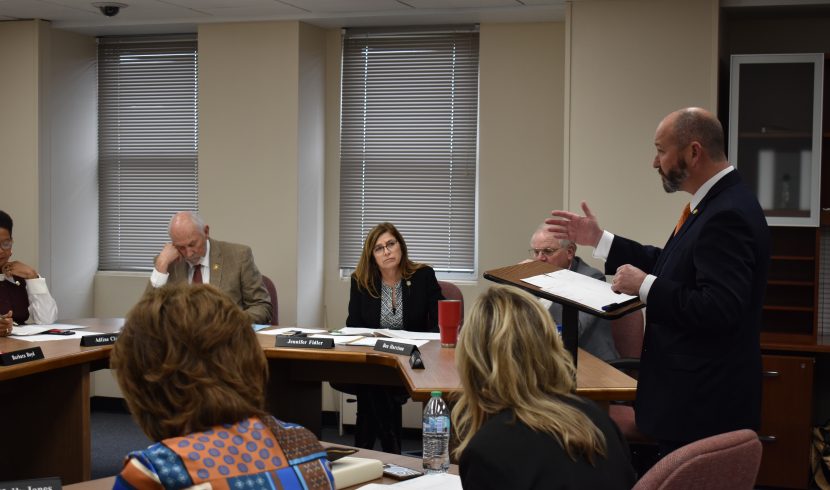
MONTGOMERY Ala. – A bill that would allow government officials to remove local library board members from their positions narrowly made it out of the House Committee on County and Municipal Government after a public hearing Wednesday afternoon.
Senate Bill 26, sponsored by Sen. Chris Elliott, was met with opposition from both parties during Wednesday’s meeting because it allows appointing authorities – like city councilors or mayors – to remove a board member without cause. This is Elliott’s third attempt to get the bill passed.
The bills have been discussed at the same time that conservative groups have pushed to remove or restrict young library users’ access to books with LGBTQ-related and sexual content. A state library oversight board has voted repeatedly to withhold funding from the Fairhope Library after it said the library violated state policies the board said protect children from inappropriate materials.
Rep. Sam Jones, D-Mobile, introduced an amendment that would add the phrase “for cause” to the sentence allowing member removal with a two-thirds vote of the appointing authority. The amendment failed.
Jones said he brought the amendment because he feels it’s a “common courtesy” to let people know why they are being removed, adding that the phrase was included in last year’s version of the bill.
Elliot asked the amendment be tabled because he felt requiring cause could drag out and publicize removals.
“These are volunteer positions. This is a library board,” Elliot said to the committee. “It’s not a situation where I think cause needs to be there. There’s no due process necessary for a volunteer position.”
Elliot argued that “for cause” is a legal phrase that carries with it case law that could complicate his bill. He said he would entertain an amendment that would require the appointing authority to provide a reason for the removal.
Chair Rep. Reed Ingram, R-Matthews, said he would be willing to carry that amendment on the House floor. The committee discussed other amendments, but Ingram said he didn’t want the committee to vote on a handwritten amendment not vetted by the Legislative Services Agency.
Jones’ amendment failed by a vote of 5-6, with Rep. Barbara Boyd, D-Anniston, abstaining. Two Republicans – Rep. Danny Crawford, R-Athens, and Rep. Jennifer Fidler, R-Silverhill – voted with Democrats in favor of the amendment.
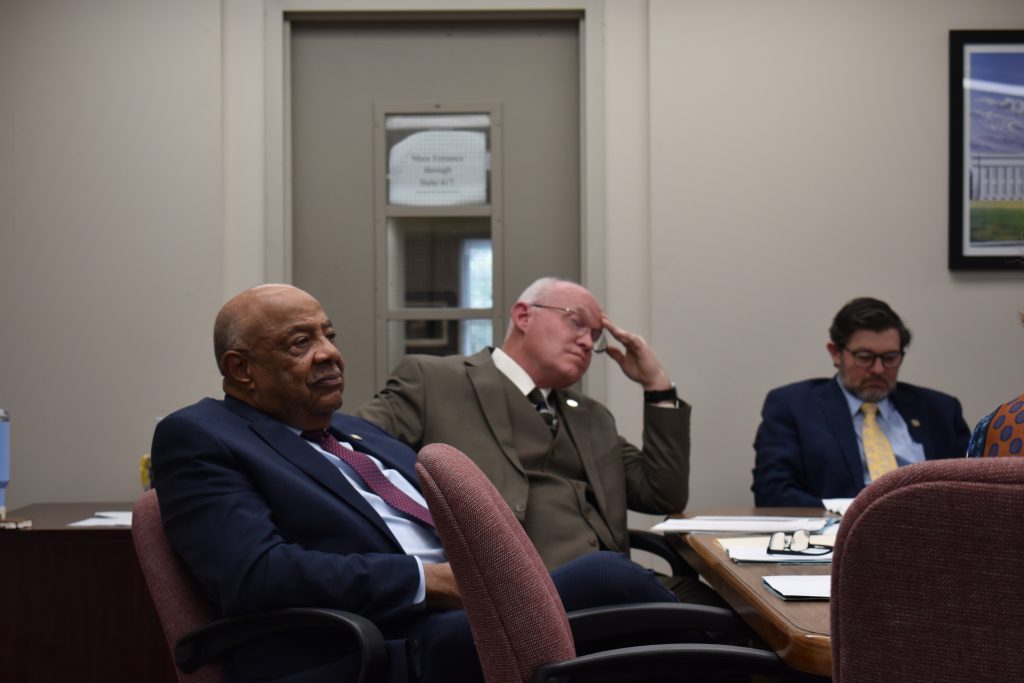
After it failed, four members of the public spoke in opposition to the bill because it did not include the very provision of cause Jones was trying to add with his amendment.
Angie Hayden, a founding member of Read Freely Alabama, opposed the bill and said that the lack of a standard for just cause would make Alabama an outlier nationally. Hayden disagreed with the framing of the bill and expressed concerns that it would add politics into libraries.
“I would like to first point out that this bill was presented in the Senate as a simple governance alignment bill, but the sponsor said recently that it’s actually intended to make it easier to censor library material,” Hayden said. “So when I tell you that this bill is government overreach and intended to politicize libraries, that’s not hyperbole or suspicion.”
Gadsden Public Library Director Craig Scott opposed the bill because of how it singles out library boards among the many in the state.
“If a governance issue needs to be addressed, it should be addressed consistently across all similarly situated boards, not directed at one type alone,” Scott said. “Public policy must be uniform and applied fairly. Targeting library boards creates unequal treatment and sets a troubling precedent.”
Lawmakers passed two other amendments to the bill during committee.
The first, carried by Rep. Troy Stubbs, R-Wetumpka, specifies that appointing authorities should make appointments that make sure board members reflect “the racial, gender, geographic, urban, rural, and economic diversity” of the population the library serves, not the state of Alabama as a whole’s population.
Stubbs said he introduced the amendment to recognize that libraries in different areas of the state serve very different populations.
Crawford introduced the second, which allows the officials to appoint themselves to the library boards.
“(The board) is the authority of the appointing authority, and they’re delegating it to someone else. So the theory is that if they want to retain that authority, they certainly can,” Elliot said of the amendment.
Support for the amendment contradicted what Elliott said on the Senate floor during debate last week. He had previously said that if the bill didn’t pass, city councils would appoint themselves to library boards.
“And they’re going to manage it because they don’t want to deal with the library board that’s not going to be accountable to the people,” Elliott said last week.
Lawmakers passed the bill by a vote of 7-5. Crawford and the four Democrats on the committee voted no.
After the bill passed, Rep. Kelvin Datcher, D-Birmingham, followed the speakers out of the room to encourage them to keep fighting against the bill. He told them to keep calling their representatives and said they should be encouraged by the bipartisan support for Jones’ amendment.

The bill now heads to the House floor. If it passes, the Senate would have to vote to concur with its House amendments for it to earn final passage.