
Those who know me well know that the Fourth of July is my favorite holiday. That’s not to knock Christmas, Easter, or even Thanksgiving, which are all wonderful in their own right.
But to me, Independence Day just hits different, as the kids say. It’s our annual reminder of where we came from, how far we have come, and why this great country is worth preserving. It’s uniquely American and America is special.
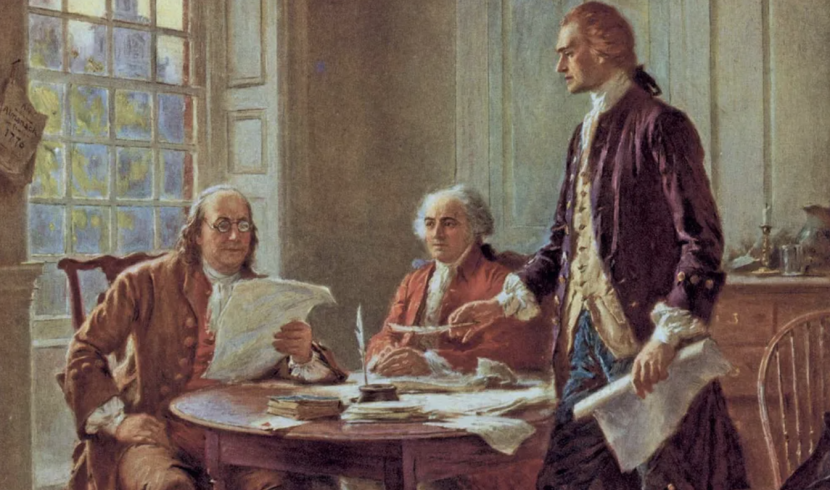
Two hundred and fifty years ago, flawed people of differing philosophies and backgrounds risked their lives to set their own destiny in a way that acknowledged human nature, nurtured the best parts of our humanity, and acknowledged the caution necessary to keep a Republic. Against great odds, they prevailed against the British. Against perhaps greater odds, they prevailed against themselves. Washington retired to his farm. Jefferson and Adams, philosophical and political rivals, died on the same Independence Day 50 years later, leaving behind the glorious, messy, and ever-evolving legacy upon which every person reading this has built their lives. We have grown our entrepreneurial society on rewarding risk to accomplish great things just as our founders did.
A few weeks ago I was asked to speak to history and civics teachers gathered at Jacksonville State University as part of the Center for Leadership and American Principles. Through a federal grant, the center is equipping educators to better emphasize civics education in our schools. That’s a cause worth celebrating, so I was thrilled to be asked to participate.
The title of the talk was “Teaching Patriotism in Troubled Times.” I thought it appropriate given that the times are objectively troubled and yet young people desperately need to be taught about how our country came to be and why they should be proud that they get to be a part of this enduring experiment.
Too often in modern society, we tarry into absolutist thinking. All or nothing. Black and white. To be worthy of our support, we require purity tests of people, ideas and institutions. We come up with political dealbreakers and write off those we disagree with. We tend to scorn those we don’t understand rather than try to understand them. It’s the kind of hive mind thinking that leads to people and programs getting cancelled. And because the United States has a pretty complicated history, there has been a tendency to avoid teaching it fully for fear its impurities don’t live up to that absolutist standard. This, of course, is folly. It neglects perhaps our greatest truth – that America was built to change in a slow and stable way. That’s why I’m encouraged by efforts at places like Jacksonville State and others to encourage and prepare schools to teach a robust civics education.
I believe we need more civics education because we need to produce citizens who understand the basics of our government and are equipped to engage in public discourse in a civil and productive way. In other words, when we need more Alabamians and more Americans who can think and talk about politics or culture or just the news with civility and respect.
Why are civility and respect and understanding so important? Because those shared qualities allow us to disagree, however harshly, and then unify after our disagreements. We live in a culture in which we are incentivized every day to argue, vilify, dig in to our own opinions, and sort ourselves into starkly divisive groups. And I don’t think there’s any question that it is eroding the fabric of our society.
It’s not that disagreeing and arguing are inherently bad. They aren’t. I love a good argument. We’ve been arguing with each other in this country since before its founding. But things are different now for two reasons. First is social media. The way hate and bitterness are fueled online is just grotesque. And everyone from politicians to news organizations have figured out that the best way to engage an audience and gain followers is to appeal to our fears, doubts, and prejudices. I’m afraid the social media situation is a structural problem that isn’t going away, and there’s not a lot we can do about the technology itself.
But the second reason things are different now is something we can deal with. It’s hard to pinpoint exactly when it happened – I’d say late ’90s or mid- 2000s – but politicians, and media companies and others seeking power began to prey on the relative ignorance of the American people. To the more cynical among us, the lack of civics education in our society was not a bug but a feature to be exploited. And boy do they exploit it.
Do you know why there are so many nasty attack ads around election time? Because they work! Everybody loves to complain about negative political ads, but believe me, campaigns wouldn’t run them if they weren’t effective. This current election cycle is proof positive, is it not? In an disengaged public, many voters are scared into voting against something or someone rather than voting for something or someone. This lack of civic literacy gives rise to sloganeering and mob mentality. And that’s a problem we can solve.
But how? How do you turn that cultural ship around? It’s tricky.
Even when you get past the distractions and the structural difficulties, I think the main challenge is this: powerful influencers on both the left and right are working hard to entrench the view that the United States is only good and worth preserving if their side is in charge. I’m sure many will read that and think, “well the other side does that, but not my side!” Sorry, dawg, they do it, too. So if we leave it up to society to teach our young people about politics, they are liable to go down that same absolutist path.
So we teach civics and patriotism by helping students understand that America is so much bigger than that lazy view. Actually, I’m not talking about just the students anymore, I’m talking about all of us. We all need to remember that America is so much bigger.
We’ve been through a lot as a country. It was not a perfect union on July 4, 1776 –- far from it. It took us another 90 years and a civil war to abolish slavery. It took us 100 more years to overcome Jim Crow and guarantee the right to vote. There have been a lot of ways we had to improve as a country, and we have. There’s a lot more we need to do, and we’ll do it all together. It is exactly now in this troubled time that we should remember how much our country has endured and be confident that it will overcome new challenges.
Each July 4th, I like to re-read the Declaration of Independence, sometimes out loud at a cookout. Thankfully, this year the professionals at the American Village took care of that.
I encourage you to re-read it as well. It is a sublime expression of our foundational ideals and principles: life, liberty, equality. But don’t stop at the Delcaration because the founding didn’t stop there.
Read the Gettysburg Address. Listen to how Lincoln draws a straight line, not from the Constitution, but from the Declaration, to that hallowed ground. He could have understandably seen the Civil War as proof that this experiment didn’t work and called for a departure from those foundational principles. Instead, he calls for a “new birth of freedom” of the nation that was “conceived in liberty, and dedicated to the proposition that all men are created equal.”
Read Martin Luther King, Jr.’s “I Have A Dream” speech from 1963. Again, it would have been easy for King to conclude that a nation that can’t live up to its founding principles isn’t worth preserving. Instead, he continues that straight line from Philadelphia and Gettysburg by establishing that the struggle for civil rights is the next step toward truly embodying those founding principles.
There’s another speech I’d encourage you to read as well, though it is much more obscure. In fact, I wasn’t turned on to it until a few years ago when Dispatch Co-Founder Jonah Goldberg read it aloud on his podcast.
It’s from President Calvin Coolidge upon the 150th anniversary of the Declaration of Independence in 1926. Here’s a passage…
“Governments do not make ideals, but ideals make governments. This is both historically and logically true. Of course the government can help to sustain ideals and can create institutions through which they can be the better observed, but their source by their very nature is in the people. The people have to bear their own responsibilities. There is no method by which that burden can be shifted to the government. It is not the enactment, but the observance of laws, that creates the character of a nation.
“About the Declaration there is a finality that is exceedingly restful. It is often asserted that the world has made a great deal of progress since 1776, that we have had new thoughts and new experiences which have given us a great advance over the people of that day, and that we may therefore very well discard their conclusions for something more modern. But that reasoning can not be applied to this great charter. If all men are created equal, that is final. If they are endowed with inalienable rights, that is final. If governments derive their just powers from the consent of the governed, that is final. No advance, no progress can be made beyond these propositions. If anyone wishes to deny their truth or their soundness, the only direction in which he can proceed historically is not forward, but backward toward the time when there was no equality, no rights of the individual, no rule of the people. Those who wish to proceed in that direction can not lay claim to progress…”
Those words were spoken 100 years ago. No one knew the challenges that lay ahead. The Great Depression. The Dust Bowl. The rise in fascism in Europe and the Second World War. The Civil Rights Movement. We were able to rise to those challenges and meet them because we adhered to the ideals of our founding and did not abandon them.
So let’s teach that in our classrooms. Let’s remind ourselves of it every day. Let that be the lesson for how we will overcome the challenges of today and tomorrow.
How do you embrace patriotism in troubled times? By remembering the many other troubled times this nation has faced and how each time we have leaned on and leaned into the ideals of our founding to overcome them.
I love this country. Here’s to another 250 years!