
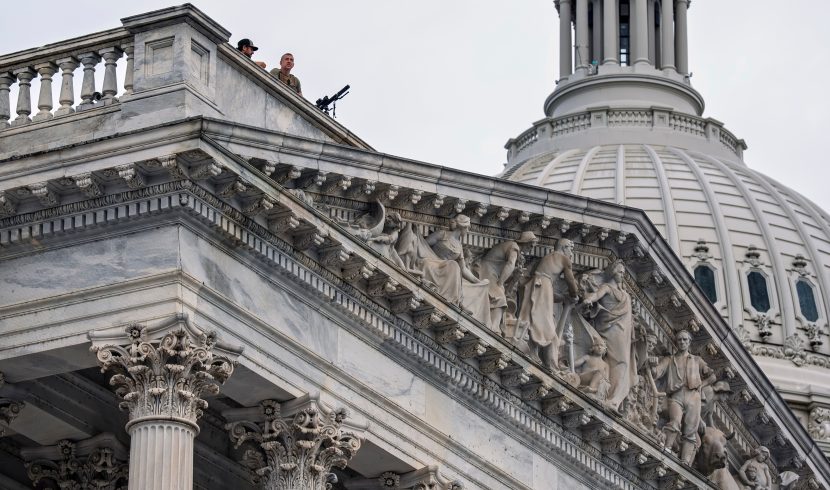
WASHINGTON — The U.S. Senate returns Monday in a final three-week push before the midterms.
Senators are set to begin voting this week on legislation to regulate cryptocurrency. The CLARITY Act would provide federal rules for digital assets and define regulatory oversight between the SEC and the Commodity Futures Trading Commission.
The Senate will take its initial procedural vote on the bipartisan bill Tuesday, though Democratic concerns about ethics may hinder progress, as it requires 60 votes to move forward.
Democratic U.S. Sen. Elizabeth Warren of Massachusetts, the ranking member on the Senate Banking Committee, has argued the CLARITY Act needs ethics guardrails to prevent loopholes that could allow President Donald Trump and other government officials to profit off the crypto industry.
Warren urged Republican and Democratic Senate leaders to implement those changes in July after financial disclosures revealed that Trump profited about $1.4 billion from his crypto industry ventures.
“The crypto legislation heading to the Senate floor must prevent the President, Vice President, senior administration officials, members of Congress, and their families from profiting off the crypto industry,” Warren wrote to Senate leaders. “Anything less would be a flagrant giveaway to the President and his family at the expense of the public.”
On Sunday, Republican authors of the bill released a new draft of the legislation that added new ethics language aimed at easing those concerns. The bill now gives state attorneys general a role in enforcement.
One of the bill’s key Republican leaders, U.S. Sen. Cynthia Lummis, has recently urged her Democratic colleagues to support the bill on the floor this month as the Senate prepares to return to Washington for the first time since the beginning of August.
“We have incorporated more than 114 separate provisions at my Democrat colleagues’ request, and as a result, this bill is a strong bipartisan product,” Lummis, R-WY., said in a statement. “Unlike rulemaking, legislation gives this industry a lasting solution that shields it from the whiplash of changes in the White House.”
NIL
With the return of college football game days, the Senate could also take up legislation this month to regulate name, image and likeness in college sports under the Protect College Sports Act, though no vote has been scheduled.
The bill would reshape the rules governing college sports by establishing a national framework for student-athlete compensation, limiting transfers and restricting coaches from switching jobs during a season. It also would create limited antitrust protections for the NCAA.
U.S. Sen. Katie Britt, R-Ala., said there are “good things” in the Protect College Sports Act such as transfer limits, but she needs clarity on other topics in the bill.
“We want to make sure that we are crystal clear that we are not going to circumvent state law when it comes to men in women’s sports,” Britt recently told host Todd Stacy on Capitol Journal. “There’s also other things that come in the title two provision of the actual act where there is some pooling dynamics, and capping of conferences and people having to sit out of conferences if they choose to move.”
U.S. Sen. Tommy Tuberville, R-Ala., has been vocal in his opposition to the bipartisan legislation, arguing it amounts to federal overreach in college sports. He has instead been advocating for a more tailored approach to the issue. But before the recess, the former Auburn football coach signaled that he was getting closer to supporting the Protect College Sports Act.
Former Alabama football coach Nick Saban, who is a strong supporter of the college sports bill, is now appearing in a national commercial urging Congress to pass it.
“Join the winning team today and help Congress protect this American tradition,” Saban said in the 30-second ad.
Even if the Protect College Sports Act clears the Senate, it faces an uncertain future in the U.S. House.
House agenda
The House will also return to Washington for one week on Monday, before breaking again until after the midterm elections.
As the debate over data centers seeps into campaign season across the country, the lower chamber is scheduled to vote next week on a bill, the Ratepayer Protection Act, to help ease concerns about consumers paying for data centers’ high electric costs.
The bipartisan bill would require state utility regulators to consider rules for large-load data centers to cover the full costs of power generation, transmission lines, and other energy infrastructure upgrades to meet their massive energy demand.
Lawmakers will consider the bill under suspension of rules, which is a process meant to fast-track legislation when leaders believe bills can pass.
Considering the bill as one of the final pieces of legislation before the midterms shows lawmakers want to act on data centers, as voters keep the issue top of mind this year.