
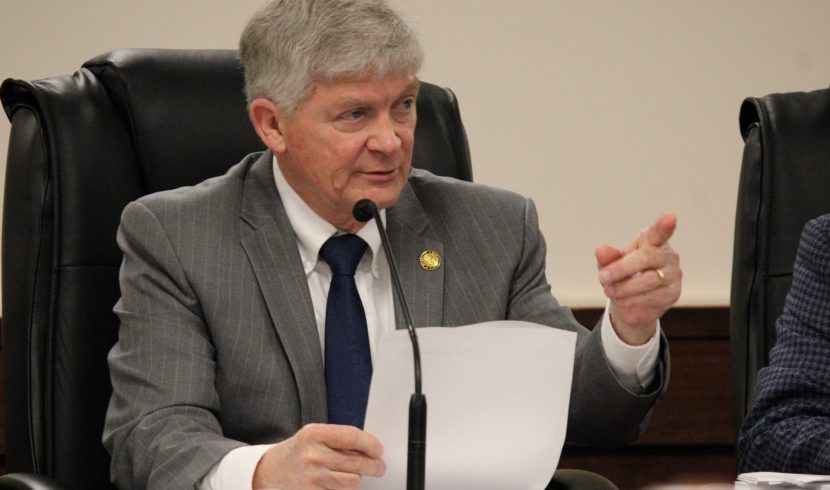
Legislation to change how at least some of the sales tax revenue collected from online purchases is distributed to Alabama cities and counties is dead for this legislative session.
Sen. Greg Albritton’s Senate Bill 347 stalled in his Senate General Fund budget committee earlier this month over concerns about it creating “winners and losers.”
Wednesday, Albritton, R-Range, told Alabama Daily News his bill will not get a vote. There are six legislative days remaining in this session.
Conversations about revenue distribution and finding a “more complete solution” will continue in the future, Albritton said.
The Simplified Sellers Use Tax was established about a decade ago to collect a flat 8% on online purchases from distributors without a physical presence in Alabama. Half of the revenue from SSUT goes to the state, 30% to cities and 20% to counties, based on population.
For years, some of the state’s larger cities have said the formula isn’t equitable to them — they’d receive significantly more money to support their services and infrastructure under a formula more like the sales taxes paid on in-person purchases.
Last year, the City of Tuscaloosa and other municipalities filed a lawsuit over the distribution system worked out in the Legislature nearly a decade ago. The cities voluntarily dropped the lawsuit in mid-February, instead hoping to find a solution in the State House.
Albritton had said his bill was not a perfect solution, but a good-faith effort to address cities’ concerns.
Under it, the state would gather population data from the U.S. Census Bureau Population and Housing Estimates Program every five years beginning in 2027, instead of every 10 years from the census as is now law.
Albritton previously said there was consensus behind the bill, but when some municipalities started studying the numbers, support was lost.
“We don’t have a consensus anymore,” Albritton said Wednesday.
“… We’re just going to have to find another solution.”
And communities whose population loss was exposed under Albritton’s proposal are likely going to lose population — and SSUT funding — in the 2030 census.
“There will be winners and losers and we’ll have to deal with that,” he said. “We might as well try to deal with that now.”
Richard Rush, a spokesman for Tuscaloosa, said that although SB347 will not be moving this legislative session, the city appreciates Albritton’s willingness to continue the conversation.
“We remain committed to working in good faith with all parties to find a common-sense solution,” Rush told ADN. “This is a complex issue and will require continued collaboration as we move toward an outcome that is fair and more accurately reflects the growth of Alabama’s communities.”
The SSUT is worth about $1 billion annually — and growing.
When the lawsuit was filed against the state, every county and dozens of cities intervened on behalf of the defendants.
“We continue to fully support the preservation of Alabama’s system for collecting use tax on internet transactions,” Sonny Brasfield, executive director of the Association of County Commissions of Alabama, told ADN. “Later this spring, we will again meet with those who filed a lawsuit challenging SSUT to explore their proposals. Our previous meetings have been marked by open and productive communication, and we expect that to continue.
“However, the Association’s position remains unchanged,” Brasfield said. “We cannot support structural changes to SSUT. We cannot support changes that put SSUT at constitutional risk. And we cannot support changes that reduce revenue to local governments that rely on SSUT to provide essential services.”