
WASHINGTON — After multiple switch-ups and voter confusion, the candidates running to represent four of Alabama’s congressional districts have been established.
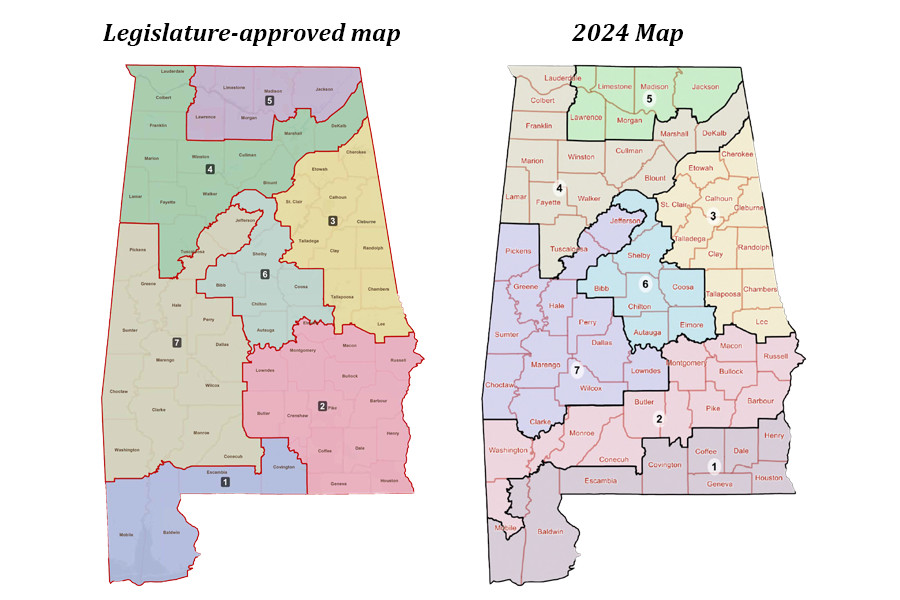
The Supreme Court’s ruling on Tuesday allows the state to use a congressional map in this year’s elections that a court previously found diluted the power of Black voters. With the decision, Alabama can now lock in the special August primaries for the 1st, 2nd, 6th and 7th congressional districts.
Alabama Secretary of State Wes Allen said his office would certify the party’s qualified candidates and send them to counties on Wednesday.
The secretary’s of state’s office referred Alabama Daily News’ questions on the status of reassigning voters to different districts to part of its press release from Tuesday night, in which it said the office would work with local election officials to ensure the necessary updates to the districts are implemented ahead of Aug. 11.
Jeff Elrod, Alabama’s director of elections, previously testified during a federal court hearing that voters would need to be reassigned to the new districts by June 2, the same day the Supreme Court ruled. Plaintiffs pointed to that fact in their arguments to the Supreme Court, urging the justices to oppose allowing the 2023 map this year, in part because it’s too late to switch maps before the election.
The new 1st District race
Once a Republican battle between seven candidates, including previous frontrunners former U.S. Rep. Jerry Carl of Mobile and State Rep. Rhett Marques of Enterprise, the 1st District Republican field has dwindled to four qualified candidates. The district will now include all of Mobile and Baldwin County. The boundaries favor Republicans.
“I look forward to running in the First Congressional District and earning the opportunity to represent the people of South Alabama,” Carl said in a statement. “South Alabama deserves a proven conservative fighter, and I have the proven record that shows I will take that fight to Washington on behalf of the people of the First District.”
Along with Carl, Republicans Lucas Burger, John Mills and Austin Sidwell are also running for the 1st District on Aug. 11. Burger is a new addition to the ballot for the special primary. Mills, who lives in the new 2nd District, explained why he’s remaining in the AL-1 race this year.
“My campaign has always been rooted in service to the Gulf Coast, and the 1st District is where my background, experience, and message are most directly aligned,” Mills said. “I spent much of my adult life serving along the Gulf Coast as a Navy pilot, military leader, and emergency management professional. I understand the district’s shipbuilding, aviation, national security, veterans, small business, hurricane preparedness, coastal resilience, and mitigation priorities.”
Carl represented the slightly different 1st District from 2020 to 2024 before losing to U.S. Rep. Barry Moore, R-Enterprise, in a competitive primary under the current court-drawn map.
Sidwell, who lives in Baldwin County, confirmed he will continue to be in the race for the new 1st District seat on social media, saying he will “fight to ensure we have true representation in Congress.”
Democrat Clyde Jones, Jr. will remain unopposed in the Democratic primary.
2nd District could flip red
The 2nd Congressional District could likely flip from blue to red under the 2023 map. U.S. Rep. Shomari Figures, D-Mobile, will face more of an uphill battle to defend his seat this year.
Despite that, Figures said he’s all in on the campaign to keep his seat in Congress
“Eight of the 13 counties that I currently represent are in this new district,” Figures told Alabama Daily News. “So I’ve had the privilege to be able to represent the people there, to learn about the issues, to get to know those communities in ways that I think will be beneficial in moving forward.”
“It obviously adds some new…counties to the district, but at the end of the day, the issues are the same.”
The new 2nd District will span the Wiregrass area up into Montgomery and stop at Butler and Lowndes counties on the western side. It will no longer include Mobile, which Figures calls home. Federal law does not require candidates to live in the districts they represent, only in the state.
Figures said he will rely on his record during his first term in Washington to speak to the 2nd District voters, such as highlighting the federal dollars he has already brought back to Alabama.
“We have a record of paying attention to our rural communities, have a record of delivering real results,” he told ADN.
In the Nov. 3 general election, Figures will face one of six Republicans who are also vying for the seat.
Marques switched from the AL-1 race to the 2nd District when the state said it would implement the 2023 map this year.
“Now, it’s time to send President Trump an America First fighter who will stand with him and deliver for the people of Alabama’s Second Congressional District,” Marques said Tuesday night.
Marques will compete against fellow Republican Hampton Harris, who was previously the only GOP candidate in the 2nd District race under the current congressional map.
Joshua McKee and James Richardson also switched to the 2nd District race under the 2023 map after previously running for the AL-1 seat.
David Matthews, who worked in the U.S. Department of Agriculture under the Trump administration, and Christian Horn are new additions to the GOP special primary ballot.
6th and 7th districts
The 6th and 7th congressional districts in central and West Alabama will also slightly change under the 2023 map, so they are also set for special primaries.
U.S. Rep. Gary Palmer, R-Birmingham, and physical therapy assistant Case Dixon will remain the two Republican candidates vying for the 6th District seat. Jacob Bouma-Sims, Ashtyn Kennedy, Maurice Mercer and Keith Pilkington are the Democrats running in August.
U.S. Rep. Terri Sewell, D-Birmingham, will stay unopposed in the primary. But under the 2023 map, she will face a Republican challenger, either Ammie Akin or David Perry, in the general election.
There will be no runoffs for the special election, so the winners will be decided based on plurality.
This story has been updated to include all the Democratic candidates running for the 6th District.