MONTGOMERY, Ala. – The Alabama State Board of Education returned Thursday to the question of approving new social studies textbooks, but members spent much of the discussion focused on the board’s role in approving the materials.
A vote, initially expected in November, was delayed after some members raised questions about the contents of the textbooks and their selection process. At Thursday’s work session, the conversation centered on whether the board should accept the recommendations of its appointed textbook committee or take a more active role in shaping the approved list.
State Superintendent Eric Mackey outlined four possible board actions he will bring to the board for a vote in March: approve the committee’s recommendations as a whole; amend the list to remove certain publishers; split the adoption by grade level, as was done with English language arts textbooks in 2022; or take no action.
Mackey said he had received few direct complaints about the textbooks, though he acknowledged that board members had heard from constituents with concerns.
“My recommendation is to vote on it, to approve it, to tell anybody who’s your constituent that says ‘there are books on that list I don’t like,’ then say ‘call your local board and ask them not to buy those books,’” Mackey said. “They’ve got other options.”
Under state law, textbook committees are appointed after new academic standards are adopted. The board approved new social studies standards in late 2024. The committees review and score publisher submissions based on alignment to those standards, then submit recommendations to the board. The board then votes on whether to adopt the committee’s recommendations. Local school systems ultimately choose which approved materials to purchase but they are waiting for state board action before buying new social studies textbooks, even though the new standards take effect in August.
If the board declines to adopt the committee’s recommendations, local school systems would have to convene their own textbook committees and evaluate textbooks on their own, duplicating work already completed at the state level.
“Our role is not to choose the book,” board member Tonya Chestnut said. “It’s our place to determine whether or not the process was followed and whether or not the law was followed.”
Board Vice President Marie Manning said public criticism often reflects misunderstandings about how textbooks are used in classrooms.
“We don’t teach textbooks,” she said. “We use them to teach what we’re supposed to teach.”
Other members said the issue was not the process, but the substance of the materials.
Board member Allen Long said some of the materials he reviewed lacked substance and that he would prefer a delay rather than approving books he believes fall short of what students deserve.
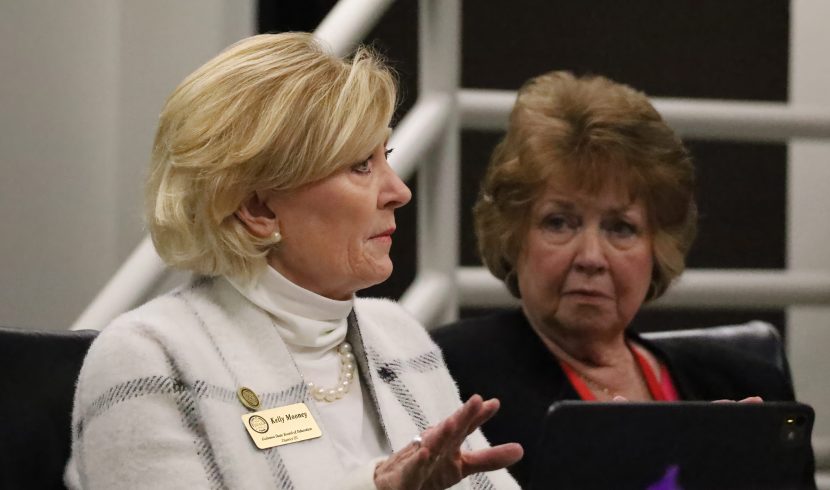
Board member Kelly Mooney said some materials do not reflect what she described as Alabama values. She cited a textbook image of a logging truck labeled “deforestation,” saying the term casts the state’s timber industry in a negative light.
“That is Alabama’s No. 1 industry as an agricultural product,” Mooney said. “That may be what it might be in Washington State or somewhere else, but that’s in the Alabama textbook.”
Board member Yvette Richardson responded that textbooks are aligned to academic standards, not values.
“We don’t align our textbooks to values. We align our textbooks to standards,” she said. “Values can be different depending upon whose value it is. The standards are supposed to be across the board and consistent.”
Mackey said Gov. Kay Ivey has proposed $7 million in funding to allow the state to develop its own elementary social studies textbooks, an idea he said he previously discussed with board members. He said the effort could take several years and would give the state more direct control over classroom content.