
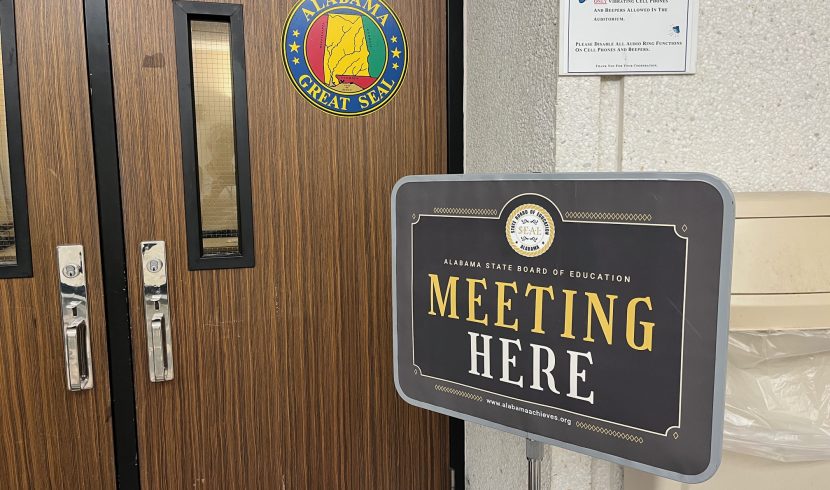
BIRMINGHAM, Ala. – The Alabama State Board of Education on Thursday continued shaping a $6.8 billion FY28 budget request, about $247 million more than the $6.6 billion approved for FY27.
The request is still preliminary and could change before the board votes on a final version Oct. 8.
State Superintendent Eric Mackey told board members during their work session in Montgomery that the budget will likely be “very tight,” with rising costs for existing programs and less excess revenue expected to be available for large supplemental appropriations.
The board’s top priorities include adolescent literacy, expanding opportunities for high school students to become college and career ready and school safety. Mackey said he also wants to move several programs that have relied on supplemental funding into the regular Education Trust Fund budget.
“There is a huge demand on the funds available,” Mackey said.
One of the board’s biggest requests is $45 million for Struggling Readers Beyond Grade 3, the department’s adolescent literacy initiative that builds on the work of the Alabama Literacy Act.
Lawmakers provided $10 million for the effort in the FY27 supplemental budget, but Mackey said he wants the program moved into the regular ETF budget so the work does not depend each year on excess revenue being available.
The same is true for College and Career Readiness Grants, another major priority. The board is requesting $20 million for grants that help districts pay for things like second ACT administrations, college campus visits, industry credential exams and dual enrollment.
The grants were created after the board adopted a requirement that students demonstrate college or career readiness to receive a diploma and have helped support a statewide CCR rate that Mackey said has risen from 74% to more than 90%.
The department wants those grants moved from supplemental funding into the regular ETF budget as well.
School safety is another area where the board is looking for a more permanent funding source.
The board is requesting $27.5 million for school safety in FY28, $25 million more than the $2.5 million lawmakers included in the regular FY27 budget. Lawmakers also provided an additional $22 million for school safety through the FY27 supplemental budget.
Recent safety funding has helped schools pay for various equipment such as weapons detection systems, cameras, emergency alert buttons and other security improvements. The department also funds regional school safety specialists who conduct inspections, train school personnel and help districts develop safety plans.
Moving more of that money into the regular ETF budget would make those efforts less dependent on excess revenue and supplemental appropriations.
The budget request also includes $30 million for the Alabama Summer and Afterschool Program and another $17 million for ASAP grants to support local school and community efforts.
Those programs are separate from the summer reading and math programs required under the Literacy and Numeracy acts.
During the board’s August retreat, Mackey said the summer and afterschool grants support programs run by schools and community organizations, including YMCAs, churches and other groups. The state funded 192 summer sites this year, he said.
Beyond those priorities, costs for several major ongoing initiatives also continue to grow.
The board is requesting $116.5 million for the Alabama Numeracy Act, up from $114 million, as the state continues adding and supporting math coaches.
Mackey said the cost does not stop once those coaches are hired.
“The law says we have to support them,” Mackey said. “We have to provide professional development for them. So it’s a continuing cost.”
The request also increases funding for the Alabama Math, Science and Technology Initiative from $38.8 million to $41.3 million, data literacy from $2.6 million to $6 million and Advanced Placement programs from $13.5 million to $14.5 million.
The Alabama Reading Initiative would remain level funded at $112.9 million.
Educator health insurance
One of the biggest pressures on the education budget is the rising cost of educators’ health insurance.
Mackey, who serves on the Public Education Employees’ Health Insurance Plan board, said PEEHIP is expected to ask lawmakers for $222 million to cover a projected FY28 shortfall.
He said lawmakers do not want teachers and other education employees to pay more, and he expects them to cover part of the shortfall. Additional money could come from PEEHIP’s retiree health trust, which Mackey said remains healthy.
But he warned that the state cannot continue using the trust to absorb large shortfalls year after year without eventually making changes to the plan.
Those changes could include higher premiums, increased copays or reduced benefits.
“I do not think we will be able to go through another year without the cost going up to employees,” Mackey said.