
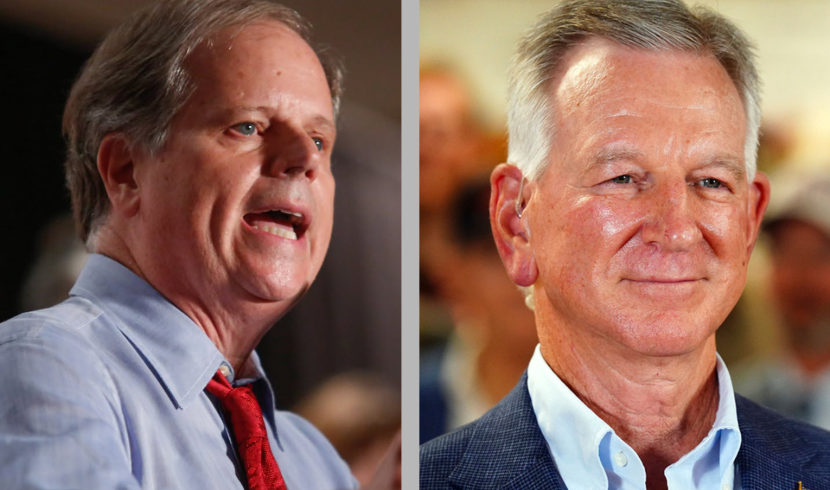
MONTGOMERY, Ala. – Republican gubernatorial candidate Tommy Tuberville has an 11-point lead on Democrat Doug Jones in the race to be Alabama’s next governor, according to a Cygnal poll commissioned by Alabama Daily News and Gray Television.
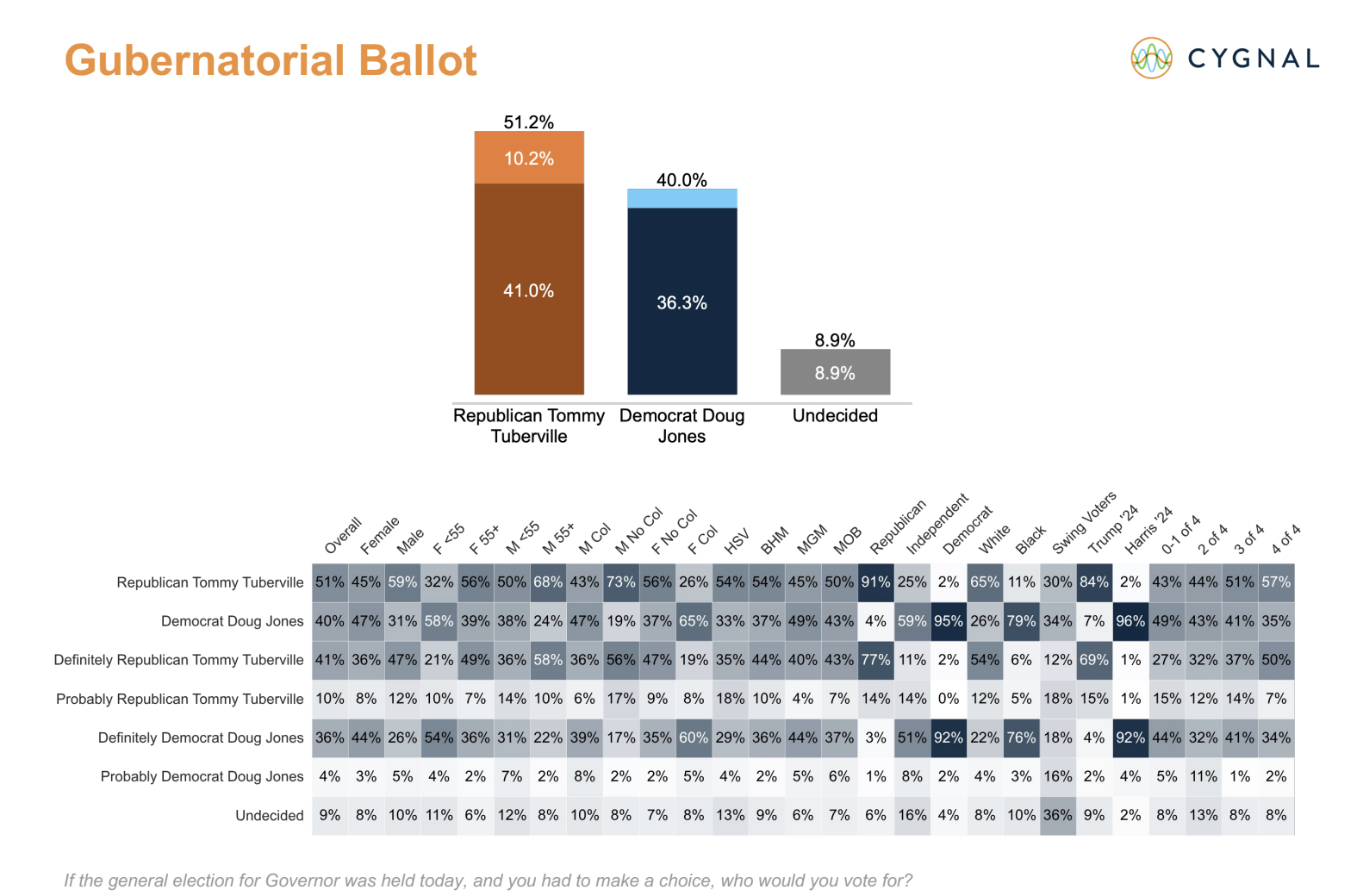
In a survey of 500 likely general election voters, 51.2% said they would vote for Tuberville, Alabama’s senior U.S. senator, if the election were today, while 40% said they would vote for Jones, the former U.S. senator. The remaining 8.9% said they were undecided.
The survey was conducted statewide on Oct. 16 and 17 and has a margin of error of ±4.38%.
Both candidates had strong support from their party bases. Ninety-one percent of Republicans said they would vote for Tuberville, 4% said they would vote for Jones and 6% were undecided. Jones earned an even higher percentage of his party’s votes, with 95% of Democrats saying they would vote for him. Two percent of Democrats said they would vote for Tuberville and 4% were undecided.
Likely voters who identified as independents – around a quarter of those surveyed – went heavily for Jones. Fifty-nine percent of independent voters said they would vote for Jones, 25% said they would vote for Tuberville and 16% said they were still undecided.
More than a third of swing voters – 36% – said they were still undecided about who they would support in the governor’s race. Thirty-four percent of the group favored Jones, while 30% said they would vote for Tuberville.
Where undecided voters stand on other issues
Nearly 9% of the likely voters polled said they were undecided about who they would support in the governor’s race. But how those voters answered other questions in the survey offers insight into how they might lean.
Inflation and the cost of living was by far the most important issue for these voters at 47%. Fifteen percent said data centers, a concern that transcends partisanship in the survey. Corruption in politics came in third with 14% of undecided voters in the governor’s race calling it the single most important issue.
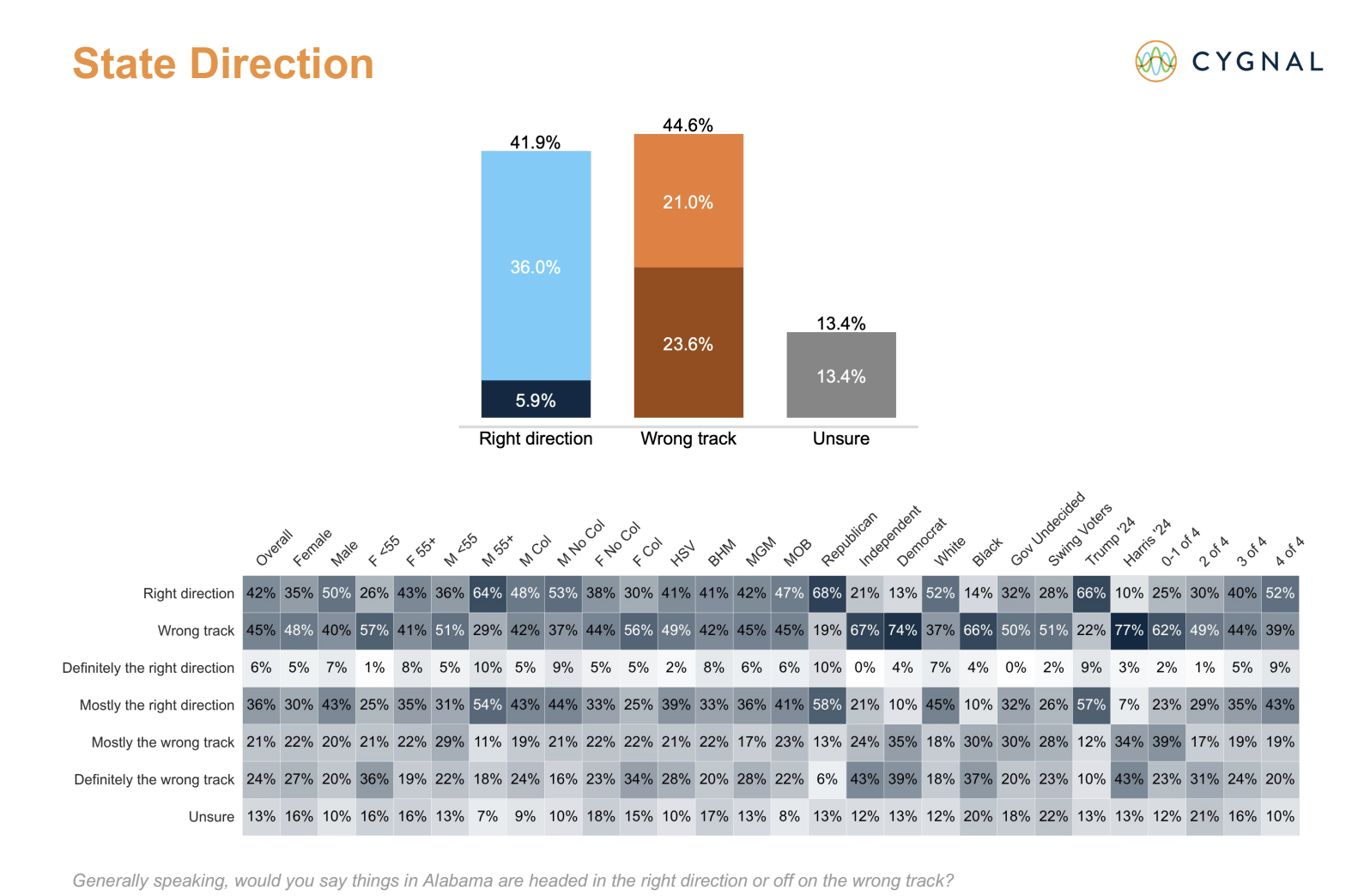
Half of the group said the state was headed in the wrong direction, 32% said it was headed in the right direction and 18% were unsure.
When asked generally if they would vote for a Democratic candidate versus a Republican candidate, three-quarters of the group was undecided. Twenty-one percent said they would support a Republican, while just 4% said they would support a Democrat.
Statistically, even if Jones were able to convert every single undecided voter to his side, it wouldn’t be enough for the Democrat to get the 50% plus one vote needed to win the election, according to the survey.
Direction of the state
Support by geography
Tuberville dominated in rural areas, with 63% of rural voters surveyed saying they would vote for the former Auburn coach, compared to 28% for Jones. Jones had similar dominance in urban areas with 62%, compared to Tuberville’s 32%.
Tuberville earned the support of 55% of voters who said they lived in a town, while Jones had 33%. The two candidates polled similarly with suburban voters, though Jones’ 46% slightly edged out Tuberville’s 44%.
Though Jones performed well in urban areas, Tuberville was ahead in all larger media markets except for Montgomery.
Fifty-four percent of Birmingham voters said they would support Tuberville, and 37% said they would support Jones, who grew up near the city. Tuberville took 54% again in Huntsville, while Jones polled lower at 33%, his worst in the areas included in the survey. The Republican had 50% of likely voters’ support in Mobile, and Jones had 43%.
The state’s capital city was the only area that polled higher for Jones. The Democrat had 49% of support in Montgomery, while Tuberville got 45%.
Support by demographics
Sixty-five percent of voters who identified as white said they would vote for Tuberville, while 26% said they would support Jones. Eight percent of white voters, the largest racial group in the state by far, were undecided.
Black voters overwhelmingly expressed support for Jones, with 79% saying they would vote for the Democrat and 11% saying they would vote for Tuberville. Ten percent of Black voters were undecided.
Asian, Pacific Islander, Hispanic/Latino and other racial groups were not large enough in the survey to be statistically significant.
Older voters also said they would vote for Tuberville at a higher rate, while younger voters said they would vote for Jones.
Tuberville got the support of 61% of voters 55 years and older, a foundational base of the population that reliably gets out and votes on election day. Thirty-two percent of the group said they would vote for Jones, and 7% were undecided.
Forty-nine percent of voters under 55, a group the Jones campaign has been courting, said they would support the Democrat if the election were held today. Tuberville took 40% of the group, and the other 11% was undecided. Jones especially dominated the 18-29 age group with 71% to Tuberville’s 21%.
Image testing
Though Tuberville took a clear lead when likely voters were asked who they would vote for if the election were today, a similar percentage of voters viewed the two candidates unfavorably and neither earned a majority favorability rating.
A net of 48% of those surveyed viewed Tuberville favorably, with 22% saying they viewed him very favorably and 25% viewing him somewhat favorably. Jones had a net favorable rating of 42% – 26% very favorable and 16% somewhat favorable.
Tuberville and Jones’ net unfavorable ratings were very similar across both categories of unfavorability. Tuberville’s net unfavorable rating was 44%, while Jones’ was 43%.
Six percent of surveyed likely voters said they viewed Tuberville somewhat unfavorably, and 38% said they viewed him very unfavorably. Seven percent said they viewed Jones somewhat unfavorably, and 36% said they viewed him very unfavorably.
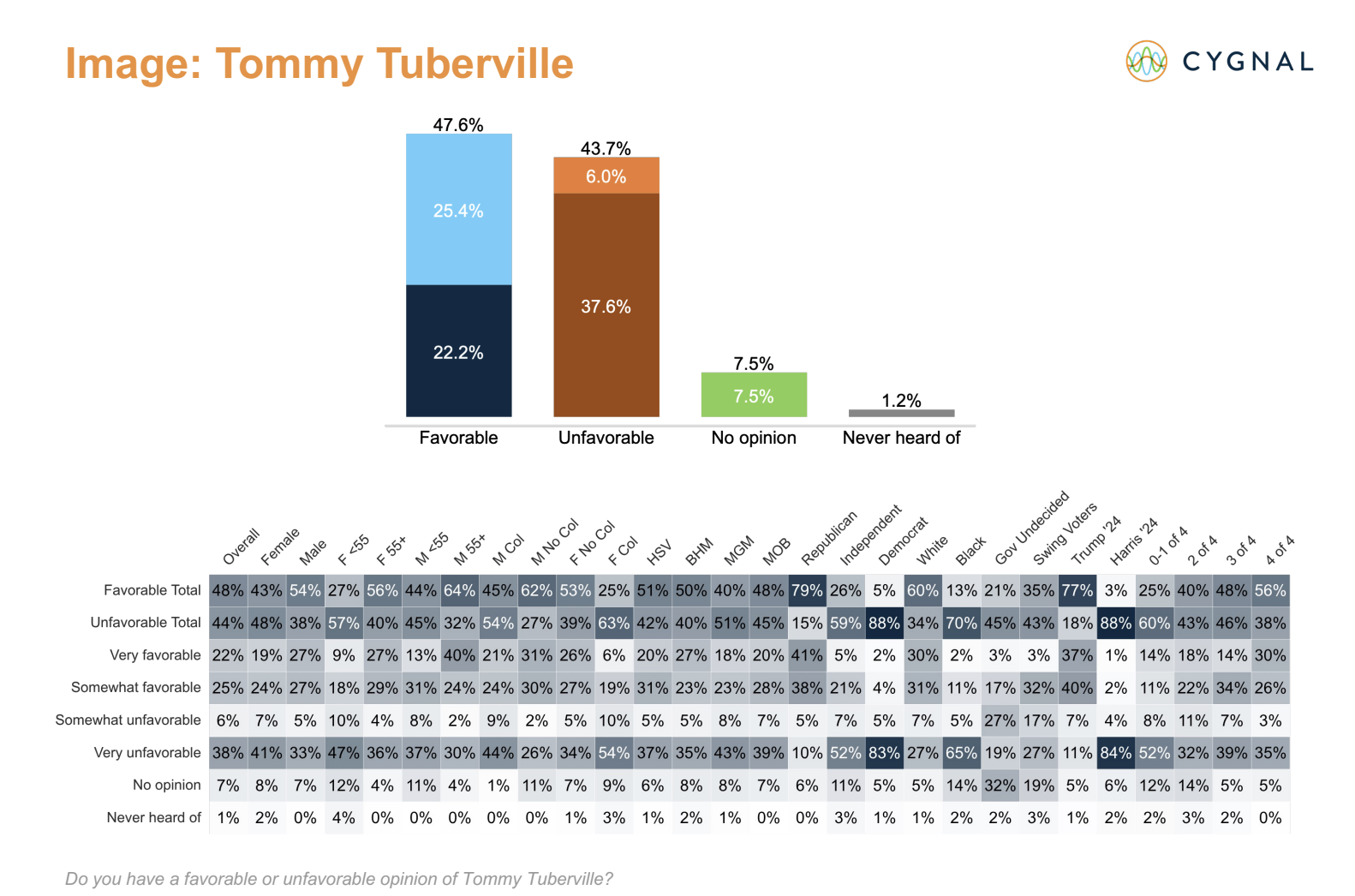
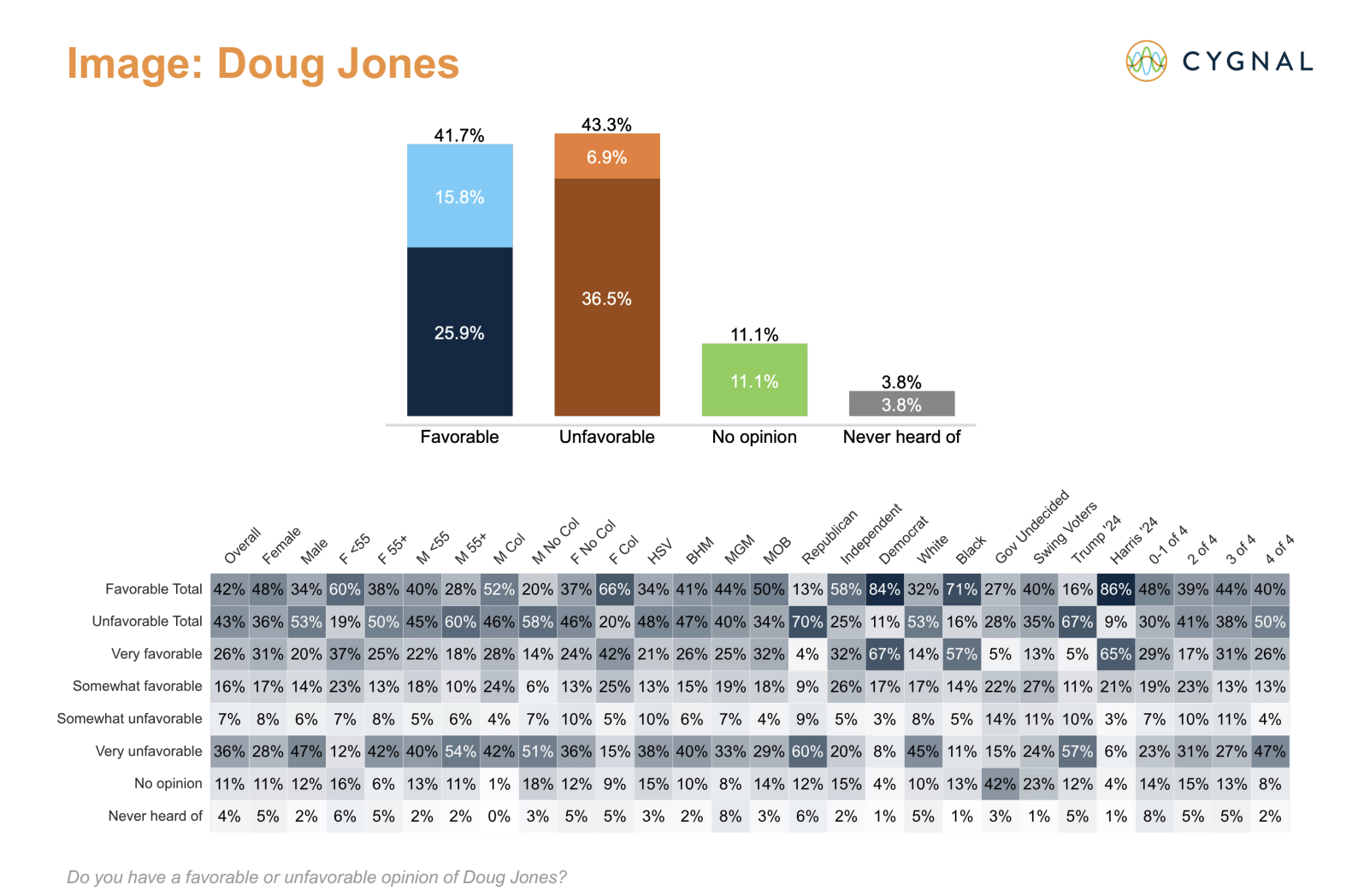
Name recognition was better for Tuberville, with only 1% of those surveyed saying they had never heard of him. Four percent said they had never heard of Jones.
A smaller proportion of those surveyed were neutral about Tuberville than Jones. Seven percent had no opinion on Tuberville, while 11% had no opinion on Jones.
Jones also had a higher rate of favorability from within his own party than Tuberville. Eighty-four percent of Democrats said they had a favorable opinion of Jones, while 79% of Republicans said they had a favorable opinion of Tuberville.
The Democrat also had a higher rate of cross-party favorability. Thirteen percent of Republicans had a favorable opinion of Jones, compared with 5% of Democrats saying they viewed Tuberville favorably.
Surveyed voters who identified as independents had a much more favorable view of Jones than Tuberville. Fifty-eight percent of independents said they had a favorable opinion of Jones, compared with 26% for Tuberville.
Jones’ strongest demographic groups for favorable opinions were Black voters (71%), college-educated women (66%) and women under the age of 55 (60%). Likely voters from the Mobile area had the highest percentage of favorable opinions of Jones at 50%.
Tuberville’s favorable viewing was highest among men over the age of 55 (64%), men without a college education (62%) and white voters (60%). Voters surveyed from Huntsville had the highest percentage of favorability for Tuberville at 51%.
The general election is Nov. 3.