
Is your high school sophomore ditching math next year?
A new high school diploma pathway – the Workforce Pathways Diploma – will be available starting this fall, and students are making decisions right now during registration that could shape their futures. Parents of rising juniors and seniors need to understand this new option.
Created by lawmakers last year, the Workforce Pathways Diploma offers a career-focused alternative to the traditional college-prep track. Students can swap upper-level math and science for hands-on courses in fields like welding, health sciences and automotive repair – while still earning a high school diploma.
But education leaders caution: this isn’t an “easier” path. It’s just a different one.
“We’re doing our registration now and educating our students on the option for next year,” said Cherokee County High School Principal Bobby Tittle. “We’re trying to educate them (about the new option) and, at the same time and almost more importantly, educating parents.”
Tittle said students and families need to understand the longer-term consequences of their choices – especially before completing class registration this spring.
“You don’t want a child that’s in tenth grade right now – a 15-, 16-year-old child – to be determining if they’re going to not take their next two courses of math and science their junior and senior year,” Tittle said. “Because, let’s just face it, for probably 60% of the kids, they’re only going to look at it (and think) ‘Oh, that’s an easier option.’ But it’s not.”
Tittle said he’s glad the new pathway exists – especially for students who are better suited to technical careers – but he wants students and families to know that career-tech classes can be just as rigorous.
“There’s always been an underlying factor of ‘Look, this child doesn’t need to be taking (trigonometry,)’” he said. “They need to be taking another welding course, which is sometimes harder than trig, or a higher-level automotive course, which again is sometimes harder than trig.”
“It’s not like it’s an easier path,” Tittle said. “It’s just a different path.”
What are the diploma options?
Under Alabama’s new system, students can now choose from two diploma options:
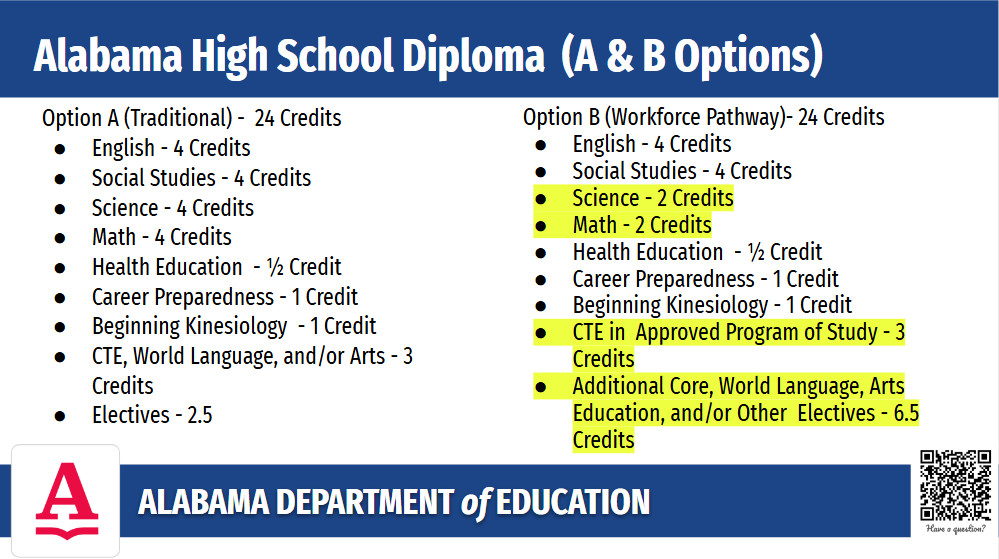
Option A: Traditional four-by-four curriculum
- Four credits each in math, science, English, and social studies
- This pathway is recommended for students planning to attend a four-year college
Option B: Workforce pathways diploma
- Four credits in English and social studies
- Two credits in math: Algebra I and Geometry (typically taken in 9th and 10th grade)
- Two credits in science: Biology and a physical science
- Plus three credits in a career technical education (CTE) sequence that qualifies the student as a “completer” in a chosen field
The image below depicts the two options.
Questions parents should ask
Before choosing Option B, families should consider:
- Does my child plan to attend a four-year university?
- Would they benefit more from career training than college prep?
- Are they ready to commit to a specific pathway?
- What career tech programs does my child’s school offer?
- Is there time to switch back if they change their mind?
What about college and sports eligibility?
Students who complete the Workforce Pathways Diploma will still graduate with a high school diploma. However, not all colleges accept it. For example, the University of Alabama requires three credits in math and science.
According to state education officials, the Alabama High School Athletic Association has confirmed that students choosing Option B will remain eligible to participate in high school sports.
Officials say students who take Option B in 11th grade may still have time to switch back to the traditional college-prep route if they change their plans. But once they enter senior year, it may be too late to make the change and meet college entrance requirements.
It’s very important for families to talk through these options with their children and to keep that conversation open, state education officials said.
More options on the table
And while the Workforce Pathways Diploma is brand new, lawmakers are considering two more options: the REACH Act and Move On When Ready.
The REACH Act, House Bill 266, sponsored by Rep. Matt Woods, R-Jasper, would require high schools to share contact info for students who don’t graduate with the Alabama Community College System so they can reach out and offer the chance to earn a diploma through adult education programs. This builds on an existing option that’s been available since 2016.
The Move On When Ready Act, Senate Bill 196, sponsored by Sen. Arthur Orr, R-Decatur, would let eligible high school juniors and seniors take dual enrollment courses full-time at their local community college – potentially replacing all high school coursework with college credit.