

A silent killer stalks deer in Alabama, and I’m not talking about hunters or visible predators like bears and bobcats. Nobody can see this killer with the naked eye.
This killer, Chronic Wasting Disease, first appeared in Alabama in January 2022. Since then, 19 deer in Lauderdale County and two in Colbert County tested positive. The state established a CWD Management Zone in Lauderdale, Colbert and included Franklin County as a buffer zone.
Mississippi detected 140 positive deer in 2025-2026 with many positives in the northeastern part of the state. In recent sampling, Tennessee detected CWD in Wayne and Hardin Counties, which border northwestern Alabama.
“Currently, we have had a total of 21 confirmed CWD detections in Alabama since 2022,” said Olivia F. Sciandra, the Wildlife Health Program Coordinator for the Alabama Division of Wildlife & Freshwater Fisheries. “Florida recently detected CWD in Holmes County, which borders Geneva and Houston counties in southeast Alabama. Georgia detected CWD for the first time in 2025 in the south-central part of the state.”
Similar to Mad Cow Disease, CWD affects the nervous system in members of the cervid family, which includes whitetails, mule deer, elk and other species. Biologists first identified the disease in captive mule deer in Colorado in 1967 and discovered it in wild deer and elk in the 1980s. It spread from there. It’s not known to pass from deer to humans or any other animals outside the cervid family.
A small mutated protein called a prion causes the disease. Ordinarily harmless, prions become infectious when they mutate. When infected prions accumulate to high levels in the central nervous system of deer, the animal dies.
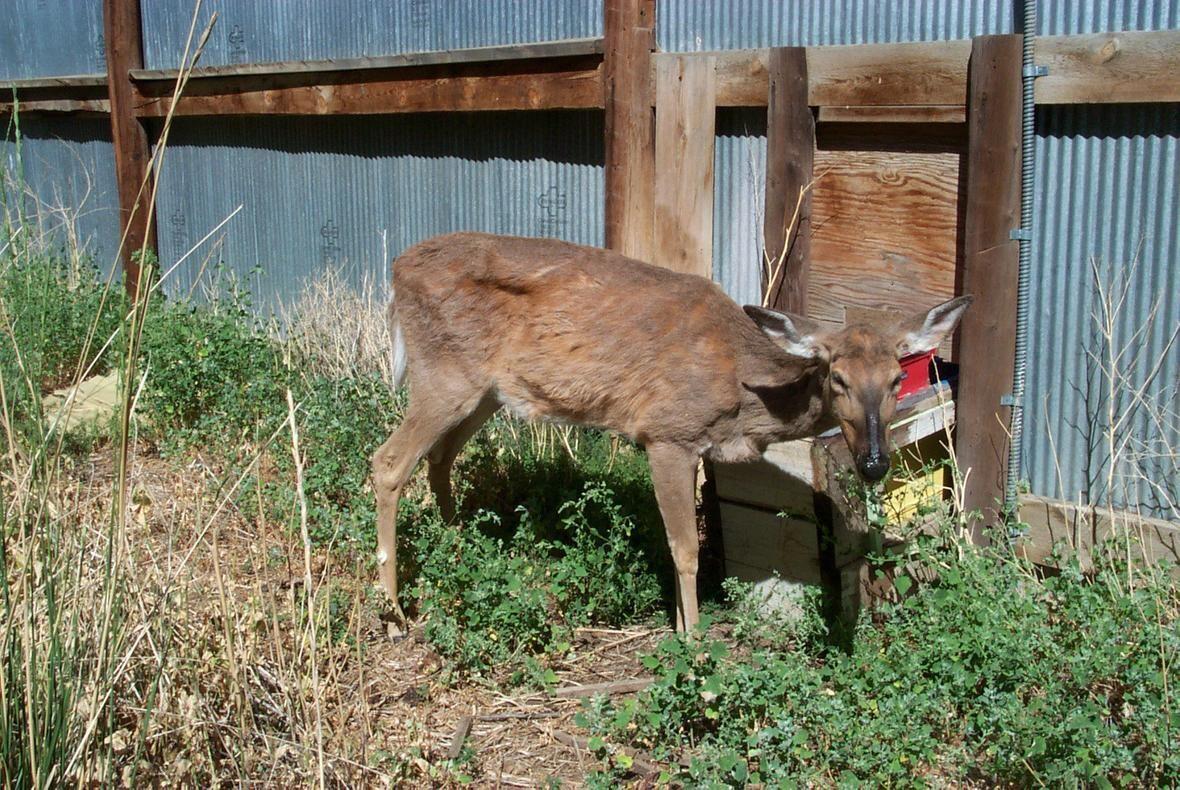
posture. Credit: USGS.
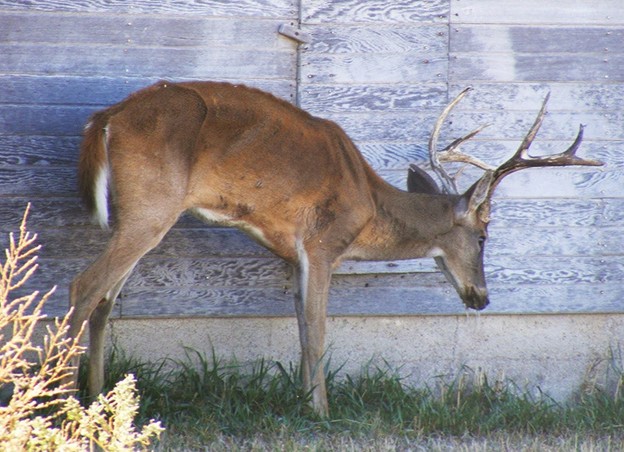
skinniness, drooping head, and an A-frame posture. Courtesy of Mike Hopper, Kansas
Dept. of Wildlife, Parks and Tourism.
“It’s not like bacteria or a virus that’s considered alive,” Sciandra advised. “When a prion misfolds, it becomes infectious. Prions are very persistent in the environment because they are not alive. It can’t be degraded as easily as bacteria or a virus. Prions can persist in nature up to 20 years.”
These infectious prions attack a deer’s nervous system. Prions start building up in the deer’s brain, throughout its nervous system and lymph tissues. Concentrations of infectious prions create microscopic holes in the brain tissue. That causes the animal neurological problems.
“On average, the incubation period for CWD is about 1.5 to two years,” Sciandra detailed. “In Lauderdale County, we detected it in a 1.5-year-old buck. We don’t know if a deer has CWD until it’s been harvested and the hunter submitted a sample for testing. Someone could shoot a deer that looks perfectly healthy and not get it tested, but it could be positive.”
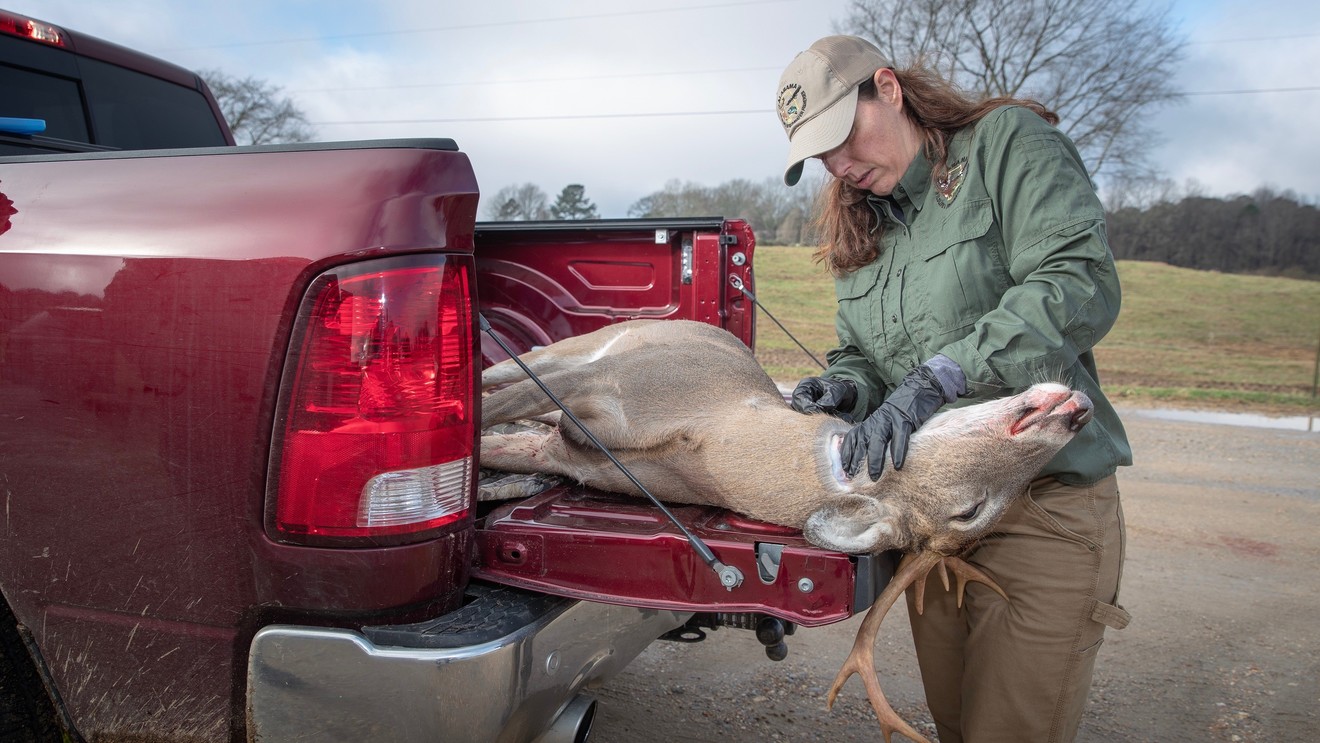
harvested deer to test for CWD. Credit: Alabama Department of Conservation and
Natural Resources.
A whitetail doe could live eight to 10 years in the wild, bucks five to six years if not killed. An infected deer might not exhibit any signs of the disease. However, once the disease progresses, deer look sickly and emaciated. They become less wary of humans than normal. They might stand with an odd posture. They could stagger or walk with difficulty. Deer with CWD drool excessively, drink often and urinate frequently.
“The prions can build up in a deer over time until they reach an ‘infectious load,’ or a certain number of infected prions to get infected,” Sciandra explained. “Once a deer gets infected by enough prions, that can cause it to have the disease.”
Some animals might serve as “disease reservoirs” and could spread the prions. For instance, if some types of scavengers eat sick or dead deer, those animals won’t likely contract CWD, but they could shed the prions. Other deer could ingest those prions and become infected.
“Scavenging by different predators could potentially spread CWD prions through their feet and digestive tract,” Sciandra said. “If they eat infected parts, they can spread it through their feces. One interaction with a scrape or feces from an animal that carried those infectious prions might not cause disease in the deer, but progressive subsequent interactions could.”
Many sportsmen bring deer they kill to professional processors. When preparing to process a deer, take precautions. Use surgical gloves, especially when handing the brain or spinal cord. Don’t cut through high-risk tissue like the brain or spinal cord. If possible, field dress it in the county where it died. Leave all the waste parts there. After processing a deer, sterilize the equipment by soaking it in 40 percent bleach for at least 15 minutes, then rinse thoroughly.
“The disease is typically spread through the high-risk parts, the brain and the spinal cord,” Sciandra said. “If hunters are not taking their deer to a processor, but processing it themselves, we encourage them to dispose of carcasses with household trash instead of just leaving it out in the woods. Bag it up with the household trash or bury it to help reduce the risk of spreading prions on the landscape.”
Many sportsmen enjoy hunting deer in other states. Hunters cannot bring anything containing brain or spinal cord materials, large bones or antlers in velvet back across the Alabama state line. Sportsmen who bag deer in other states should process it there. For more information on processing and disposing of waste, see www.outdooralabama.com/cwd/cwd-harvest-disposal.
Sportsmen who think they spotted or killed an infected deer should contact the nearest state wildlife office. That also refers to capturing a sickly deer on a game camera, which gives better evidence of the animal’s condition.
“The best way to reduce the risk of spreading CWD is limiting movement of carcasses from either the CWD Management Zone in Alabama or from other states,” Sciandra stated. “We certainly encourage hunters to get their deer tested, even out of the CWD Management Zone. We offer that at no cost to hunters. Outside of that zone it’s voluntary, but hunters can submit their harvested deer’s head for testing. After testing, we’ll get results back to that hunter so they can have peace of mind about their deer.”
To report a sickly deer, call the state Nongame Resources and Wildlife Health Section office at 334-242-3857. For more information on CWD in Alabama, see www.outdooralabama.com/CWD-Info.
An avid sportsman, Felsher is professional writer, photographer and radio show host who has written thousands of articles for many publications. He’s always looking for ideas or outdoors adventures that will make good stories. Contact Felsh at [email protected] or through Facebook. He also hosts an outdoors tips show for WAVH FM Talk 106.5 radio station in Mobile.