
BIRMINGHAM, Ala. – Democrats gained ground in Alabama legislative races Tuesday, narrowing Republican leads in many districts and flipping four Republican-held seats, according to unofficial election returns.
But the results also highlight a longstanding feature of Alabama politics: In most legislative districts, voters didn’t have a choice between a Republican and a Democrat.
An Alabama Daily News analysis of election returns from 2018, 2022 and 2026 found enough information to measure changes in the margin between Republican and Democratic candidates in just 46 of the state’s 140 legislative districts.
In House District 4, for example, which covers parts of the Decatur and Huntsville areas, the Republican candidate won by 44 percentage points in 2018. That lead shrank to 19 points in 2026 – a shift of 25 points toward Democrats, although the Republican still won.
Professor David Hughes, an expert on Alabama elections, said the results reflect several political trends, including growing Democratic support in suburban communities with highly educated voters.
He pointed to areas around Birmingham, Huntsville and Auburn, where historically Republican voters have increasingly supported Democratic candidates.
“That’s a story I would be telling,” Hughes said of the suburban shifts.
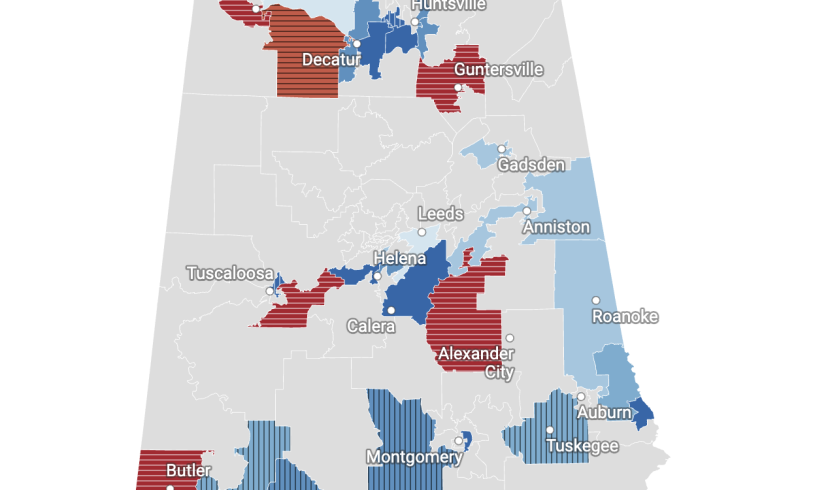
The interactive map below shows how much the margin between Republican and Democratic candidates changed in House districts and which party gained ground.
Blue indicates a shift toward Democrats, while red indicates a shift toward Republicans.
Click here if you’re unable to see the House map.
The House map shows shifts Hughes mentioned toward Democrats in several districts around Birmingham, Huntsville and Montgomery, along with shifts toward Republicans in parts of north and south Alabama. Most districts are shaded gray because they did not have two elections with both major parties competing.
Straight-ticket voting also plays a role. According to unofficial figures released by the Alabama Secretary of State, 70.5% of ballots cast Tuesday were straight-ticket votes, allowing voters to select a party’s candidates with a single mark.
Hughes said a popular statewide candidate can help candidates from the same party farther down the ballot.
Alabama’s voting patterns are also strongly divided along racial lines, Hughes said, with Black voters overwhelmingly supporting Democrats and white voters predominantly supporting Republicans.
“Alabama elections are really polarized, and they’re particularly polarized by race,” he said.
Those divisions, combined with the way legislative districts are drawn, help explain why so many races are uncontested, he added.
When voters with similar political preferences are concentrated in the same districts, one party can have such a large advantage that candidates from the other party see little reason to run.
In 2026, 88 of Alabama’s 140 House and Senate races had only one named candidate on the ballot.
Hughes said the consequences go beyond election results. Research has linked uncontested races to lower voter participation, and Hughes said candidates without opponents face less pressure to defend their records or engage with voters.
Competitive campaigns draw attention to issues and force incumbents to defend their records. Without opponents, lawmakers face less scrutiny and voters have fewer opportunities to consider alternatives.
Hughes said having so many uncontested races can also contribute to voter frustration and weaken political accountability.
The Senate map shows a similar mix of changes, with shifts toward Democrats in several districts in central and eastern Alabama and shifts toward Republicans in parts of northern and eastern Alabama.
Click here if you’re unable to see the Senate map below.
The ADN analysis shows how difficult it is to track changes in voting patterns when so many legislative races lack competition.
The analysis compares 2018 with 2026 wherever both parties had candidates in those years. Otherwise, it uses 2018-2022 or 2022-2026 when both elections included Republican and Democratic candidates.
Comparisons involving 2018 may also reflect changes in district boundaries following redistricting. Hughes noted that 2022 was an unusually weak election year for Alabama Democrats, another factor to consider when interpreting the results.