
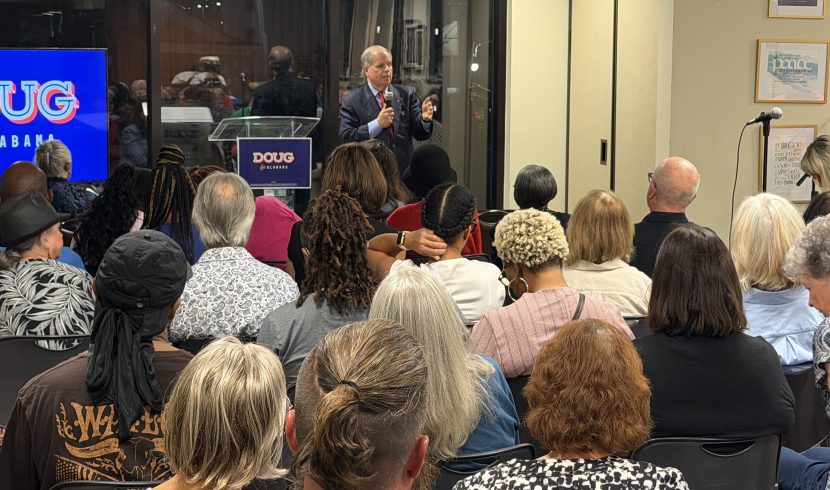
MONTGOMERY, Ala. – Democratic gubernatorial candidate Doug Jones told attendees at an education town hall Tuesday evening that he wants to phase out Alabama’s CHOOSE Act for private schools, increase teacher pay, protect health insurance benefits and find new education funding through a state lottery.
About 100 people attended the event at Dexter Avenue King Memorial Baptist Church in Montgomery, the 18th town hall Jones has held since July.
The former U.S. senator praised several recent education initiatives, including the RAISE Act, which directs additional funding to high-needs public schools, and the Literacy and Numeracy Acts, which focus on improving reading and math achievement.
But Jones sharply criticized the CHOOSE Act, Alabama’s education savings account program, under which the majority of taxpayer funding has been used to pay for eligible students to attend private schools.
“It’s not about parent choice,” Jones said of the CHOOSE Act. “The only entities that have a choice under the CHOOSE Act are the private schools who can pick and choose which students they want.”
Jones also criticized the lack of accountability and transparency for private schools receiving taxpayer funds.
“It is stunning to me that a Republican-controlled legislature would just give money away without any kind of accountability,” Jones said.
Jones said he initially favored eliminating the CHOOSE Act program altogether but reconsidered because some families have already changed schools. His proposal would allow students currently receiving private school funding to continue through graduation while phasing out the program for others.
He said he would retain funding for homeschooling, which provides up to $2,000 per student for expenses such as supplies and curriculum. He said he views homeschooling differently from taxpayer-funded private school tuition and believes parents should continue to have that option.
Jones also said he supported the Alabama Accountability Act, which provides scholarships for qualifying students to attend participating private schools.
Jones pointed to preliminary figures showing Alabama public school enrollment declined by approximately 12,000 students this year, following a smaller decline last year. He argued the CHOOSE Act is a major driver of the decline, although he acknowledged other factors, including declining birth rates and immigration enforcement, could also be contributing.
Teacher compensation and benefits would be major priorities in a Jones administration, he said.
He pledged to pursue continued salary increases, address rising health insurance costs and work toward providing cost-of-living adjustments for retired educators.
Jones also said Alabama needs to find ways to retain experienced classroom teachers, who often leave the state for better-paying jobs or move into administrative positions to earn more money.
“I want to figure out ways that we can keep the good teachers in class because that’s what they love,” he said.
Funding those initiatives would require additional revenue, Jones acknowledged. He renewed his support for a state lottery, arguing Alabama needs a governor willing to champion the proposal.
Jones said Alabama needs a lottery to generate additional revenue for public education, including teacher recruitment and retention.
Both a lottery and changes to the CHOOSE Act would require action by the Alabama Legislature. Jones acknowledged that passing a lottery would also require voter approval and that the state would face funding challenges even if voters approved one.
The discussion also turned to the connection between education and incarceration.
During the question-and-answer portion of the town hall, former Alabama Supreme Court Chief Justice Sue Bell Cobb asked Jones about the school-to-prison pipeline and the need for effective alternative schools that help struggling students rather than pushing them out of traditional classrooms.
Jones called for better information about alternative schools, more mental health support and additional training for teachers dealing with students with behavioral challenges.
One of the evening’s most emotional moments came when a public school teacher, fighting back tears, asked Jones when he would publicly defend educators against accusations made by politicians.
She described the accusations against teachers as hurtful and damaging, particularly claims that educators are pushing political or gender-related agendas on children.
“Sadly, there are people who believe” those accusations, she said.
Jones hugged the teacher and rejected Republican opponent, U.S. Sen. Tommy Tuberville’s characterization of public schools, including accusations that they are indoctrinating children with socialism.
“I’m tired of him insulting teachers, insulting schools,” Jones said, adding that he would “continue to stand up and speak out” in defense of educators.
Before the town hall, Jones also promised to take an active role as president of the Alabama State Board of Education, a position the governor holds.
“I’m going to make sure that in education policy, that the governor’s voice is there,” Jones said.
He said he would attend as many State Board meetings as possible and direct his staff to organize his schedule around them.