
MONTGOMERY, Ala. – As the deadline to make recommendations to the governor approaches, the Alabama group studying the use of technology in education met in Montgomery Wednesday to refine its suggestions about how and when educators should incorporate technology in the classroom.
Coming to the group from a variety of disciplines within education, members of the Governor’s Commission on Screen-Based Instruction discussed how to ensure instructional technology is used in a way that will benefit students. They offered preliminary suggestions from subgroups, including creating a statewide definition for screen time, improving digital literacy and ensuring professional development opportunities for teachers to learn about technology.
Rep. Jeana Ross, R-Guntersville, who chairs the commission, said that the group is not intending to ban screen time in education or replace teachers but rather to ensure technology is a tool to improve instruction. Ross said the group is basing its recommendations on evidence to best serve Alabama students.
“Our recommendations should be clear, practical, research-based,” Ross told commission members. “Bottom line, we want to cite it. We want to say why. How did we come up with this? Where did it come from? And focus on improving outcomes for students while supporting teachers and preserving appropriate instructional flexibility.”
The commission is also surveying parents, teachers and school administrators to get more information about Alabamians’ experiences and hopes for screen-based instruction going forward.
Cailin Kerch, a clinical associate professor of early childhood education, curriculum and instruction at the University of Alabama, said the surveyors are hoping for more than 200 respondents per survey. The university’s Institutional Review Board is working to finalize the survey and will release it this week, Kerch said.
“It would be great to have a huge amount of data, and then we can make really more generalizable statements about what’s occurring in our state,” Kerch said. “The more people we have, the more we can just be a continued leader in the state of Alabama.”
Commission members shared a variety of findings from existing research, including a recent law from Tennessee that requires school districts to adopt policies that minimize screen time. Ross said she expects the commission’s final product to be “more comprehensive” than the two-page bill.
Members said it’s important to diversify recommendations for different ages and stages of development and avoid oversimplifying into a one-size-fits-all approach. Others members said the commission must make sure screen-based instruction is improving learning outcomes, not just entertaining students.
Members also said that penning a set of recommendations is difficult in an ever-changing technological landscape.
Frankie Mathis, assistant superintendent of the Saraland City School District, said that there has to be a continuous review of new evidence as technology continues to evolve.
“This problem isn’t static. This problem is ever evolving, it’s ever changing,” Mathis said. “So we can’t stop the conversation, and I think that’s the challenge in writing some of the guidance because we don’t actually know some of what we’re writing for because it’s going to be different in three years.”
Ross called the members’ findings shared Wednesday carefully researched and reasonable. The commission will finalize a draft of its recommendations at its November meeting, she said.
“They’re going to be something that teachers and school officials are going to be easily able to implement and to consider because right now, what we’re most concerned with is making sure people are aware that screen time should be quality, and there’s certain types of screen time that should be limited or not at all,” Ross said.
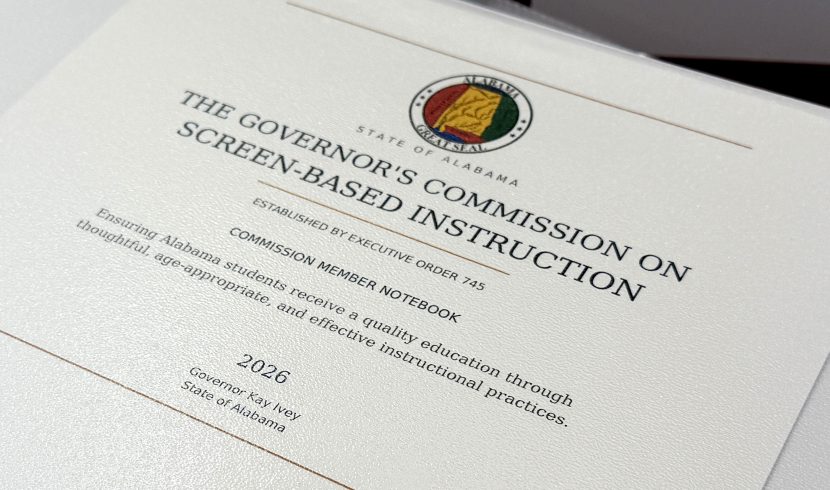
Gov. Kay Ivey established the commission in July via executive order in response to bills passed during recent legislative sessions, including the FOCUS Act. Sponsored by Ross, the legislation restricted students’ use of personal cellphones and other wireless communication devices during the school day beginning with the 2025-26 school year.
Ross also carried the Healthy Early Development and Screen Time Act during the 2026 legislative session, which set limits on screen use for young children in covered childcare, pre-K and kindergarten settings. It becomes effective Jan. 1.
Another bill Ross sponsored during the 2026 session would have required the State Board of Education to develop research-supported standards for technology used in instruction and local school boards to adopt policies consistent with them. The House passed HB584, but the Senate did not take it up.
The commission’s next meeting is Nov. 10. Its recommendations to the governor are due by Dec. 1.