
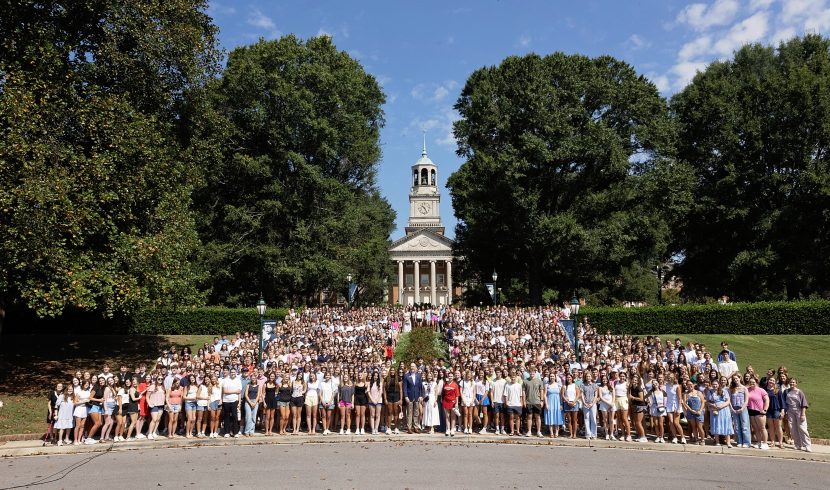
BIRMINGHAM, Ala. – Samford University enrolled its largest freshman class in history this fall, continuing years of growth as colleges across the country prepare for a smaller pool of high school graduates.
The private university opened the fall semester with 6,522 students, its highest enrollment in 185 years and more than 40% higher than in 2009, according to figures released Wednesday.
Its freshman class grew even faster. Samford enrolled 1,271 first-year students, up 9.8% from last year’s record class of 1,156. Undergraduate enrollment also reached a record 4,575 students.
“The Samford experience —where students thrive intellectually and find their calling on a Christ-centered campus— is increasingly unique in the landscape of higher education,” Jason Black, the university’s vice president for enrollment management, said in a statement. He said strong demand and high student retention have helped fuel the university’s growth.
The timing is notable because colleges have been preparing for years for a demographic slowdown.
The Western Interstate Commission for Higher Education projects the number of U.S. high school graduates has peaked at about 3.9 million in 2025 and will decline about 13% through 2041. The drop is largely tied to lower birth rates following the Great Recession.
College enrollment itself has not started falling nationally. Postsecondary enrollment increased 1% in spring 2026, while undergraduate enrollment rose 1.3%, according to the National Student Clearinghouse Research Center.
Enrollment at private nonprofit four-year colleges, the group that includes Samford, was essentially flat.
But the demographic shift is not expected to affect every part of the country equally.
The South is projected to see a 3% increase in high school graduates between 2023 and 2041, according to WICHE, while the Midwest, Northeast and West are all expected to see double-digit declines.
That geographic shift could leave Southern colleges with a larger pool of prospective students even as the number of high school graduates declines nationally.
Samford already attracts a large portion of their student body from outside of Alabama. More than 62% of all students and 76.3% of this year’s freshmen come from out of state. Students this fall represent 46 states, Puerto Rico and 12 countries, according to the university.
President Beck Taylor said applicants are arriving with some of the strongest academic credentials Samford has seen.
“High-achieving students value Samford,” Taylor said. “They seek a transformational education on a residential campus where they’ll be nurtured, motivated and equipped to lead lives of meaning and purpose.”
Samford has spent heavily to make room for continued growth. Over the past three years, the university completed more than $300 million in campus projects, including four new residence halls, a recreation, wellness and athletic complex and renovations to its University Center dining hall.
Taylor said Samford’s freshman class has grown 30% over the past five years and linked that growth to the university’s recent campus investments.
Samford is not the only Birmingham-area university reporting continued freshman growth.
The University of Alabama at Birmingham said Aug. 31 that preliminary figures show it is also on track for its largest freshman class ever. The university expects about 2,600 first-time freshmen, 3% more than last year’s record class. UAB said its freshman enrollment has grown nearly 30% over the past two years.
Samford also reported an 88.93% freshman-to-sophomore retention rate this year, which university officials cited as another sign of continued enrollment strength.
More Alabama colleges and universities are expected to release fall enrollment numbers in the coming weeks, which will show whether the growth reported by Samford and UAB is happening more broadly across the state.