
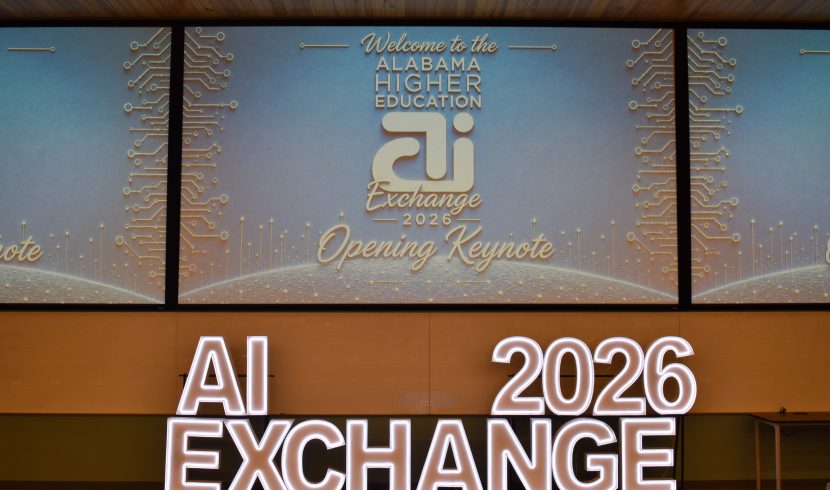
MONTGOMERY, Ala. – Higher education, industry and workforce development leaders gathered at Auburn University on Tuesday to discuss how colleges and universities can adapt as artificial intelligence changes the workforce.
The Alabama Higher Education AI Exchange, hosted by the Alabama Commission on Higher Education, is an annual effort to bring together people with diverse backgrounds to discuss artificial intelligence and its impact on education.
ACHE Director Jim Purcell said this year’s event, titled “Classroom to Career,” was all about how higher education can change to meet the constantly evolving needs of the workforce.
“Do remember how your freshman classes work and what we’re trying to get them to,” Purcell told the crowd. “We’re really building them not for that job, which has gone away or will go away through change, but careers and the future, and to me, that’s all going to be about adaptation.”
The one-day conference featured speeches, industry panel discussions and networking time aimed at forging new connections between industry, technology and education.
Auburn University Biggio Center Executive Director Asim Ali, a host of the event, said there were around 350 in-person registrants and an additional 75 virtual participants. Organizers designed this year’s exchange to shift focus from the technological aspect of AI to the oft-ignored human element, he said.
“It’s an opportunity to share those observations, those experiences that we’re seeing in the workplace, and seeing the trends as a result of artificial intelligence, so that we can bring the focus back to humans,” Ali said. “How do we need to support the humans? How do we support each other in our ecosystem to really make sure that Alabama’s economy is ready for the for the next challenges and opportunities that are coming?”
The push to prepare students for the evolving workforce has been a focus of some state lawmakers over the last several years. The Legislature allocated $150 million to career and technical education during the 2026 legislative session and passed a package of bills to expand access to career pathways, among other actions.
As college graduates face a tough market for entry-level professional jobs, it’s up to higher education to figure out how to prepare students for career success in an increasingly AI-driven world, presenters said.
Amy Bontrager, director of the U.S. Digital Service in the Executive Office of the President, and John Barnhart, director of research advisory services at consulting and research firm EAB, delivered keynote addresses in the morning.
The two hail from very different professional backgrounds, but Bontrager and Barnhart both argued that intentional implementation of artificial intelligence will help educational institutions and their students succeed in the future.
Barnhart mentioned specific examples of how companies and universities have leveraged AI to increase their productivity. He also outlined how the hiring process has changed since the advent of AI.
“We’re seeing companies that aren’t just hiring labor today; they are hiring for outcomes,” Barnhart said. “They are hiring for the things that they want to accomplish. Again, we’re moving beyond the, ‘Are we using AI?’ into how is AI actually driving value towards the bottom line, towards our customers, towards the services that we provide.”
He also said that employers are devaluing internship experience and focusing on personal connections and demonstrated soft skills, opening opportunities for new career-focused partnerships between universities and industries.
Providing examples of successful technological innovations by federal agencies, Bontrager focused on the importance of organizations being prepared for change. She said that part of this involves everyone helping prepare the next generation of employees to be involved.
“You are part of the readiness ecosystem, and ecosystems don’t succeed because one part becomes extraordinary,” Bontrager said. “They succeed because every part chose to contribute. So as you walk back onto your campus, back to your business, back to your agency, don’t ask, ‘What should we do with AI?’ Ask, ‘What is my part?’ because being in the classroom does not lead to careers by accident.”
But this sort of mass coordination and participation isn’t always easy, Ali said.
He said that one of the struggles with the “ecosystem” is getting everyone across industries on the same page about what skills employees need. He said he hopes that having hundreds of people together at Auburn to think about the topic can serve as a catalyst for opportunity.
“If we can make sure that our workforce is understanding of what that technology’s potential is, then they’ll be the most ready for what’s needed in the in the marketplace, and that marketplace is not just an Alabama marketplace, that’s a global marketplace,” Ali said.