MONTGOMERY, Ala. – Alabama students made strong gains in science and improved in all three tested subjects in eighth grade, according to preliminary statewide test results presented Tuesday.
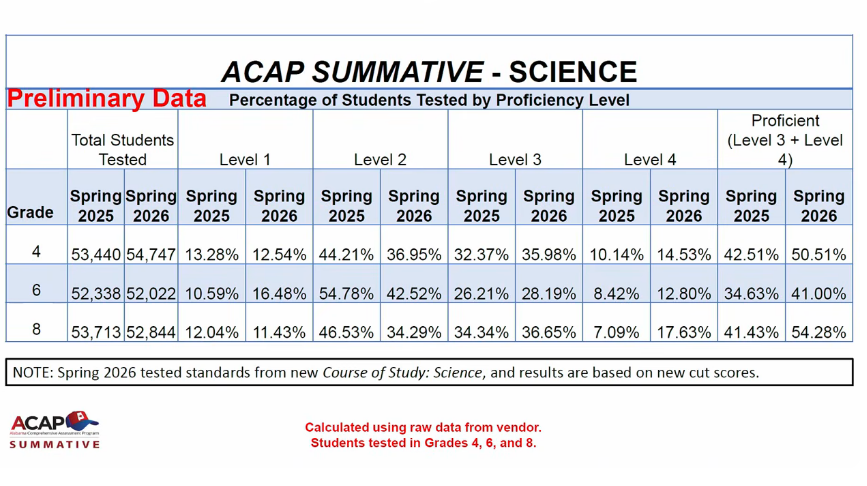
In science, the percentage of students reaching proficiency – Levels 3 and 4 on the Alabama Comprehensive Assessment Program – increased in every grade tested last spring. Fourth-grade proficiency rose from 43% to 51%, sixth-grade proficiency increased from 35% to 41%, and eighth-grade proficiency jumped from 41% to 54%.
The gains came during the first school year in which Alabama’s new science course of study was required statewide. Schools were also using newly adopted science textbooks, and the ACAP science test was changed to measure the new standards and included new cut scores – the scores that separate the test’s four achievement levels.
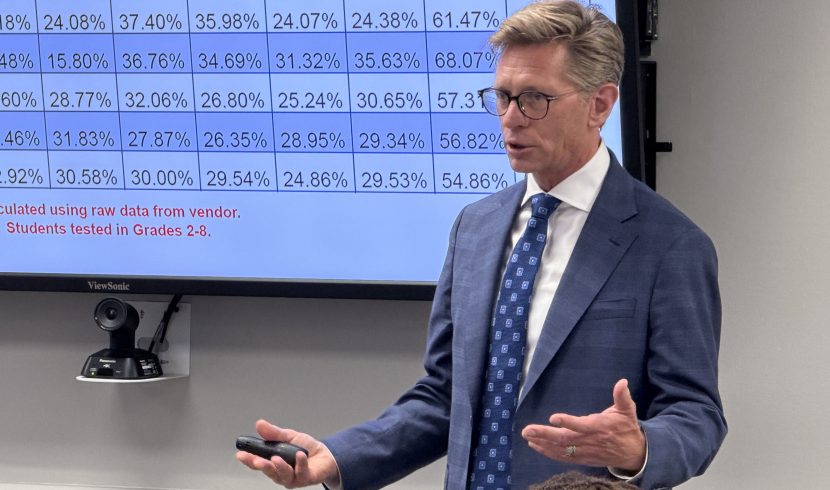
State Superintendent Eric Mackey called the results “surprising” because scores often fall at first when states roll out new standards and tests.
“Usually when we do new standard setting, we actually see it go backwards, and then you build again,” Mackey said.
Mackey said the results also push back against concerns that schools may be spending less time on science as they focus more heavily on reading. He said the assessment measures not only students’ knowledge of science facts, but also their ability to reason through scientific questions.
The results also showed strong growth among students reaching Level 4, the highest achievement level on the ACAP, particularly in science.
Eighth grade shines
Eighth-graders improved in science, English language arts and math.
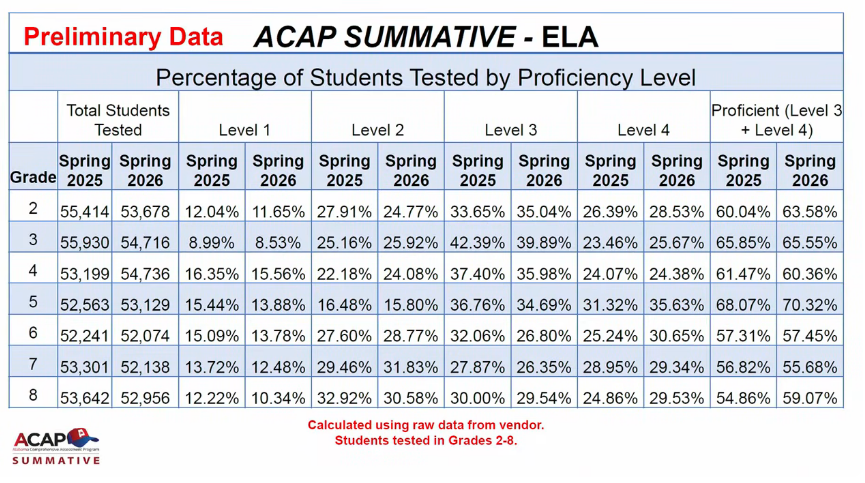
The percentage of eighth-graders proficient in English language arts rose four percentage points, from 55% to 59%. Math proficiency increased from 25% to 27%.
Those gains were smaller than the increase in science, but they stood out because Alabama has struggled for years to improve middle school performance in these subjects.
Since 2023, eighth-grade proficiency has climbed from 50% to 59% in English language arts and from 21% to 27% in math.
“Our eighth-graders way outperformed what eighth grade normally does,” Mackey told board members. “We kept seeing these big gains in fourth grade, but eighth grade – no gains to some losses in eighth grade.”
That long-running weakness also shows up in national results. On the 2024 National Assessment of Educational Progress, Alabama ranked 49th among states and jurisdictions in eighth-grade math and 47th in eighth-grade reading, making the latest ACAP gains especially notable.
Mackey said the improvement followed years of discussion about Alabama’s lagging middle school scores and a stronger focus by teachers, principals and superintendents on those students.
“I think our teachers and local principals and superintendents – they’ve just figured out that we’ve got to really invest in these middle-level kids,” he said. “There’s still lots more to do.”
Mackey said officials will need to examine district-, school- and student-level results before they can determine what drove the improvement.
Results in other grades were more mixed. ELA proficiency increased in second and fifth grades, stayed flat in third and sixth grades and dipped slightly in fourth and seventh grades. Math proficiency increased in grades two, four, six and seven, but fell slightly in grades three and five.
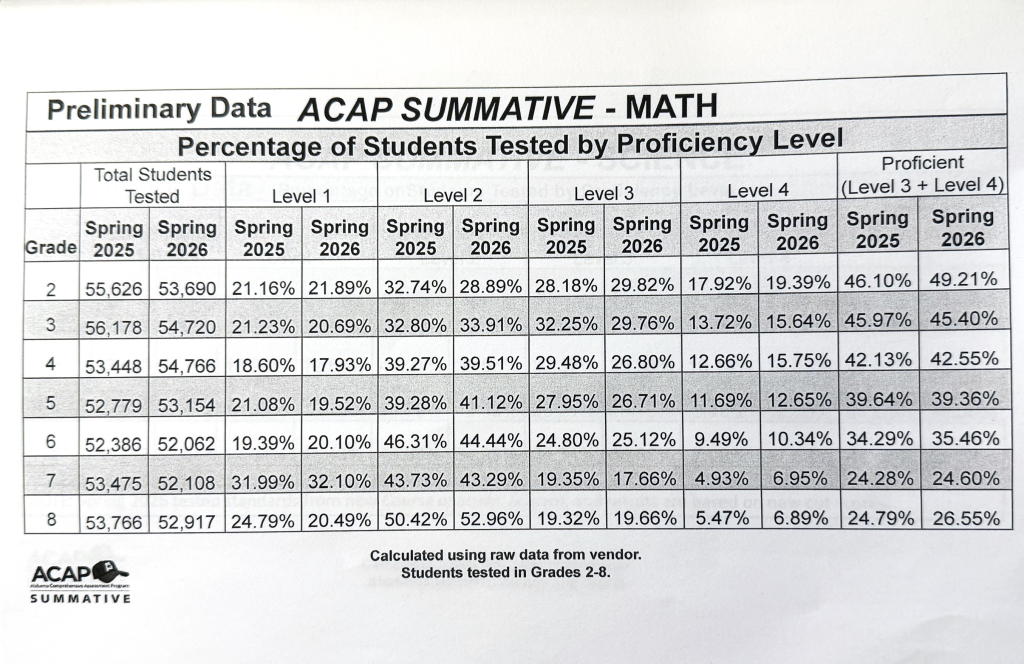
More students reach the highest level
Mackey also pointed to growth among students reaching Level 4, the highest of the four ACAP achievement levels. The Level 4 gains were particularly strong in science, including among eighth-graders, reinforcing the broader improvement seen in that subject.
The percentage of students reaching Level 4 increased in all grades in ELA and math.
Level 4 students have fully mastered grade-level standards and are showing a deeper understanding of the material, Mackey said, describing them as students who are excelling academically, although not all are enrolled in gifted programs.
He said the increases indicate that teachers are continuing to challenge their strongest students rather than concentrating only on students in the middle or those who are struggling.
“One of the places we saw real growth this last year is with those academically accelerated students, maybe more than we’ve ever seen before,” Mackey said.
He said the gains also may reflect the state’s increased investment in gifted education through the RAISE Act. But as with the eighth-grade improvement, more detailed results will be needed before officials can determine what contributed to the increases.
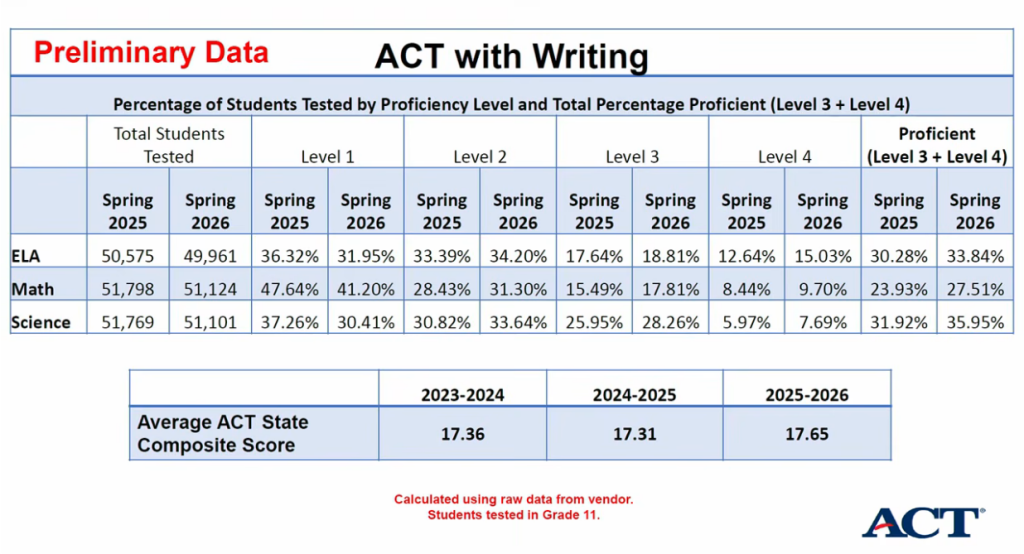
ACT with writing results
Students also improved on the ACT with writing, which is given to all Alabama public high school juniors and is designed to measure college readiness.
The average composite score – which combines English, math, reading and science – increased from 17.31 to 17.65. The writing section is scored separately and is not included in the composite.
Mackey said the increase was encouraging because scores had been mostly flat and declined slightly last year. The latest results reversed that drop, he said, although Alabama is still short of its long-term goal of raising the average composite score above 18.
Mackey noted that these results reflect only the ACT given to juniors during the school day. A separate report for graduating seniors uses each student’s best score across multiple attempts and is the better measure for comparisons with other states.
The statewide figures are considered nearly final, but districts have until the end of July to check their data. District- and school-level results will be released after the board’s August work session.