
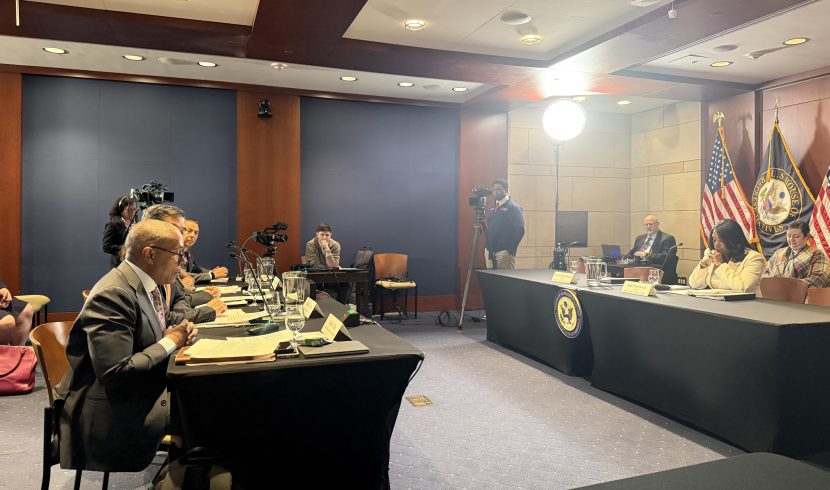
WASHINGTON — As a looming Supreme Court decision could upend a key part of the Voting Rights Act, U.S. Rep. Terri Sewell spotlighted Monday how Congress and voting rights advocates can take steps to secure access to the ballot box.
During a “shadow hearing” in Washington, Sewell and elections experts discussed their commitment to strengthening the landmark 1965 law that prohibits discrimination in voting in light of the Trump administration and Republicans’ push for voter ID requirements and mail-in voting restrictions.
“As this year marks the 250th anniversary of this great nation, voting rights face extraordinary attacks at every level of government,” Sewell, D-Birmingham, who serves as the ranking member of the House Elections Subcommittee, said.
“The work we undertake today and in the months ahead will ensure that we have a (Voting Rights Advancement Act) that meets the needs of voters and eliminates the barriers to the ballot box.”
Arthur Ago, the director of strategic litigation and advocacy at Southern Poverty Law Center, outlined five current “attacks” on voting rights during the hearing, including the Republican-led SAVE America Act, mail-in voting restrictions and redistricting efforts.
The SAVE America Act, which requires documentary proof of citizenship to vote in federal elections, has been stalled in the Senate and faces a slim chance of becoming law without the support of Senate Democrats.
In March, President Donald Trump signed an executive order to create a list of all U.S. citizens eligible to vote and instructed the U.S. Postal Service to send ballots only to those listed. Democrats swiftly sued to block it.
The Trump administration and Republicans, including Alabama’s members, argue that those policies are aimed at ensuring only U.S. citizens vote in federal elections and preventing fraudulent voting. But voting rights advocates say those measures could disenfranchise millions of voters.
Ago and Sewell also highlighted the need for the John Lewis Voting Rights Advancement Act to increase federal oversight of restrictive voting practices. Sewell is the sponsor of the Democratic-led bill, which faces little chance of advancing in a Republican-controlled Congress.
“We urge you to consider what else Congress can do to finally and fully protect the voting rights of people of color in the South and across the country,” Ago said.
A “shadow hearing” is a tool Democrats use to highlight their priorities through their own unofficial congressional meetings without Republicans present.
Monday’s hearing also kicked off the SPLC’s series of nationwide events focused on voting rights. The Montgomery-based civil rights group is at the center of a recent Department of Justice investigation into its use of paid extremist informants. Sewell used her opening remarks to express her support for the group. Republicans have long decried the group’s work as politically motivated.
“For decades, (SPLC has) done tremendous work on countering hate and extremism and fighting for civil rights, and I want to say that I’m proud to work with you,” Sewell said.
Much of the discussion centered on a impending Supreme Court decision that could strike down Section 2 of the Voting Rights Act, which prohibits voting practices that discriminate based on race. That could lead to the erosion of majority-minority districts, potentially impacting Alabama’s two Democratic-held districts and others across the South.
In 2023, the Supreme Court upheld the constitutionality of Section 2 in an Alabama redistricting case, but that could be reversed with the recent case, Louisiana v. Callais.
“So if the Supreme Court were to undermine that, it would effectually undermine the opportunity for us to protect voting rights using Section 2 tools,” Todd Cox with the Legal Defense Fund said.
Instead, Cox and the experts are hopeful there will be other avenues to help protect minority voters, such as state voting rights laws and using the 14th Amendment’s Equal Protection Clause to make the case for majority-minority districts.
Democratic Rep. Joe Morelle of New York, the ranking member of the House Administration Committee, also joined the hearing. The other panelists included Rebekah Caruthers with the Fair Elections Center, Andrea Senteno with the Mexican American Legal Defense and Educational Fund and John Yang of Asian Americans Advancing Justice.